

phenotypic.measure.MeasureShape#
- class phenotypic.measure.MeasureShape[source]#
Bases:
MeasureFeaturesMeasure comprehensive morphological characteristics of detected colonies.
Extract geometric metrics from each colony shape: area, perimeter, circularity, convex hull properties, width-based measures, Feret diameters, eccentricity, and best-fit ellipse parameters. The output DataFrame provides a full morphological profile for phenotypic classification and growth-pattern analysis.
- Returns:
pd.DataFrame: Object-level morphological measurements with columns:
Label, Area, Perimeter, Circularity, Compactness, ConvexArea, Solidity, Extent, BboxArea.
MeanRadius, MedianRadius, MaxRadius (distance-transform based).
MinFeretDiameter, MaxFeretDiameter (caliper diameters).
MajorAxisLength, MinorAxisLength, Eccentricity, Orientation.
- Best For:
Distinguishing colony morphotypes (smooth circular wild-type vs wrinkled, branching, or invasive mutants).
Assessing growth symmetry and directionality via eccentricity and orientation.
Detecting invasive or spreading growth through low solidity values.
Morphological clustering for automated strain identification.
- Consider Also:
MeasureSizefor a lightweight area-only measurement when full morphology is not needed.MeasureTexturefor surface roughness and pattern features that complement shape metrics.MeasureBoundsfor bounding box and centroid data without shape statistics.
- See Also:
Tutorial 7: Measuring and Exporting for a walkthrough of measuring and exporting colony data. Measurement Metrics and Their Biological Meaning for interpreting shape metrics in a biological context.
Category: Shape# Name
Description
Biology
Image
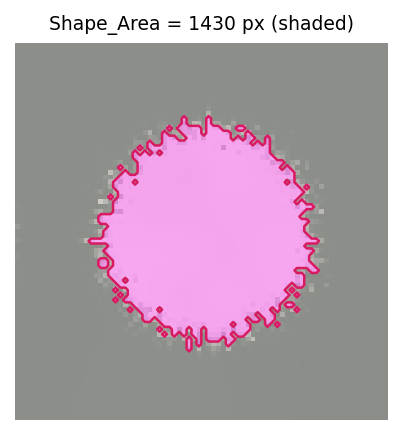
AreaTotal number of pixels occupied by the microbial colony. Represents colony biomass and growth extent on agar plates. Larger areas typically indicate more robust growth or longer incubation times.
Projected 2D footprint of the colony in pixels — a common proxy for colony size and overall growth in arrayed plate assays. With matched imaging and incubation, larger area generally reflects greater proliferation or spreading; it captures only the 2D footprint, not colony height or cell density.
PerimeterTotal length of the colony’s outer boundary in pixels. Measures colony edge complexity and surface irregularity. Smooth, circular colonies have shorter perimeters relative to their area compared to irregular or filamentous colonies.
CircularityCalculated as \(\frac{4\pi*\text{Area}}{\text{Perimeter}^2}\). Measures how closely a colony approximates a perfect circle (value = 1). Values < 1 indicate irregular colony morphology, which may result from genetic mutations, environmental stress, or mixed microbial populations on agar plates.
ConvexAreaArea of the smallest convex polygon that completely contains the colony. Represents the colony’s “filled-in” appearance if all indentations and holes were removed. Useful for detecting colony spreading patterns or invasive growth characteristics.
MedianRadiusMedian distance from colony center to edge across all directions. Provides a robust measure of typical colony size that is less sensitive to outliers than mean width. Particularly useful for colonies with uneven growth or sectoring.
MeanRadiusAverage distance from colony center to edge across all directions. Represents overall colony expansion rate. In arrayed growth assays, this correlates with microbial fitness and growth kinetics under controlled conditions.
MaxRadiusMaximum distance from colony center to edge across all directions. Represents the furthest extent of colony growth from its center. In arrayed microbial assays, this measurement helps identify asymmetric growth patterns or colonies extending toward neighboring positions.
MinFeretDiameterMinimum caliper diameter - the shortest distance between two parallel tangent lines touching opposite sides of the colony. Represents the narrowest dimension of the colony regardless of orientation. Useful for detecting elongated or irregular colony morphologies and measuring colony width.
MaxFeretDiameterMaximum caliper diameter - the longest distance between two parallel tangent lines touching opposite sides of the colony. Represents the maximum dimension of the colony regardless of orientation. Often exceeds major axis length for irregular shapes and helps quantify maximum colony extent.
EccentricityMeasure of colony elongation, ranging from 0 (perfect circle) to 1 (highly elongated). Values near 0 indicate compact, radially symmetric growth typical of healthy bacterial colonies, while higher values may suggest directional growth, motility, or environmental gradients on the agar surface.
SolidityRatio of actual colony area to its convex hull area (Area/ConvexArea). Values near 1 indicate compact, solid colonies with minimal indentations. Lower values (< 0.9) may indicate invasive growth, colony spreading, or the presence of clearing zones around colonies.
ExtentRatio of colony area to its bounding box area (ObjectArea/BboxArea). Measures how efficiently the colony fills its allocated space. Compact colonies have higher extent values, while spread-out or irregular colonies have lower values.
BboxAreaArea of the smallest rectangle that completely contains the colony. Represents the total spatial shape of the colony including any empty space. In high-throughput assays, this helps assess colony positioning and potential interference with neighboring colonies.
MajorAxisLengthLength of the longest axis of the ellipse that best fits the colony shape. Represents the maximum colony dimension. In arrayed microbial growth, this measurement helps identify colonies that have grown beyond their intended grid positions.
MinorAxisLengthLength of the shortest axis of the ellipse that best fits the colony shape. Represents the minimum colony dimension. Together with major axis length, this helps characterize colony aspect ratio and growth anisotropy.
CompactnessCalculated as \(\frac{\text{Perimeter}^2}{4\pi*\text{Area}}\). Inverse of circularity (ranges from 1 for perfect circles to higher values for irregular shapes). Measures colony shape complexity - compact, circular colonies have values near 1, while irregular or filamentous colonies have much higher values.
OrientationAngle (in radians) between the colony’s major axis and the horizontal axis. Measures colony alignment and growth directionality. Random orientations are typical for most bacterial colonies, while consistent orientations may indicate environmental gradients or mechanical stresses during plating.
Methods
Create a new model by parsing and validating input data from keyword arguments.
Returns a copy of the model.
Reconstruct an operation from JSON written by
to_json().Execute the measurement operation on a detected-object image.
Creates a new instance of the Model class with validated data.
!!! abstract "Usage Documentation"
!!! abstract "Usage Documentation"
!!! abstract "Usage Documentation"
Generates a JSON schema for a model class.
Compute the class name for parametrizations of generic classes.
Initialize logging and memory tracking after model construction.
Try to rebuild the pydantic-core schema for the model.
Validate a pydantic model instance.
!!! abstract "Usage Documentation"
Validate the given object with string data against the Pydantic model.
Serialize this operation to JSON.
Attributes
Configuration for the model, should be a dictionary conforming to [ConfigDict][pydantic.config.ConfigDict].
Get extra fields set during validation.
Returns the set of fields that have been explicitly set on this model instance.
- __del__()#
Automatically stop tracemalloc when the object is deleted.
- classmethod __get_pydantic_json_schema__(core_schema: CoreSchema, handler: GetJsonSchemaHandler, /) JsonSchemaValue#
Hook into generating the model’s JSON schema.
- Parameters:
core_schema (CoreSchema) – A pydantic-core CoreSchema. You can ignore this argument and call the handler with a new CoreSchema, wrap this CoreSchema ({‘type’: ‘nullable’, ‘schema’: current_schema}), or just call the handler with the original schema.
handler (GetJsonSchemaHandler) – Call into Pydantic’s internal JSON schema generation. This will raise a pydantic.errors.PydanticInvalidForJsonSchema if JSON schema generation fails. Since this gets called by BaseModel.model_json_schema you can override the schema_generator argument to that function to change JSON schema generation globally for a type.
- Returns:
A JSON schema, as a Python object.
- Return type:
JsonSchemaValue
- __init__(**data: Any) None#
Create a new model by parsing and validating input data from keyword arguments.
Raises [ValidationError][pydantic_core.ValidationError] if the input data cannot be validated to form a valid model.
self is explicitly positional-only to allow self as a field name.
- Parameters:
data (Any)
- Return type:
None
- __pretty__(fmt: Callable[[Any], Any], **kwargs: Any) Generator[Any]#
Used by devtools (https://python-devtools.helpmanual.io/) to pretty print objects.
- classmethod __pydantic_init_subclass__(**kwargs: Any) None#
Populate field descriptions from the subclass docstring.
Runs once per concrete subclass after pydantic has built its model. Copies parameter descriptions parsed from the Google-style
Args:docstring block onto each field’sdescriptionslot so they surface inmodel_json_schema()— the machine-readable contract used by downstream tooling (e.g. an MCP server).- Parameters:
**kwargs (Any) – Class-keyword arguments forwarded by pydantic.
- Return type:
None
- classmethod __pydantic_on_complete__() None#
This is called once the class and its fields are fully initialized and ready to be used.
This typically happens when the class is created (just before [__pydantic_init_subclass__()][pydantic.main.BaseModel.__pydantic_init_subclass__] is called on the superclass), except when forward annotations are used that could not immediately be resolved. In that case, it will be called later, when the model is rebuilt automatically or explicitly using [model_rebuild()][pydantic.main.BaseModel.model_rebuild].
- Return type:
None
- __rich_repr__() RichReprResult#
Used by Rich (https://rich.readthedocs.io/en/stable/pretty.html) to pretty print objects.
- Return type:
RichReprResult
- copy(*, include: AbstractSetIntStr | MappingIntStrAny | None = None, exclude: AbstractSetIntStr | MappingIntStrAny | None = None, update: Dict[str, Any] | None = None, deep: bool = False) Self#
Returns a copy of the model.
- !!! warning “Deprecated”
This method is now deprecated; use model_copy instead.
If you need include or exclude, use:
`python {test="skip" lint="skip"} data = self.model_dump(include=include, exclude=exclude, round_trip=True) data = {**data, **(update or {})} copied = self.model_validate(data) `- Parameters:
include (AbstractSetIntStr | MappingIntStrAny | None) – Optional set or mapping specifying which fields to include in the copied model.
exclude (AbstractSetIntStr | MappingIntStrAny | None) – Optional set or mapping specifying which fields to exclude in the copied model.
update (Dict[str, Any] | None) – Optional dictionary of field-value pairs to override field values in the copied model.
deep (bool) – If True, the values of fields that are Pydantic models will be deep-copied.
- Returns:
A copy of the model with included, excluded and updated fields as specified.
- Return type:
Self
- dict(*, include: set[int] | set[str] | Mapping[int, set[int] | set[str] | Mapping[int, IncEx | bool] | Mapping[str, IncEx | bool] | bool] | Mapping[str, set[int] | set[str] | Mapping[int, IncEx | bool] | Mapping[str, IncEx | bool] | bool] | None = None, exclude: set[int] | set[str] | Mapping[int, set[int] | set[str] | Mapping[int, IncEx | bool] | Mapping[str, IncEx | bool] | bool] | Mapping[str, set[int] | set[str] | Mapping[int, IncEx | bool] | Mapping[str, IncEx | bool] | bool] | None = None, by_alias: bool = False, exclude_unset: bool = False, exclude_defaults: bool = False, exclude_none: bool = False) Dict[str, Any]#
- Parameters:
include (set[int] | set[str] | Mapping[int, set[int] | set[str] | Mapping[int, IncEx | bool] | Mapping[str, IncEx | bool] | bool] | Mapping[str, set[int] | set[str] | Mapping[int, IncEx | bool] | Mapping[str, IncEx | bool] | bool] | None)
exclude (set[int] | set[str] | Mapping[int, set[int] | set[str] | Mapping[int, IncEx | bool] | Mapping[str, IncEx | bool] | bool] | Mapping[str, set[int] | set[str] | Mapping[int, IncEx | bool] | Mapping[str, IncEx | bool] | bool] | None)
by_alias (bool)
exclude_unset (bool)
exclude_defaults (bool)
exclude_none (bool)
- Return type:
- classmethod from_json(json_data: str | Path | dict) BaseOperation#
Reconstruct an operation from JSON written by
to_json().Accepts a JSON string, a path to a JSON file, or a pre-parsed envelope dict (same input handling as
ImagePipeline.from_json()). Polymorphic:ImageOperation.from_json(path)returns whatever concrete operation the file holds. When called on a narrower subclass, the resolved class must be a subclass of it, else aTypeErroris raised.- Parameters:
json_data (str | Path | dict) – A JSON string, path to a JSON file, or envelope dict.
- Returns:
The reconstructed operation instance.
- Raises:
AttributeError – If the recorded class cannot be resolved in the
phenotypicnamespace.TypeError – If called on a concrete subclass and the file holds a class that is not a subclass of it.
- Return type:
Example
>>> import tempfile
>>> from pathlib import Path
>>> from phenotypic.abc_ import ImageOperation
>>> from phenotypic.detect import OtsuDetector
>>> with tempfile.TemporaryDirectory() as d:
...     p = Path(d) / "op.json"
...     OtsuDetector().to_json(p)
...     loaded = ImageOperation.from_json(p)  # polymorphic
>>> type(loaded).__name__
'OtsuDetector'
- json(*, include: set[int] | set[str] | Mapping[int, set[int] | set[str] | Mapping[int, IncEx | bool] | Mapping[str, IncEx | bool] | bool] | Mapping[str, set[int] | set[str] | Mapping[int, IncEx | bool] | Mapping[str, IncEx | bool] | bool] | None = None, exclude: set[int] | set[str] | Mapping[int, set[int] | set[str] | Mapping[int, IncEx | bool] | Mapping[str, IncEx | bool] | bool] | Mapping[str, set[int] | set[str] | Mapping[int, IncEx | bool] | Mapping[str, IncEx | bool] | bool] | None = None, by_alias: bool = False, exclude_unset: bool = False, exclude_defaults: bool = False, exclude_none: bool = False, encoder: Callable[[Any], Any] | None = PydanticUndefined, models_as_dict: bool = PydanticUndefined, **dumps_kwargs: Any) str#
- Parameters:
include (set[int] | set[str] | Mapping[int, set[int] | set[str] | Mapping[int, IncEx | bool] | Mapping[str, IncEx | bool] | bool] | Mapping[str, set[int] | set[str] | Mapping[int, IncEx | bool] | Mapping[str, IncEx | bool] | bool] | None)
exclude (set[int] | set[str] | Mapping[int, set[int] | set[str] | Mapping[int, IncEx | bool] | Mapping[str, IncEx | bool] | bool] | Mapping[str, set[int] | set[str] | Mapping[int, IncEx | bool] | Mapping[str, IncEx | bool] | bool] | None)
by_alias (bool)
exclude_unset (bool)
exclude_defaults (bool)
exclude_none (bool)
models_as_dict (bool)
dumps_kwargs (Any)
- Return type:
- measure(image, include_meta=False)#
Execute the measurement operation on a detected-object image.
This is the main public API method for extracting measurements. It handles: input validation, parameter extraction via introspection, calling the subclass-specific _operate() method, optional metadata merging, and exception handling.
How it works (for users):
Pass your processed Image (with detected objects) to measure()
The method calls your subclass’s _operate() implementation
Results are validated and returned as a pandas DataFrame
If include_meta=True, image metadata (filename, grid info) is merged in
How it works (for developers):
When you subclass MeasureFeatures, you only implement _operate(). This measure() method automatically:
Calls _operate(), which reads its parameters from
selfValidates the Image has detected objects (objmap)
Wraps exceptions in OperationFailedError with context
Merges grid/object metadata if requested
- Parameters:
image (Image) – A PhenoTypic Image object with detected objects (must have non-empty objmap from a prior detection operation).
include_meta (bool, optional) – If True, merge image metadata columns (filename, grid position, etc.) into the results DataFrame. Defaults to False.
- Returns:
Measurement results with structure:
First column: OBJECT.LABEL (integer IDs from image.objmap[:])
Remaining columns: Measurement values (float, int, or string)
One row per detected object
If include_meta=True, additional metadata columns are prepended before OBJECT.LABEL (e.g., Filename, GridRow, GridCol).
- Return type:
pd.DataFrame
- Raises:
OperationFailedError – If _operate() raises any exception, it is caught and re-raised as OperationFailedError with details including the original exception type, message, image name, and operation class. This provides consistent error handling across all measurers.
Notes
This method is the main entry point; do not override in subclasses
Subclasses implement _operate() only, not this method
Automatic memory profiling is available via logging configuration
Image must have detected objects (image.objmap should be non-empty)
Examples
Basic measurement extraction:
>>> from phenotypic import Image
>>> from phenotypic.measure import MeasureSize
>>> from phenotypic.detect import OtsuDetector
>>> # Load and detect
>>> image = Image('plate.jpg')
>>> image = OtsuDetector().operate(image)
>>> # Extract measurements
>>> measurer = MeasureSize()
>>> df = measurer.measure(image)
>>> print(df.head())
Include metadata in measurements:
>>> # With image metadata (filename, grid info)
>>> df_with_meta = measurer.measure(image, include_meta=True)
>>> print(df_with_meta.columns)
# Output: ['Filename', 'GridRow', 'GridCol', 'OBJECT.LABEL',
#          'Area', 'IntegratedIntensity', ...]
- model_computed_fields = {}#
- model_config: ClassVar[ConfigDict] = {'arbitrary_types_allowed': True, 'extra': 'forbid', 'validate_assignment': True}#
Configuration for the model, should be a dictionary conforming to [ConfigDict][pydantic.config.ConfigDict].
- classmethod model_construct(_fields_set: set[str] | None = None, **values: Any) Self#
Creates a new instance of the Model class with validated data.
Creates a new model setting __dict__ and __pydantic_fields_set__ from trusted or pre-validated data. Default values are respected, but no other validation is performed.
- !!! note
model_construct() generally respects the model_config.extra setting on the provided model. That is, if model_config.extra == ‘allow’, then all extra passed values are added to the model instance’s __dict__ and __pydantic_extra__ fields. If model_config.extra == ‘ignore’ (the default), then all extra passed values are ignored. Because no validation is performed with a call to model_construct(), having model_config.extra == ‘forbid’ does not result in an error if extra values are passed, but they will be ignored.
- Parameters:
_fields_set (set[str] | None) – A set of field names that were originally explicitly set during instantiation. If provided, this is directly used for the [model_fields_set][pydantic.BaseModel.model_fields_set] attribute. Otherwise, the field names from the values argument will be used.
values (Any) – Trusted or pre-validated data dictionary.
- Returns:
A new instance of the Model class with validated data.
- Return type:
- model_copy(*, update: Mapping[str, Any] | None = None, deep: bool = False) Self#
- !!! abstract “Usage Documentation”
[model_copy](../concepts/models.md#model-copy)
Returns a copy of the model.
- !!! note
The underlying instance’s [__dict__][object.__dict__] attribute is copied. This might have unexpected side effects if you store anything in it, on top of the model fields (e.g. the value of [cached properties][functools.cached_property]).
- model_dump(*, mode: Literal['json', 'python'] | str = 'python', include: set[int] | set[str] | Mapping[int, set[int] | set[str] | Mapping[int, IncEx | bool] | Mapping[str, IncEx | bool] | bool] | Mapping[str, set[int] | set[str] | Mapping[int, IncEx | bool] | Mapping[str, IncEx | bool] | bool] | None = None, exclude: set[int] | set[str] | Mapping[int, set[int] | set[str] | Mapping[int, IncEx | bool] | Mapping[str, IncEx | bool] | bool] | Mapping[str, set[int] | set[str] | Mapping[int, IncEx | bool] | Mapping[str, IncEx | bool] | bool] | None = None, context: Any | None = None, by_alias: bool | None = None, exclude_unset: bool = False, exclude_defaults: bool = False, exclude_none: bool = False, exclude_computed_fields: bool = False, round_trip: bool = False, warnings: bool | Literal['none', 'warn', 'error'] = True, fallback: Callable[[Any], Any] | None = None, serialize_as_any: bool = False) dict[str, Any]#
- !!! abstract “Usage Documentation”
[model_dump](../concepts/serialization.md#python-mode)
Generate a dictionary representation of the model, optionally specifying which fields to include or exclude.
- Parameters:
mode (Literal['json', 'python'] | str) – The mode in which to_python should run. If mode is ‘json’, the output will only contain JSON serializable types. If mode is ‘python’, the output may contain non-JSON-serializable Python objects.
include (set[int] | set[str] | Mapping[int, set[int] | set[str] | Mapping[int, IncEx | bool] | Mapping[str, IncEx | bool] | bool] | Mapping[str, set[int] | set[str] | Mapping[int, IncEx | bool] | Mapping[str, IncEx | bool] | bool] | None) – A set of fields to include in the output.
exclude (set[int] | set[str] | Mapping[int, set[int] | set[str] | Mapping[int, IncEx | bool] | Mapping[str, IncEx | bool] | bool] | Mapping[str, set[int] | set[str] | Mapping[int, IncEx | bool] | Mapping[str, IncEx | bool] | bool] | None) – A set of fields to exclude from the output.
context (Any | None) – Additional context to pass to the serializer.
by_alias (bool | None) – Whether to use the field’s alias in the dictionary key if defined.
exclude_unset (bool) – Whether to exclude fields that have not been explicitly set.
exclude_defaults (bool) – Whether to exclude fields that are set to their default value.
exclude_none (bool) – Whether to exclude fields that have a value of None.
exclude_computed_fields (bool) – Whether to exclude computed fields. While this can be useful for round-tripping, it is usually recommended to use the dedicated round_trip parameter instead.
round_trip (bool) – If True, dumped values should be valid as input for non-idempotent types such as Json[T].
warnings (bool | Literal['none', 'warn', 'error']) – How to handle serialization errors. False/”none” ignores them, True/”warn” logs errors, “error” raises a [PydanticSerializationError][pydantic_core.PydanticSerializationError].
fallback (Callable[[Any], Any] | None) – A function to call when an unknown value is encountered. If not provided, a [PydanticSerializationError][pydantic_core.PydanticSerializationError] error is raised.
serialize_as_any (bool) – Whether to serialize fields with duck-typing serialization behavior.
- Returns:
A dictionary representation of the model.
- Return type:
- model_dump_json(*, indent: int | None = None, ensure_ascii: bool = False, include: set[int] | set[str] | Mapping[int, set[int] | set[str] | Mapping[int, IncEx | bool] | Mapping[str, IncEx | bool] | bool] | Mapping[str, set[int] | set[str] | Mapping[int, IncEx | bool] | Mapping[str, IncEx | bool] | bool] | None = None, exclude: set[int] | set[str] | Mapping[int, set[int] | set[str] | Mapping[int, IncEx | bool] | Mapping[str, IncEx | bool] | bool] | Mapping[str, set[int] | set[str] | Mapping[int, IncEx | bool] | Mapping[str, IncEx | bool] | bool] | None = None, context: Any | None = None, by_alias: bool | None = None, exclude_unset: bool = False, exclude_defaults: bool = False, exclude_none: bool = False, exclude_computed_fields: bool = False, round_trip: bool = False, warnings: bool | Literal['none', 'warn', 'error'] = True, fallback: Callable[[Any], Any] | None = None, serialize_as_any: bool = False) str#
- !!! abstract “Usage Documentation”
[model_dump_json](../concepts/serialization.md#json-mode)
Generates a JSON representation of the model using Pydantic’s to_json method.
- Parameters:
indent (int | None) – Indentation to use in the JSON output. If None is passed, the output will be compact.
ensure_ascii (bool) – If True, the output is guaranteed to have all incoming non-ASCII characters escaped. If False (the default), these characters will be output as-is.
include (set[int] | set[str] | Mapping[int, set[int] | set[str] | Mapping[int, IncEx | bool] | Mapping[str, IncEx | bool] | bool] | Mapping[str, set[int] | set[str] | Mapping[int, IncEx | bool] | Mapping[str, IncEx | bool] | bool] | None) – Field(s) to include in the JSON output.
exclude (set[int] | set[str] | Mapping[int, set[int] | set[str] | Mapping[int, IncEx | bool] | Mapping[str, IncEx | bool] | bool] | Mapping[str, set[int] | set[str] | Mapping[int, IncEx | bool] | Mapping[str, IncEx | bool] | bool] | None) – Field(s) to exclude from the JSON output.
context (Any | None) – Additional context to pass to the serializer.
by_alias (bool | None) – Whether to serialize using field aliases.
exclude_unset (bool) – Whether to exclude fields that have not been explicitly set.
exclude_defaults (bool) – Whether to exclude fields that are set to their default value.
exclude_none (bool) – Whether to exclude fields that have a value of None.
exclude_computed_fields (bool) – Whether to exclude computed fields. While this can be useful for round-tripping, it is usually recommended to use the dedicated round_trip parameter instead.
round_trip (bool) – If True, dumped values should be valid as input for non-idempotent types such as Json[T].
warnings (bool | Literal['none', 'warn', 'error']) – How to handle serialization errors. False/”none” ignores them, True/”warn” logs errors, “error” raises a [PydanticSerializationError][pydantic_core.PydanticSerializationError].
fallback (Callable[[Any], Any] | None) – A function to call when an unknown value is encountered. If not provided, a [PydanticSerializationError][pydantic_core.PydanticSerializationError] error is raised.
serialize_as_any (bool) – Whether to serialize fields with duck-typing serialization behavior.
- Returns:
A JSON string representation of the model.
- Return type:
- property model_extra: dict[str, Any] | None#
Get extra fields set during validation.
- Returns:
A dictionary of extra fields, or None if config.extra is not set to “allow”.
- model_fields = {}#
- property model_fields_set: set[str]#
Returns the set of fields that have been explicitly set on this model instance.
- Returns:
- A set of strings representing the fields that have been set,
i.e. that were not filled from defaults.
- classmethod model_json_schema(by_alias: bool = True, ref_template: str = '#/$defs/{model}', schema_generator: type[~pydantic.json_schema.GenerateJsonSchema] = <class 'pydantic.json_schema.GenerateJsonSchema'>, mode: ~typing.Literal['validation', 'serialization'] = 'validation', *, union_format: ~typing.Literal['any_of', 'primitive_type_array'] = 'any_of') dict[str, Any]#
Generates a JSON schema for a model class.
- Parameters:
by_alias (bool) – Whether to use attribute aliases or not.
ref_template (str) – The reference template.
union_format (Literal['any_of', 'primitive_type_array']) –
The format to use when combining schemas from unions together. Can be one of:
’any_of’: Use the [anyOf](https://json-schema.org/understanding-json-schema/reference/combining#anyOf)
keyword to combine schemas (the default). - ‘primitive_type_array’: Use the [type](https://json-schema.org/understanding-json-schema/reference/type) keyword as an array of strings, containing each type of the combination. If any of the schemas is not a primitive type (string, boolean, null, integer or number) or contains constraints/metadata, falls back to any_of.
schema_generator (type[GenerateJsonSchema]) – To override the logic used to generate the JSON schema, as a subclass of GenerateJsonSchema with your desired modifications
mode (Literal['validation', 'serialization']) – The mode in which to generate the schema.
- Returns:
The JSON schema for the given model class.
- Return type:
- classmethod model_parametrized_name(params: tuple[type[Any], ...]) str#
Compute the class name for parametrizations of generic classes.
This method can be overridden to achieve a custom naming scheme for generic BaseModels.
- Parameters:
params (tuple[type[Any], ...]) – Tuple of types of the class. Given a generic class Model with 2 type variables and a concrete model Model[str, int], the value (str, int) would be passed to params.
- Returns:
String representing the new class where params are passed to cls as type variables.
- Raises:
TypeError – Raised when trying to generate concrete names for non-generic models.
- Return type:
- model_post_init(_BaseOperation__context: Any) None#
Initialize logging and memory tracking after model construction.
Replaces the legacy
__init__body: creates the per-class logger and, when that logger is enabled for INFO level or higher, startstracemallocso per-operation memory usage can be logged.- Parameters:
__context – Pydantic post-init context (unused).
_BaseOperation__context (Any)
- Return type:
None
- classmethod model_rebuild(*, force: bool = False, raise_errors: bool = True, _parent_namespace_depth: int = 2, _types_namespace: MappingNamespace | None = None) bool | None#
Try to rebuild the pydantic-core schema for the model.
This may be necessary when one of the annotations is a ForwardRef which could not be resolved during the initial attempt to build the schema, and automatic rebuilding fails.
- Parameters:
force (bool) – Whether to force the rebuilding of the model schema, defaults to False.
raise_errors (bool) – Whether to raise errors, defaults to True.
_parent_namespace_depth (int) – The depth level of the parent namespace, defaults to 2.
_types_namespace (MappingNamespace | None) – The types namespace, defaults to None.
- Returns:
Returns None if the schema is already “complete” and rebuilding was not required. If rebuilding _was_ required, returns True if rebuilding was successful, otherwise False.
- Return type:
bool | None
- classmethod model_validate(obj: Any, *, strict: bool | None = None, extra: Literal['allow', 'ignore', 'forbid'] | None = None, from_attributes: bool | None = None, context: Any | None = None, by_alias: bool | None = None, by_name: bool | None = None) Self#
Validate a pydantic model instance.
- Parameters:
obj (Any) – The object to validate.
strict (bool | None) – Whether to enforce types strictly.
extra (Literal['allow', 'ignore', 'forbid'] | None) – Whether to ignore, allow, or forbid extra data during model validation. See the [extra configuration value][pydantic.ConfigDict.extra] for details.
from_attributes (bool | None) – Whether to extract data from object attributes.
context (Any | None) – Additional context to pass to the validator.
by_alias (bool | None) – Whether to use the field’s alias when validating against the provided input data.
by_name (bool | None) – Whether to use the field’s name when validating against the provided input data.
- Raises:
ValidationError – If the object could not be validated.
- Returns:
The validated model instance.
- Return type:
- classmethod model_validate_json(json_data: str | bytes | bytearray, *, strict: bool | None = None, extra: Literal['allow', 'ignore', 'forbid'] | None = None, context: Any | None = None, by_alias: bool | None = None, by_name: bool | None = None) Self#
- !!! abstract “Usage Documentation”
[JSON Parsing](../concepts/json.md#json-parsing)
Validate the given JSON data against the Pydantic model.
- Parameters:
json_data (str | bytes | bytearray) – The JSON data to validate.
strict (bool | None) – Whether to enforce types strictly.
extra (Literal['allow', 'ignore', 'forbid'] | None) – Whether to ignore, allow, or forbid extra data during model validation. See the [extra configuration value][pydantic.ConfigDict.extra] for details.
context (Any | None) – Extra variables to pass to the validator.
by_alias (bool | None) – Whether to use the field’s alias when validating against the provided input data.
by_name (bool | None) – Whether to use the field’s name when validating against the provided input data.
- Returns:
The validated Pydantic model.
- Raises:
ValidationError – If json_data is not a JSON string or the object could not be validated.
- Return type:
- classmethod model_validate_strings(obj: Any, *, strict: bool | None = None, extra: Literal['allow', 'ignore', 'forbid'] | None = None, context: Any | None = None, by_alias: bool | None = None, by_name: bool | None = None) Self#
Validate the given object with string data against the Pydantic model.
- Parameters:
obj (Any) – The object containing string data to validate.
strict (bool | None) – Whether to enforce types strictly.
extra (Literal['allow', 'ignore', 'forbid'] | None) – Whether to ignore, allow, or forbid extra data during model validation. See the [extra configuration value][pydantic.ConfigDict.extra] for details.
context (Any | None) – Extra variables to pass to the validator.
by_alias (bool | None) – Whether to use the field’s alias when validating against the provided input data.
by_name (bool | None) – Whether to use the field’s name when validating against the provided input data.
- Returns:
The validated Pydantic model.
- Return type:
- classmethod parse_file(path: str | Path, *, content_type: str | None = None, encoding: str = 'utf8', proto: DeprecatedParseProtocol | None = None, allow_pickle: bool = False) Self#
- classmethod parse_raw(b: str | bytes, *, content_type: str | None = None, encoding: str = 'utf8', proto: DeprecatedParseProtocol | None = None, allow_pickle: bool = False) Self#
- classmethod schema_json(*, by_alias: bool = True, ref_template: str = '#/$defs/{model}', **dumps_kwargs: Any) str#
- to_json(filepath: str | Path | None = None) str | None#
Serialize this operation to JSON.
Captures the operation as a
{"class", "params"}envelope:paramsismodel_dump(mode="json")(every declared field, including nested operations and raw arrays;PrivateAttrstate such as loggers and timing is excluded automatically), andclassrecords the concrete class name sofrom_json()can rebuild the right subclass. This mirrorsImagePipeline.to_json().- Parameters:
filepath (str | Path | None) – Optional path to write the JSON to. When None, the JSON string is returned instead. Accepts a
strorPath.- Returns:
The JSON string when
filepathis None, otherwise None.- Return type:
str | None
Example
>>> import tempfile
>>> from pathlib import Path
>>> from phenotypic.detect import OtsuDetector
>>> from phenotypic.sdk_ import CONFIG_SUFFIX_OPERATION, ensure_typed_json_suffix
>>> with tempfile.TemporaryDirectory() as d:
...     p = Path(d) / "op.json"
...     saved = ensure_typed_json_suffix(p, CONFIG_SUFFIX_OPERATION)
...     OtsuDetector(ignore_zeros=True).to_json(p)
...     loaded = OtsuDetector.from_json(saved)
>>> loaded.ignore_zeros
True