

phenotypic.measure package#
Feature extraction from detected fungal colonies.
Computes per-colony and grid-level metrics describing growth, morphology, and appearance on agar plates. Measurements span bounds, size/integrated intensity, shape descriptors, texture, color, and grid-level statistics such as spatial spread and linear gradients. Results are returned as pandas DataFrames ready for analysis.
- class phenotypic.measure.MeasureBounds[source]#
Bases:
MeasureFeaturesExtract bounding box coordinates and centroids of detected colonies.
Compute the axis-aligned bounding box and centroid (geometric and intensity-weighted) for each detected colony. These spatial measurements form the foundation for region-of-interest extraction, grid alignment assessment, and neighbor-distance calculations.
- Returns:
pd.DataFrame: Object-level spatial data with columns:
Label: unique object identifier.
CenterRR, CenterCC: geometric centroid coordinates.
IntensityWeightedCenterRR, IntensityWeightedCenterCC: intensity-weighted centroid coordinates (skimage
centroid_weighted).DistWeightedCenterRR, DistWeightedCenterCC: per-object DT-weighted centroid (Sum(dt*pos)/Sum(dt)) — robust to thin filamentous extensions (low DT weight) and to budding doublets (the two lobes balance to the neck).
MinRR, MinCC: top-left corner of bounding box.
MaxRR, MaxCC: bottom-right corner of bounding box.
- Best For:
Computing centroids for aligning colonies to expected grid positions in arrayed assays.
Extracting region-of-interest crops for downstream intensity, color, or texture analysis.
Assessing colony positioning relative to plate edges or well boundaries.
- Consider Also:
MeasureShapefor full morphological metrics built on top of bounding box data.MeasureGridLinRegStatsfor regression-based grid alignment quality using centroid positions.MeasureGridSpatialfor neighbor distance calculations using bounding boxes.
- See Also:
Tutorial 7: Measuring and Exporting for a walkthrough of measuring and exporting colony data.
Category: Bbox# Name
Description
CenterRRThe row coordinate of the center of the bounding box.
MinRRThe smallest row coordinate of the bounding box.
MaxRRThe largest row coordinate of the bounding box.
CenterCCThe column coordinate of the center of the bounding box.
MinCCThe smallest column coordinate of the bounding box.
MaxCCThe largest column coordinate of the bounding box.
IntensityWeightedCenterRRThe intensity-weighted center row coordinate of the object (skimage
centroid_weighted).IntensityWeightedCenterCCThe intensity-weighted center column coordinate of the object (skimage
centroid_weighted).DistWeightedCenterRRRow coordinate of the per-object Euclidean-distance-transform maximum (deepest interior point of the object mask). Robust to thin filamentous extensions that pull intensity-weighted centroids off-body.
DistWeightedCenterCCColumn coordinate of the per-object Euclidean-distance-transform maximum (deepest interior point of the object mask). Robust to thin filamentous extensions that pull intensity-weighted centroids off-body.
- classmethod __get_pydantic_json_schema__(core_schema: CoreSchema, handler: GetJsonSchemaHandler, /) JsonSchemaValue#
Hook into generating the model’s JSON schema.
- Parameters:
core_schema (CoreSchema) – A pydantic-core CoreSchema. You can ignore this argument and call the handler with a new CoreSchema, wrap this CoreSchema ({‘type’: ‘nullable’, ‘schema’: current_schema}), or just call the handler with the original schema.
handler (GetJsonSchemaHandler) – Call into Pydantic’s internal JSON schema generation. This will raise a pydantic.errors.PydanticInvalidForJsonSchema if JSON schema generation fails. Since this gets called by BaseModel.model_json_schema you can override the schema_generator argument to that function to change JSON schema generation globally for a type.
- Returns:
A JSON schema, as a Python object.
- Return type:
JsonSchemaValue
- classmethod __pydantic_init_subclass__(**kwargs: Any) None#
Populate field descriptions from the subclass docstring.
Runs once per concrete subclass after pydantic has built its model. Copies parameter descriptions parsed from the Google-style
Args:docstring block onto each field’sdescriptionslot so they surface inmodel_json_schema()— the machine-readable contract used by downstream tooling (e.g. an MCP server).- Parameters:
**kwargs (Any) – Class-keyword arguments forwarded by pydantic.
- Return type:
None
- classmethod __pydantic_on_complete__() None#
This is called once the class and its fields are fully initialized and ready to be used.
This typically happens when the class is created (just before [__pydantic_init_subclass__()][pydantic.main.BaseModel.__pydantic_init_subclass__] is called on the superclass), except when forward annotations are used that could not immediately be resolved. In that case, it will be called later, when the model is rebuilt automatically or explicitly using [model_rebuild()][pydantic.main.BaseModel.model_rebuild].
- Return type:
None
- classmethod from_json(json_data: str | Path | dict) BaseOperation#
Reconstruct an operation from JSON written by
to_json().Accepts a JSON string, a path to a JSON file, or a pre-parsed envelope dict (same input handling as
ImagePipeline.from_json()). Polymorphic:ImageOperation.from_json(path)returns whatever concrete operation the file holds. When called on a narrower subclass, the resolved class must be a subclass of it, else aTypeErroris raised.- Parameters:
json_data (str | Path | dict) – A JSON string, path to a JSON file, or envelope dict.
- Returns:
The reconstructed operation instance.
- Raises:
AttributeError – If the recorded class cannot be resolved in the
phenotypicnamespace.TypeError – If called on a concrete subclass and the file holds a class that is not a subclass of it.
- Return type:
Example
>>> import tempfile
>>> from pathlib import Path
>>> from phenotypic.abc_ import ImageOperation
>>> from phenotypic.detect import OtsuDetector
>>> with tempfile.TemporaryDirectory() as d:
...     p = Path(d) / "op.json"
...     OtsuDetector().to_json(p)
...     loaded = ImageOperation.from_json(p)  # polymorphic
>>> type(loaded).__name__
'OtsuDetector'
- classmethod model_construct(_fields_set: set[str] | None = None, **values: Any) Self#
Creates a new instance of the Model class with validated data.
Creates a new model setting __dict__ and __pydantic_fields_set__ from trusted or pre-validated data. Default values are respected, but no other validation is performed.
- !!! note
model_construct() generally respects the model_config.extra setting on the provided model. That is, if model_config.extra == ‘allow’, then all extra passed values are added to the model instance’s __dict__ and __pydantic_extra__ fields. If model_config.extra == ‘ignore’ (the default), then all extra passed values are ignored. Because no validation is performed with a call to model_construct(), having model_config.extra == ‘forbid’ does not result in an error if extra values are passed, but they will be ignored.
- Parameters:
_fields_set (set[str] | None) – A set of field names that were originally explicitly set during instantiation. If provided, this is directly used for the [model_fields_set][pydantic.BaseModel.model_fields_set] attribute. Otherwise, the field names from the values argument will be used.
values (Any) – Trusted or pre-validated data dictionary.
- Returns:
A new instance of the Model class with validated data.
- Return type:
- classmethod model_json_schema(by_alias: bool = True, ref_template: str = '#/$defs/{model}', schema_generator: type[~pydantic.json_schema.GenerateJsonSchema] = <class 'pydantic.json_schema.GenerateJsonSchema'>, mode: ~typing.Literal['validation', 'serialization'] = 'validation', *, union_format: ~typing.Literal['any_of', 'primitive_type_array'] = 'any_of') dict[str, Any]#
Generates a JSON schema for a model class.
- Parameters:
by_alias (bool) – Whether to use attribute aliases or not.
ref_template (str) – The reference template.
union_format (Literal['any_of', 'primitive_type_array']) –
The format to use when combining schemas from unions together. Can be one of:
’any_of’: Use the [anyOf](https://json-schema.org/understanding-json-schema/reference/combining#anyOf)
keyword to combine schemas (the default). - ‘primitive_type_array’: Use the [type](https://json-schema.org/understanding-json-schema/reference/type) keyword as an array of strings, containing each type of the combination. If any of the schemas is not a primitive type (string, boolean, null, integer or number) or contains constraints/metadata, falls back to any_of.
schema_generator (type[GenerateJsonSchema]) – To override the logic used to generate the JSON schema, as a subclass of GenerateJsonSchema with your desired modifications
mode (Literal['validation', 'serialization']) – The mode in which to generate the schema.
- Returns:
The JSON schema for the given model class.
- Return type:
- classmethod model_parametrized_name(params: tuple[type[Any], ...]) str#
Compute the class name for parametrizations of generic classes.
This method can be overridden to achieve a custom naming scheme for generic BaseModels.
- Parameters:
params (tuple[type[Any], ...]) – Tuple of types of the class. Given a generic class Model with 2 type variables and a concrete model Model[str, int], the value (str, int) would be passed to params.
- Returns:
String representing the new class where params are passed to cls as type variables.
- Raises:
TypeError – Raised when trying to generate concrete names for non-generic models.
- Return type:
- classmethod model_rebuild(*, force: bool = False, raise_errors: bool = True, _parent_namespace_depth: int = 2, _types_namespace: MappingNamespace | None = None) bool | None#
Try to rebuild the pydantic-core schema for the model.
This may be necessary when one of the annotations is a ForwardRef which could not be resolved during the initial attempt to build the schema, and automatic rebuilding fails.
- Parameters:
force (bool) – Whether to force the rebuilding of the model schema, defaults to False.
raise_errors (bool) – Whether to raise errors, defaults to True.
_parent_namespace_depth (int) – The depth level of the parent namespace, defaults to 2.
_types_namespace (MappingNamespace | None) – The types namespace, defaults to None.
- Returns:
Returns None if the schema is already “complete” and rebuilding was not required. If rebuilding _was_ required, returns True if rebuilding was successful, otherwise False.
- Return type:
bool | None
- classmethod model_validate(obj: Any, *, strict: bool | None = None, extra: Literal['allow', 'ignore', 'forbid'] | None = None, from_attributes: bool | None = None, context: Any | None = None, by_alias: bool | None = None, by_name: bool | None = None) Self#
Validate a pydantic model instance.
- Parameters:
obj (Any) – The object to validate.
strict (bool | None) – Whether to enforce types strictly.
extra (Literal['allow', 'ignore', 'forbid'] | None) – Whether to ignore, allow, or forbid extra data during model validation. See the [extra configuration value][pydantic.ConfigDict.extra] for details.
from_attributes (bool | None) – Whether to extract data from object attributes.
context (Any | None) – Additional context to pass to the validator.
by_alias (bool | None) – Whether to use the field’s alias when validating against the provided input data.
by_name (bool | None) – Whether to use the field’s name when validating against the provided input data.
- Raises:
ValidationError – If the object could not be validated.
- Returns:
The validated model instance.
- Return type:
- classmethod model_validate_json(json_data: str | bytes | bytearray, *, strict: bool | None = None, extra: Literal['allow', 'ignore', 'forbid'] | None = None, context: Any | None = None, by_alias: bool | None = None, by_name: bool | None = None) Self#
- !!! abstract “Usage Documentation”
[JSON Parsing](../concepts/json.md#json-parsing)
Validate the given JSON data against the Pydantic model.
- Parameters:
json_data (str | bytes | bytearray) – The JSON data to validate.
strict (bool | None) – Whether to enforce types strictly.
extra (Literal['allow', 'ignore', 'forbid'] | None) – Whether to ignore, allow, or forbid extra data during model validation. See the [extra configuration value][pydantic.ConfigDict.extra] for details.
context (Any | None) – Extra variables to pass to the validator.
by_alias (bool | None) – Whether to use the field’s alias when validating against the provided input data.
by_name (bool | None) – Whether to use the field’s name when validating against the provided input data.
- Returns:
The validated Pydantic model.
- Raises:
ValidationError – If json_data is not a JSON string or the object could not be validated.
- Return type:
- classmethod model_validate_strings(obj: Any, *, strict: bool | None = None, extra: Literal['allow', 'ignore', 'forbid'] | None = None, context: Any | None = None, by_alias: bool | None = None, by_name: bool | None = None) Self#
Validate the given object with string data against the Pydantic model.
- Parameters:
obj (Any) – The object containing string data to validate.
strict (bool | None) – Whether to enforce types strictly.
extra (Literal['allow', 'ignore', 'forbid'] | None) – Whether to ignore, allow, or forbid extra data during model validation. See the [extra configuration value][pydantic.ConfigDict.extra] for details.
context (Any | None) – Extra variables to pass to the validator.
by_alias (bool | None) – Whether to use the field’s alias when validating against the provided input data.
by_name (bool | None) – Whether to use the field’s name when validating against the provided input data.
- Returns:
The validated Pydantic model.
- Return type:
- classmethod parse_file(path: str | Path, *, content_type: str | None = None, encoding: str = 'utf8', proto: DeprecatedParseProtocol | None = None, allow_pickle: bool = False) Self#
- classmethod parse_raw(b: str | bytes, *, content_type: str | None = None, encoding: str = 'utf8', proto: DeprecatedParseProtocol | None = None, allow_pickle: bool = False) Self#
- classmethod schema_json(*, by_alias: bool = True, ref_template: str = '#/$defs/{model}', **dumps_kwargs: Any) str#
- __del__()#
Automatically stop tracemalloc when the object is deleted.
- __init__(**data: Any) None#
Create a new model by parsing and validating input data from keyword arguments.
Raises [ValidationError][pydantic_core.ValidationError] if the input data cannot be validated to form a valid model.
self is explicitly positional-only to allow self as a field name.
- Parameters:
data (Any)
- Return type:
None
- __pretty__(fmt: Callable[[Any], Any], **kwargs: Any) Generator[Any]#
Used by devtools (https://python-devtools.helpmanual.io/) to pretty print objects.
- __rich_repr__() RichReprResult#
Used by Rich (https://rich.readthedocs.io/en/stable/pretty.html) to pretty print objects.
- Return type:
RichReprResult
- copy(*, include: AbstractSetIntStr | MappingIntStrAny | None = None, exclude: AbstractSetIntStr | MappingIntStrAny | None = None, update: Dict[str, Any] | None = None, deep: bool = False) Self#
Returns a copy of the model.
- !!! warning “Deprecated”
This method is now deprecated; use model_copy instead.
If you need include or exclude, use:
`python {test="skip" lint="skip"} data = self.model_dump(include=include, exclude=exclude, round_trip=True) data = {**data, **(update or {})} copied = self.model_validate(data) `- Parameters:
include (AbstractSetIntStr | MappingIntStrAny | None) – Optional set or mapping specifying which fields to include in the copied model.
exclude (AbstractSetIntStr | MappingIntStrAny | None) – Optional set or mapping specifying which fields to exclude in the copied model.
update (Dict[str, Any] | None) – Optional dictionary of field-value pairs to override field values in the copied model.
deep (bool) – If True, the values of fields that are Pydantic models will be deep-copied.
- Returns:
A copy of the model with included, excluded and updated fields as specified.
- Return type:
Self
- dict(*, include: set[int] | set[str] | Mapping[int, set[int] | set[str] | Mapping[int, IncEx | bool] | Mapping[str, IncEx | bool] | bool] | Mapping[str, set[int] | set[str] | Mapping[int, IncEx | bool] | Mapping[str, IncEx | bool] | bool] | None = None, exclude: set[int] | set[str] | Mapping[int, set[int] | set[str] | Mapping[int, IncEx | bool] | Mapping[str, IncEx | bool] | bool] | Mapping[str, set[int] | set[str] | Mapping[int, IncEx | bool] | Mapping[str, IncEx | bool] | bool] | None = None, by_alias: bool = False, exclude_unset: bool = False, exclude_defaults: bool = False, exclude_none: bool = False) Dict[str, Any]#
- Parameters:
include (set[int] | set[str] | Mapping[int, set[int] | set[str] | Mapping[int, IncEx | bool] | Mapping[str, IncEx | bool] | bool] | Mapping[str, set[int] | set[str] | Mapping[int, IncEx | bool] | Mapping[str, IncEx | bool] | bool] | None)
exclude (set[int] | set[str] | Mapping[int, set[int] | set[str] | Mapping[int, IncEx | bool] | Mapping[str, IncEx | bool] | bool] | Mapping[str, set[int] | set[str] | Mapping[int, IncEx | bool] | Mapping[str, IncEx | bool] | bool] | None)
by_alias (bool)
exclude_unset (bool)
exclude_defaults (bool)
exclude_none (bool)
- Return type:
- json(*, include: set[int] | set[str] | Mapping[int, set[int] | set[str] | Mapping[int, IncEx | bool] | Mapping[str, IncEx | bool] | bool] | Mapping[str, set[int] | set[str] | Mapping[int, IncEx | bool] | Mapping[str, IncEx | bool] | bool] | None = None, exclude: set[int] | set[str] | Mapping[int, set[int] | set[str] | Mapping[int, IncEx | bool] | Mapping[str, IncEx | bool] | bool] | Mapping[str, set[int] | set[str] | Mapping[int, IncEx | bool] | Mapping[str, IncEx | bool] | bool] | None = None, by_alias: bool = False, exclude_unset: bool = False, exclude_defaults: bool = False, exclude_none: bool = False, encoder: Callable[[Any], Any] | None = PydanticUndefined, models_as_dict: bool = PydanticUndefined, **dumps_kwargs: Any) str#
- Parameters:
include (set[int] | set[str] | Mapping[int, set[int] | set[str] | Mapping[int, IncEx | bool] | Mapping[str, IncEx | bool] | bool] | Mapping[str, set[int] | set[str] | Mapping[int, IncEx | bool] | Mapping[str, IncEx | bool] | bool] | None)
exclude (set[int] | set[str] | Mapping[int, set[int] | set[str] | Mapping[int, IncEx | bool] | Mapping[str, IncEx | bool] | bool] | Mapping[str, set[int] | set[str] | Mapping[int, IncEx | bool] | Mapping[str, IncEx | bool] | bool] | None)
by_alias (bool)
exclude_unset (bool)
exclude_defaults (bool)
exclude_none (bool)
models_as_dict (bool)
dumps_kwargs (Any)
- Return type:
- measure(image, include_meta=False)#
Execute the measurement operation on a detected-object image.
This is the main public API method for extracting measurements. It handles: input validation, parameter extraction via introspection, calling the subclass-specific _operate() method, optional metadata merging, and exception handling.
How it works (for users):
Pass your processed Image (with detected objects) to measure()
The method calls your subclass’s _operate() implementation
Results are validated and returned as a pandas DataFrame
If include_meta=True, image metadata (filename, grid info) is merged in
How it works (for developers):
When you subclass MeasureFeatures, you only implement _operate(). This measure() method automatically:
Calls _operate(), which reads its parameters from
selfValidates the Image has detected objects (objmap)
Wraps exceptions in OperationFailedError with context
Merges grid/object metadata if requested
- Parameters:
image (Image) – A PhenoTypic Image object with detected objects (must have non-empty objmap from a prior detection operation).
include_meta (bool, optional) – If True, merge image metadata columns (filename, grid position, etc.) into the results DataFrame. Defaults to False.
- Returns:
Measurement results with structure:
First column: OBJECT.LABEL (integer IDs from image.objmap[:])
Remaining columns: Measurement values (float, int, or string)
One row per detected object
If include_meta=True, additional metadata columns are prepended before OBJECT.LABEL (e.g., Filename, GridRow, GridCol).
- Return type:
pd.DataFrame
- Raises:
OperationFailedError – If _operate() raises any exception, it is caught and re-raised as OperationFailedError with details including the original exception type, message, image name, and operation class. This provides consistent error handling across all measurers.
Notes
This method is the main entry point; do not override in subclasses
Subclasses implement _operate() only, not this method
Automatic memory profiling is available via logging configuration
Image must have detected objects (image.objmap should be non-empty)
Examples
Basic measurement extraction:
>>> from phenotypic import Image
>>> from phenotypic.measure import MeasureSize
>>> from phenotypic.detect import OtsuDetector
>>> # Load and detect
>>> image = Image('plate.jpg')
>>> image = OtsuDetector().operate(image)
>>> # Extract measurements
>>> measurer = MeasureSize()
>>> df = measurer.measure(image)
>>> print(df.head())
Include metadata in measurements:
>>> # With image metadata (filename, grid info)
>>> df_with_meta = measurer.measure(image, include_meta=True)
>>> print(df_with_meta.columns)
# Output: ['Filename', 'GridRow', 'GridCol', 'OBJECT.LABEL',
#          'Area', 'IntegratedIntensity', ...]
- model_copy(*, update: Mapping[str, Any] | None = None, deep: bool = False) Self#
- !!! abstract “Usage Documentation”
[model_copy](../concepts/models.md#model-copy)
Returns a copy of the model.
- !!! note
The underlying instance’s [__dict__][object.__dict__] attribute is copied. This might have unexpected side effects if you store anything in it, on top of the model fields (e.g. the value of [cached properties][functools.cached_property]).
- model_dump(*, mode: Literal['json', 'python'] | str = 'python', include: set[int] | set[str] | Mapping[int, set[int] | set[str] | Mapping[int, IncEx | bool] | Mapping[str, IncEx | bool] | bool] | Mapping[str, set[int] | set[str] | Mapping[int, IncEx | bool] | Mapping[str, IncEx | bool] | bool] | None = None, exclude: set[int] | set[str] | Mapping[int, set[int] | set[str] | Mapping[int, IncEx | bool] | Mapping[str, IncEx | bool] | bool] | Mapping[str, set[int] | set[str] | Mapping[int, IncEx | bool] | Mapping[str, IncEx | bool] | bool] | None = None, context: Any | None = None, by_alias: bool | None = None, exclude_unset: bool = False, exclude_defaults: bool = False, exclude_none: bool = False, exclude_computed_fields: bool = False, round_trip: bool = False, warnings: bool | Literal['none', 'warn', 'error'] = True, fallback: Callable[[Any], Any] | None = None, serialize_as_any: bool = False) dict[str, Any]#
- !!! abstract “Usage Documentation”
[model_dump](../concepts/serialization.md#python-mode)
Generate a dictionary representation of the model, optionally specifying which fields to include or exclude.
- Parameters:
mode (Literal['json', 'python'] | str) – The mode in which to_python should run. If mode is ‘json’, the output will only contain JSON serializable types. If mode is ‘python’, the output may contain non-JSON-serializable Python objects.
include (set[int] | set[str] | Mapping[int, set[int] | set[str] | Mapping[int, IncEx | bool] | Mapping[str, IncEx | bool] | bool] | Mapping[str, set[int] | set[str] | Mapping[int, IncEx | bool] | Mapping[str, IncEx | bool] | bool] | None) – A set of fields to include in the output.
exclude (set[int] | set[str] | Mapping[int, set[int] | set[str] | Mapping[int, IncEx | bool] | Mapping[str, IncEx | bool] | bool] | Mapping[str, set[int] | set[str] | Mapping[int, IncEx | bool] | Mapping[str, IncEx | bool] | bool] | None) – A set of fields to exclude from the output.
context (Any | None) – Additional context to pass to the serializer.
by_alias (bool | None) – Whether to use the field’s alias in the dictionary key if defined.
exclude_unset (bool) – Whether to exclude fields that have not been explicitly set.
exclude_defaults (bool) – Whether to exclude fields that are set to their default value.
exclude_none (bool) – Whether to exclude fields that have a value of None.
exclude_computed_fields (bool) – Whether to exclude computed fields. While this can be useful for round-tripping, it is usually recommended to use the dedicated round_trip parameter instead.
round_trip (bool) – If True, dumped values should be valid as input for non-idempotent types such as Json[T].
warnings (bool | Literal['none', 'warn', 'error']) – How to handle serialization errors. False/”none” ignores them, True/”warn” logs errors, “error” raises a [PydanticSerializationError][pydantic_core.PydanticSerializationError].
fallback (Callable[[Any], Any] | None) – A function to call when an unknown value is encountered. If not provided, a [PydanticSerializationError][pydantic_core.PydanticSerializationError] error is raised.
serialize_as_any (bool) – Whether to serialize fields with duck-typing serialization behavior.
- Returns:
A dictionary representation of the model.
- Return type:
- model_dump_json(*, indent: int | None = None, ensure_ascii: bool = False, include: set[int] | set[str] | Mapping[int, set[int] | set[str] | Mapping[int, IncEx | bool] | Mapping[str, IncEx | bool] | bool] | Mapping[str, set[int] | set[str] | Mapping[int, IncEx | bool] | Mapping[str, IncEx | bool] | bool] | None = None, exclude: set[int] | set[str] | Mapping[int, set[int] | set[str] | Mapping[int, IncEx | bool] | Mapping[str, IncEx | bool] | bool] | Mapping[str, set[int] | set[str] | Mapping[int, IncEx | bool] | Mapping[str, IncEx | bool] | bool] | None = None, context: Any | None = None, by_alias: bool | None = None, exclude_unset: bool = False, exclude_defaults: bool = False, exclude_none: bool = False, exclude_computed_fields: bool = False, round_trip: bool = False, warnings: bool | Literal['none', 'warn', 'error'] = True, fallback: Callable[[Any], Any] | None = None, serialize_as_any: bool = False) str#
- !!! abstract “Usage Documentation”
[model_dump_json](../concepts/serialization.md#json-mode)
Generates a JSON representation of the model using Pydantic’s to_json method.
- Parameters:
indent (int | None) – Indentation to use in the JSON output. If None is passed, the output will be compact.
ensure_ascii (bool) – If True, the output is guaranteed to have all incoming non-ASCII characters escaped. If False (the default), these characters will be output as-is.
include (set[int] | set[str] | Mapping[int, set[int] | set[str] | Mapping[int, IncEx | bool] | Mapping[str, IncEx | bool] | bool] | Mapping[str, set[int] | set[str] | Mapping[int, IncEx | bool] | Mapping[str, IncEx | bool] | bool] | None) – Field(s) to include in the JSON output.
exclude (set[int] | set[str] | Mapping[int, set[int] | set[str] | Mapping[int, IncEx | bool] | Mapping[str, IncEx | bool] | bool] | Mapping[str, set[int] | set[str] | Mapping[int, IncEx | bool] | Mapping[str, IncEx | bool] | bool] | None) – Field(s) to exclude from the JSON output.
context (Any | None) – Additional context to pass to the serializer.
by_alias (bool | None) – Whether to serialize using field aliases.
exclude_unset (bool) – Whether to exclude fields that have not been explicitly set.
exclude_defaults (bool) – Whether to exclude fields that are set to their default value.
exclude_none (bool) – Whether to exclude fields that have a value of None.
exclude_computed_fields (bool) – Whether to exclude computed fields. While this can be useful for round-tripping, it is usually recommended to use the dedicated round_trip parameter instead.
round_trip (bool) – If True, dumped values should be valid as input for non-idempotent types such as Json[T].
warnings (bool | Literal['none', 'warn', 'error']) – How to handle serialization errors. False/”none” ignores them, True/”warn” logs errors, “error” raises a [PydanticSerializationError][pydantic_core.PydanticSerializationError].
fallback (Callable[[Any], Any] | None) – A function to call when an unknown value is encountered. If not provided, a [PydanticSerializationError][pydantic_core.PydanticSerializationError] error is raised.
serialize_as_any (bool) – Whether to serialize fields with duck-typing serialization behavior.
- Returns:
A JSON string representation of the model.
- Return type:
- model_post_init(_BaseOperation__context: Any) None#
Initialize logging and memory tracking after model construction.
Replaces the legacy
__init__body: creates the per-class logger and, when that logger is enabled for INFO level or higher, startstracemallocso per-operation memory usage can be logged.- Parameters:
__context – Pydantic post-init context (unused).
_BaseOperation__context (Any)
- Return type:
None
- to_json(filepath: str | Path | None = None) str | None#
Serialize this operation to JSON.
Captures the operation as a
{"class", "params"}envelope:paramsismodel_dump(mode="json")(every declared field, including nested operations and raw arrays;PrivateAttrstate such as loggers and timing is excluded automatically), andclassrecords the concrete class name sofrom_json()can rebuild the right subclass. This mirrorsImagePipeline.to_json().- Parameters:
filepath (str | Path | None) – Optional path to write the JSON to. When None, the JSON string is returned instead. Accepts a
strorPath.- Returns:
The JSON string when
filepathis None, otherwise None.- Return type:
str | None
Example
>>> import tempfile
>>> from pathlib import Path
>>> from phenotypic.detect import OtsuDetector
>>> from phenotypic.sdk_ import CONFIG_SUFFIX_OPERATION, ensure_typed_json_suffix
>>> with tempfile.TemporaryDirectory() as d:
...     p = Path(d) / "op.json"
...     saved = ensure_typed_json_suffix(p, CONFIG_SUFFIX_OPERATION)
...     OtsuDetector(ignore_zeros=True).to_json(p)
...     loaded = OtsuDetector.from_json(saved)
>>> loaded.ignore_zeros
True
- model_computed_fields = {}#
- model_config: ClassVar[ConfigDict] = {'arbitrary_types_allowed': True, 'extra': 'forbid', 'validate_assignment': True}#
Configuration for the model, should be a dictionary conforming to [ConfigDict][pydantic.config.ConfigDict].
- property model_extra: dict[str, Any] | None#
Get extra fields set during validation.
- Returns:
A dictionary of extra fields, or None if config.extra is not set to “allow”.
- model_fields = {}#
- class phenotypic.measure.MeasureColor(*, include_XYZ: bool = False, include_xy: bool = False, geomedian_max_iter: int = 50, geomedian_tol: float = 0.0001, medoid_max_pixels: int = 1000, random_seed: int = 0)[source]#
Bases:
MeasureFeaturesMeasure robust colorimetric statistics for each colony.
Default output (always on):
CIE L*a*b* – ΔE76 geometric-median center, ΔE2000 medoid center, ΔE2000 within-colony consistency (median/mean/P95 from the medoid),
LabTotalVariance, and an sRGB hex swatch (plot-only).HSV – a cone-embedded robust center (circular-correct) and
HSVConeVariance.
Opt-in, hidden from the reference doc:
CIE XYZ (
include_XYZ=True) and xy chromaticity (include_xy=True) – legacy per-channel min/Q1/mean/median/Q3/max/ stddev/CoeffVar suites.
- Args:
include_XYZ: Emit the legacy CIE XYZ per-channel suite. Default
False. include_xy: Emit the legacy xy chromaticity per-channel suite. DefaultFalse.- geomedian_max_iter: Weiszfeld iteration cap for the L*a*b* geometric
median. Default
50.
geomedian_tol: Weiszfeld convergence tolerance. Default
1e-4. medoid_max_pixels: Subsample cap for the O(N^2) ΔE2000 medoid selection;consistency scalars still use all pixels. Default
1000.random_seed: Seed for reproducible medoid subsampling. Default
0.- Examples:
Measure robust colorimetric statistics for a detected plate:
>>> from phenotypic.data import load_synth_yeast_plate
>>> from phenotypic.detect import OtsuDetector
>>> from phenotypic.measure import MeasureColor
>>> from phenotypic.schema import ColorLab
>>> image = OtsuDetector().apply(load_synth_yeast_plate())
>>> df = MeasureColor().measure(image)
>>> str(ColorLab.MEDOID_COLOR_HEX) in df.columns
True
Category: ColorLab# Name
Description
L*GeoMedianL* of the ΔE76 (Euclidean) geometric-median center color of the object
a*GeoMediana* of the ΔE76 (Euclidean) geometric-median center color of the object
b*GeoMedianb* of the ΔE76 (Euclidean) geometric-median center color of the object
L*MedoidL* of the ΔE2000 medoid center color (real pixel minimizing total ΔE2000)
a*Medoida* of the ΔE2000 medoid center color (real pixel minimizing total ΔE2000)
b*Medoidb* of the ΔE2000 medoid center color (real pixel minimizing total ΔE2000)
DeltaE2000MedianFromMedoidMedian ΔE2000 of object pixels from the ΔE2000 medoid center (robust perceptual MAD)
DeltaE2000MeanFromMedoidMean ΔE2000 of object pixels from the ΔE2000 medoid center (color-uniformity standard)
DeltaE2000P95FromMedoid95th-percentile ΔE2000 of object pixels from the ΔE2000 medoid center (worst-case / sectoring flag)
LabTotalVarianceTrace of the 3x3 L*a*b* covariance (var L* + var a* + var b*); mean-squared ΔE76 spread about the arithmetic mean (NOT about the reported GeoMedian/Medoid center)
MedoidColorHexsRGB hex string of the ΔE2000 medoid color; for plot visualization only (not a numeric measurement)
Category: ColorHSV# Name
Description
HueRobustMeanHue of the cone-embedded geometric-median robust center (circular-correct)
SaturationRobustMeanSaturation of the cone-embedded geometric-median robust center
ValueRobustMeanValue (brightness) of the cone-embedded geometric-median robust center
HSVConeVarianceTrace of the HSV cone-Cartesian covariance (single 3D HSV spread scalar); spread about the arithmetic mean of the cone coordinates (NOT about the reported RobustMean center)
- Parameters:
- classmethod __get_pydantic_json_schema__(core_schema: CoreSchema, handler: GetJsonSchemaHandler, /) JsonSchemaValue#
Hook into generating the model’s JSON schema.
- Parameters:
core_schema (CoreSchema) – A pydantic-core CoreSchema. You can ignore this argument and call the handler with a new CoreSchema, wrap this CoreSchema ({‘type’: ‘nullable’, ‘schema’: current_schema}), or just call the handler with the original schema.
handler (GetJsonSchemaHandler) – Call into Pydantic’s internal JSON schema generation. This will raise a pydantic.errors.PydanticInvalidForJsonSchema if JSON schema generation fails. Since this gets called by BaseModel.model_json_schema you can override the schema_generator argument to that function to change JSON schema generation globally for a type.
- Returns:
A JSON schema, as a Python object.
- Return type:
JsonSchemaValue
- classmethod __pydantic_init_subclass__(**kwargs: Any) None#
Populate field descriptions from the subclass docstring.
Runs once per concrete subclass after pydantic has built its model. Copies parameter descriptions parsed from the Google-style
Args:docstring block onto each field’sdescriptionslot so they surface inmodel_json_schema()— the machine-readable contract used by downstream tooling (e.g. an MCP server).- Parameters:
**kwargs (Any) – Class-keyword arguments forwarded by pydantic.
- Return type:
None
- classmethod __pydantic_on_complete__() None#
This is called once the class and its fields are fully initialized and ready to be used.
This typically happens when the class is created (just before [__pydantic_init_subclass__()][pydantic.main.BaseModel.__pydantic_init_subclass__] is called on the superclass), except when forward annotations are used that could not immediately be resolved. In that case, it will be called later, when the model is rebuilt automatically or explicitly using [model_rebuild()][pydantic.main.BaseModel.model_rebuild].
- Return type:
None
- classmethod from_json(json_data: str | Path | dict) BaseOperation#
Reconstruct an operation from JSON written by
to_json().Accepts a JSON string, a path to a JSON file, or a pre-parsed envelope dict (same input handling as
ImagePipeline.from_json()). Polymorphic:ImageOperation.from_json(path)returns whatever concrete operation the file holds. When called on a narrower subclass, the resolved class must be a subclass of it, else aTypeErroris raised.- Parameters:
json_data (str | Path | dict) – A JSON string, path to a JSON file, or envelope dict.
- Returns:
The reconstructed operation instance.
- Raises:
AttributeError – If the recorded class cannot be resolved in the
phenotypicnamespace.TypeError – If called on a concrete subclass and the file holds a class that is not a subclass of it.
- Return type:
Example
>>> import tempfile
>>> from pathlib import Path
>>> from phenotypic.abc_ import ImageOperation
>>> from phenotypic.detect import OtsuDetector
>>> with tempfile.TemporaryDirectory() as d:
...     p = Path(d) / "op.json"
...     OtsuDetector().to_json(p)
...     loaded = ImageOperation.from_json(p)  # polymorphic
>>> type(loaded).__name__
'OtsuDetector'
- classmethod model_construct(_fields_set: set[str] | None = None, **values: Any) Self#
Creates a new instance of the Model class with validated data.
Creates a new model setting __dict__ and __pydantic_fields_set__ from trusted or pre-validated data. Default values are respected, but no other validation is performed.
- !!! note
model_construct() generally respects the model_config.extra setting on the provided model. That is, if model_config.extra == ‘allow’, then all extra passed values are added to the model instance’s __dict__ and __pydantic_extra__ fields. If model_config.extra == ‘ignore’ (the default), then all extra passed values are ignored. Because no validation is performed with a call to model_construct(), having model_config.extra == ‘forbid’ does not result in an error if extra values are passed, but they will be ignored.
- Parameters:
_fields_set (set[str] | None) – A set of field names that were originally explicitly set during instantiation. If provided, this is directly used for the [model_fields_set][pydantic.BaseModel.model_fields_set] attribute. Otherwise, the field names from the values argument will be used.
values (Any) – Trusted or pre-validated data dictionary.
- Returns:
A new instance of the Model class with validated data.
- Return type:
- classmethod model_json_schema(by_alias: bool = True, ref_template: str = '#/$defs/{model}', schema_generator: type[~pydantic.json_schema.GenerateJsonSchema] = <class 'pydantic.json_schema.GenerateJsonSchema'>, mode: ~typing.Literal['validation', 'serialization'] = 'validation', *, union_format: ~typing.Literal['any_of', 'primitive_type_array'] = 'any_of') dict[str, Any]#
Generates a JSON schema for a model class.
- Parameters:
by_alias (bool) – Whether to use attribute aliases or not.
ref_template (str) – The reference template.
union_format (Literal['any_of', 'primitive_type_array']) –
The format to use when combining schemas from unions together. Can be one of:
’any_of’: Use the [anyOf](https://json-schema.org/understanding-json-schema/reference/combining#anyOf)
keyword to combine schemas (the default). - ‘primitive_type_array’: Use the [type](https://json-schema.org/understanding-json-schema/reference/type) keyword as an array of strings, containing each type of the combination. If any of the schemas is not a primitive type (string, boolean, null, integer or number) or contains constraints/metadata, falls back to any_of.
schema_generator (type[GenerateJsonSchema]) – To override the logic used to generate the JSON schema, as a subclass of GenerateJsonSchema with your desired modifications
mode (Literal['validation', 'serialization']) – The mode in which to generate the schema.
- Returns:
The JSON schema for the given model class.
- Return type:
- classmethod model_parametrized_name(params: tuple[type[Any], ...]) str#
Compute the class name for parametrizations of generic classes.
This method can be overridden to achieve a custom naming scheme for generic BaseModels.
- Parameters:
params (tuple[type[Any], ...]) – Tuple of types of the class. Given a generic class Model with 2 type variables and a concrete model Model[str, int], the value (str, int) would be passed to params.
- Returns:
String representing the new class where params are passed to cls as type variables.
- Raises:
TypeError – Raised when trying to generate concrete names for non-generic models.
- Return type:
- classmethod model_rebuild(*, force: bool = False, raise_errors: bool = True, _parent_namespace_depth: int = 2, _types_namespace: MappingNamespace | None = None) bool | None#
Try to rebuild the pydantic-core schema for the model.
This may be necessary when one of the annotations is a ForwardRef which could not be resolved during the initial attempt to build the schema, and automatic rebuilding fails.
- Parameters:
force (bool) – Whether to force the rebuilding of the model schema, defaults to False.
raise_errors (bool) – Whether to raise errors, defaults to True.
_parent_namespace_depth (int) – The depth level of the parent namespace, defaults to 2.
_types_namespace (MappingNamespace | None) – The types namespace, defaults to None.
- Returns:
Returns None if the schema is already “complete” and rebuilding was not required. If rebuilding _was_ required, returns True if rebuilding was successful, otherwise False.
- Return type:
bool | None
- classmethod model_validate(obj: Any, *, strict: bool | None = None, extra: Literal['allow', 'ignore', 'forbid'] | None = None, from_attributes: bool | None = None, context: Any | None = None, by_alias: bool | None = None, by_name: bool | None = None) Self#
Validate a pydantic model instance.
- Parameters:
obj (Any) – The object to validate.
strict (bool | None) – Whether to enforce types strictly.
extra (Literal['allow', 'ignore', 'forbid'] | None) – Whether to ignore, allow, or forbid extra data during model validation. See the [extra configuration value][pydantic.ConfigDict.extra] for details.
from_attributes (bool | None) – Whether to extract data from object attributes.
context (Any | None) – Additional context to pass to the validator.
by_alias (bool | None) – Whether to use the field’s alias when validating against the provided input data.
by_name (bool | None) – Whether to use the field’s name when validating against the provided input data.
- Raises:
ValidationError – If the object could not be validated.
- Returns:
The validated model instance.
- Return type:
- classmethod model_validate_json(json_data: str | bytes | bytearray, *, strict: bool | None = None, extra: Literal['allow', 'ignore', 'forbid'] | None = None, context: Any | None = None, by_alias: bool | None = None, by_name: bool | None = None) Self#
- !!! abstract “Usage Documentation”
[JSON Parsing](../concepts/json.md#json-parsing)
Validate the given JSON data against the Pydantic model.
- Parameters:
json_data (str | bytes | bytearray) – The JSON data to validate.
strict (bool | None) – Whether to enforce types strictly.
extra (Literal['allow', 'ignore', 'forbid'] | None) – Whether to ignore, allow, or forbid extra data during model validation. See the [extra configuration value][pydantic.ConfigDict.extra] for details.
context (Any | None) – Extra variables to pass to the validator.
by_alias (bool | None) – Whether to use the field’s alias when validating against the provided input data.
by_name (bool | None) – Whether to use the field’s name when validating against the provided input data.
- Returns:
The validated Pydantic model.
- Raises:
ValidationError – If json_data is not a JSON string or the object could not be validated.
- Return type:
- classmethod model_validate_strings(obj: Any, *, strict: bool | None = None, extra: Literal['allow', 'ignore', 'forbid'] | None = None, context: Any | None = None, by_alias: bool | None = None, by_name: bool | None = None) Self#
Validate the given object with string data against the Pydantic model.
- Parameters:
obj (Any) – The object containing string data to validate.
strict (bool | None) – Whether to enforce types strictly.
extra (Literal['allow', 'ignore', 'forbid'] | None) – Whether to ignore, allow, or forbid extra data during model validation. See the [extra configuration value][pydantic.ConfigDict.extra] for details.
context (Any | None) – Extra variables to pass to the validator.
by_alias (bool | None) – Whether to use the field’s alias when validating against the provided input data.
by_name (bool | None) – Whether to use the field’s name when validating against the provided input data.
- Returns:
The validated Pydantic model.
- Return type:
- classmethod parse_file(path: str | Path, *, content_type: str | None = None, encoding: str = 'utf8', proto: DeprecatedParseProtocol | None = None, allow_pickle: bool = False) Self#
- classmethod parse_raw(b: str | bytes, *, content_type: str | None = None, encoding: str = 'utf8', proto: DeprecatedParseProtocol | None = None, allow_pickle: bool = False) Self#
- classmethod schema_json(*, by_alias: bool = True, ref_template: str = '#/$defs/{model}', **dumps_kwargs: Any) str#
- __del__()#
Automatically stop tracemalloc when the object is deleted.
- __init__(**data: Any) None#
Create a new model by parsing and validating input data from keyword arguments.
Raises [ValidationError][pydantic_core.ValidationError] if the input data cannot be validated to form a valid model.
self is explicitly positional-only to allow self as a field name.
- Parameters:
data (Any)
- Return type:
None
- __pretty__(fmt: Callable[[Any], Any], **kwargs: Any) Generator[Any]#
Used by devtools (https://python-devtools.helpmanual.io/) to pretty print objects.
- __rich_repr__() RichReprResult#
Used by Rich (https://rich.readthedocs.io/en/stable/pretty.html) to pretty print objects.
- Return type:
RichReprResult
- copy(*, include: AbstractSetIntStr | MappingIntStrAny | None = None, exclude: AbstractSetIntStr | MappingIntStrAny | None = None, update: Dict[str, Any] | None = None, deep: bool = False) Self#
Returns a copy of the model.
- !!! warning “Deprecated”
This method is now deprecated; use model_copy instead.
If you need include or exclude, use:
`python {test="skip" lint="skip"} data = self.model_dump(include=include, exclude=exclude, round_trip=True) data = {**data, **(update or {})} copied = self.model_validate(data) `- Parameters:
include (AbstractSetIntStr | MappingIntStrAny | None) – Optional set or mapping specifying which fields to include in the copied model.
exclude (AbstractSetIntStr | MappingIntStrAny | None) – Optional set or mapping specifying which fields to exclude in the copied model.
update (Dict[str, Any] | None) – Optional dictionary of field-value pairs to override field values in the copied model.
deep (bool) – If True, the values of fields that are Pydantic models will be deep-copied.
- Returns:
A copy of the model with included, excluded and updated fields as specified.
- Return type:
Self
- dict(*, include: set[int] | set[str] | Mapping[int, set[int] | set[str] | Mapping[int, IncEx | bool] | Mapping[str, IncEx | bool] | bool] | Mapping[str, set[int] | set[str] | Mapping[int, IncEx | bool] | Mapping[str, IncEx | bool] | bool] | None = None, exclude: set[int] | set[str] | Mapping[int, set[int] | set[str] | Mapping[int, IncEx | bool] | Mapping[str, IncEx | bool] | bool] | Mapping[str, set[int] | set[str] | Mapping[int, IncEx | bool] | Mapping[str, IncEx | bool] | bool] | None = None, by_alias: bool = False, exclude_unset: bool = False, exclude_defaults: bool = False, exclude_none: bool = False) Dict[str, Any]#
- Parameters:
include (set[int] | set[str] | Mapping[int, set[int] | set[str] | Mapping[int, IncEx | bool] | Mapping[str, IncEx | bool] | bool] | Mapping[str, set[int] | set[str] | Mapping[int, IncEx | bool] | Mapping[str, IncEx | bool] | bool] | None)
exclude (set[int] | set[str] | Mapping[int, set[int] | set[str] | Mapping[int, IncEx | bool] | Mapping[str, IncEx | bool] | bool] | Mapping[str, set[int] | set[str] | Mapping[int, IncEx | bool] | Mapping[str, IncEx | bool] | bool] | None)
by_alias (bool)
exclude_unset (bool)
exclude_defaults (bool)
exclude_none (bool)
- Return type:
- json(*, include: set[int] | set[str] | Mapping[int, set[int] | set[str] | Mapping[int, IncEx | bool] | Mapping[str, IncEx | bool] | bool] | Mapping[str, set[int] | set[str] | Mapping[int, IncEx | bool] | Mapping[str, IncEx | bool] | bool] | None = None, exclude: set[int] | set[str] | Mapping[int, set[int] | set[str] | Mapping[int, IncEx | bool] | Mapping[str, IncEx | bool] | bool] | Mapping[str, set[int] | set[str] | Mapping[int, IncEx | bool] | Mapping[str, IncEx | bool] | bool] | None = None, by_alias: bool = False, exclude_unset: bool = False, exclude_defaults: bool = False, exclude_none: bool = False, encoder: Callable[[Any], Any] | None = PydanticUndefined, models_as_dict: bool = PydanticUndefined, **dumps_kwargs: Any) str#
- Parameters:
include (set[int] | set[str] | Mapping[int, set[int] | set[str] | Mapping[int, IncEx | bool] | Mapping[str, IncEx | bool] | bool] | Mapping[str, set[int] | set[str] | Mapping[int, IncEx | bool] | Mapping[str, IncEx | bool] | bool] | None)
exclude (set[int] | set[str] | Mapping[int, set[int] | set[str] | Mapping[int, IncEx | bool] | Mapping[str, IncEx | bool] | bool] | Mapping[str, set[int] | set[str] | Mapping[int, IncEx | bool] | Mapping[str, IncEx | bool] | bool] | None)
by_alias (bool)
exclude_unset (bool)
exclude_defaults (bool)
exclude_none (bool)
models_as_dict (bool)
dumps_kwargs (Any)
- Return type:
- measure(image, include_meta=False)#
Execute the measurement operation on a detected-object image.
This is the main public API method for extracting measurements. It handles: input validation, parameter extraction via introspection, calling the subclass-specific _operate() method, optional metadata merging, and exception handling.
How it works (for users):
Pass your processed Image (with detected objects) to measure()
The method calls your subclass’s _operate() implementation
Results are validated and returned as a pandas DataFrame
If include_meta=True, image metadata (filename, grid info) is merged in
How it works (for developers):
When you subclass MeasureFeatures, you only implement _operate(). This measure() method automatically:
Calls _operate(), which reads its parameters from
selfValidates the Image has detected objects (objmap)
Wraps exceptions in OperationFailedError with context
Merges grid/object metadata if requested
- Parameters:
image (Image) – A PhenoTypic Image object with detected objects (must have non-empty objmap from a prior detection operation).
include_meta (bool, optional) – If True, merge image metadata columns (filename, grid position, etc.) into the results DataFrame. Defaults to False.
- Returns:
Measurement results with structure:
First column: OBJECT.LABEL (integer IDs from image.objmap[:])
Remaining columns: Measurement values (float, int, or string)
One row per detected object
If include_meta=True, additional metadata columns are prepended before OBJECT.LABEL (e.g., Filename, GridRow, GridCol).
- Return type:
pd.DataFrame
- Raises:
OperationFailedError – If _operate() raises any exception, it is caught and re-raised as OperationFailedError with details including the original exception type, message, image name, and operation class. This provides consistent error handling across all measurers.
Notes
This method is the main entry point; do not override in subclasses
Subclasses implement _operate() only, not this method
Automatic memory profiling is available via logging configuration
Image must have detected objects (image.objmap should be non-empty)
Examples
Basic measurement extraction:
>>> from phenotypic import Image
>>> from phenotypic.measure import MeasureSize
>>> from phenotypic.detect import OtsuDetector
>>> # Load and detect
>>> image = Image('plate.jpg')
>>> image = OtsuDetector().operate(image)
>>> # Extract measurements
>>> measurer = MeasureSize()
>>> df = measurer.measure(image)
>>> print(df.head())
Include metadata in measurements:
>>> # With image metadata (filename, grid info)
>>> df_with_meta = measurer.measure(image, include_meta=True)
>>> print(df_with_meta.columns)
# Output: ['Filename', 'GridRow', 'GridCol', 'OBJECT.LABEL',
#          'Area', 'IntegratedIntensity', ...]
- model_copy(*, update: Mapping[str, Any] | None = None, deep: bool = False) Self#
- !!! abstract “Usage Documentation”
[model_copy](../concepts/models.md#model-copy)
Returns a copy of the model.
- !!! note
The underlying instance’s [__dict__][object.__dict__] attribute is copied. This might have unexpected side effects if you store anything in it, on top of the model fields (e.g. the value of [cached properties][functools.cached_property]).
- model_dump(*, mode: Literal['json', 'python'] | str = 'python', include: set[int] | set[str] | Mapping[int, set[int] | set[str] | Mapping[int, IncEx | bool] | Mapping[str, IncEx | bool] | bool] | Mapping[str, set[int] | set[str] | Mapping[int, IncEx | bool] | Mapping[str, IncEx | bool] | bool] | None = None, exclude: set[int] | set[str] | Mapping[int, set[int] | set[str] | Mapping[int, IncEx | bool] | Mapping[str, IncEx | bool] | bool] | Mapping[str, set[int] | set[str] | Mapping[int, IncEx | bool] | Mapping[str, IncEx | bool] | bool] | None = None, context: Any | None = None, by_alias: bool | None = None, exclude_unset: bool = False, exclude_defaults: bool = False, exclude_none: bool = False, exclude_computed_fields: bool = False, round_trip: bool = False, warnings: bool | Literal['none', 'warn', 'error'] = True, fallback: Callable[[Any], Any] | None = None, serialize_as_any: bool = False) dict[str, Any]#
- !!! abstract “Usage Documentation”
[model_dump](../concepts/serialization.md#python-mode)
Generate a dictionary representation of the model, optionally specifying which fields to include or exclude.
- Parameters:
mode (Literal['json', 'python'] | str) – The mode in which to_python should run. If mode is ‘json’, the output will only contain JSON serializable types. If mode is ‘python’, the output may contain non-JSON-serializable Python objects.
include (set[int] | set[str] | Mapping[int, set[int] | set[str] | Mapping[int, IncEx | bool] | Mapping[str, IncEx | bool] | bool] | Mapping[str, set[int] | set[str] | Mapping[int, IncEx | bool] | Mapping[str, IncEx | bool] | bool] | None) – A set of fields to include in the output.
exclude (set[int] | set[str] | Mapping[int, set[int] | set[str] | Mapping[int, IncEx | bool] | Mapping[str, IncEx | bool] | bool] | Mapping[str, set[int] | set[str] | Mapping[int, IncEx | bool] | Mapping[str, IncEx | bool] | bool] | None) – A set of fields to exclude from the output.
context (Any | None) – Additional context to pass to the serializer.
by_alias (bool | None) – Whether to use the field’s alias in the dictionary key if defined.
exclude_unset (bool) – Whether to exclude fields that have not been explicitly set.
exclude_defaults (bool) – Whether to exclude fields that are set to their default value.
exclude_none (bool) – Whether to exclude fields that have a value of None.
exclude_computed_fields (bool) – Whether to exclude computed fields. While this can be useful for round-tripping, it is usually recommended to use the dedicated round_trip parameter instead.
round_trip (bool) – If True, dumped values should be valid as input for non-idempotent types such as Json[T].
warnings (bool | Literal['none', 'warn', 'error']) – How to handle serialization errors. False/”none” ignores them, True/”warn” logs errors, “error” raises a [PydanticSerializationError][pydantic_core.PydanticSerializationError].
fallback (Callable[[Any], Any] | None) – A function to call when an unknown value is encountered. If not provided, a [PydanticSerializationError][pydantic_core.PydanticSerializationError] error is raised.
serialize_as_any (bool) – Whether to serialize fields with duck-typing serialization behavior.
- Returns:
A dictionary representation of the model.
- Return type:
- model_dump_json(*, indent: int | None = None, ensure_ascii: bool = False, include: set[int] | set[str] | Mapping[int, set[int] | set[str] | Mapping[int, IncEx | bool] | Mapping[str, IncEx | bool] | bool] | Mapping[str, set[int] | set[str] | Mapping[int, IncEx | bool] | Mapping[str, IncEx | bool] | bool] | None = None, exclude: set[int] | set[str] | Mapping[int, set[int] | set[str] | Mapping[int, IncEx | bool] | Mapping[str, IncEx | bool] | bool] | Mapping[str, set[int] | set[str] | Mapping[int, IncEx | bool] | Mapping[str, IncEx | bool] | bool] | None = None, context: Any | None = None, by_alias: bool | None = None, exclude_unset: bool = False, exclude_defaults: bool = False, exclude_none: bool = False, exclude_computed_fields: bool = False, round_trip: bool = False, warnings: bool | Literal['none', 'warn', 'error'] = True, fallback: Callable[[Any], Any] | None = None, serialize_as_any: bool = False) str#
- !!! abstract “Usage Documentation”
[model_dump_json](../concepts/serialization.md#json-mode)
Generates a JSON representation of the model using Pydantic’s to_json method.
- Parameters:
indent (int | None) – Indentation to use in the JSON output. If None is passed, the output will be compact.
ensure_ascii (bool) – If True, the output is guaranteed to have all incoming non-ASCII characters escaped. If False (the default), these characters will be output as-is.
include (set[int] | set[str] | Mapping[int, set[int] | set[str] | Mapping[int, IncEx | bool] | Mapping[str, IncEx | bool] | bool] | Mapping[str, set[int] | set[str] | Mapping[int, IncEx | bool] | Mapping[str, IncEx | bool] | bool] | None) – Field(s) to include in the JSON output.
exclude (set[int] | set[str] | Mapping[int, set[int] | set[str] | Mapping[int, IncEx | bool] | Mapping[str, IncEx | bool] | bool] | Mapping[str, set[int] | set[str] | Mapping[int, IncEx | bool] | Mapping[str, IncEx | bool] | bool] | None) – Field(s) to exclude from the JSON output.
context (Any | None) – Additional context to pass to the serializer.
by_alias (bool | None) – Whether to serialize using field aliases.
exclude_unset (bool) – Whether to exclude fields that have not been explicitly set.
exclude_defaults (bool) – Whether to exclude fields that are set to their default value.
exclude_none (bool) – Whether to exclude fields that have a value of None.
exclude_computed_fields (bool) – Whether to exclude computed fields. While this can be useful for round-tripping, it is usually recommended to use the dedicated round_trip parameter instead.
round_trip (bool) – If True, dumped values should be valid as input for non-idempotent types such as Json[T].
warnings (bool | Literal['none', 'warn', 'error']) – How to handle serialization errors. False/”none” ignores them, True/”warn” logs errors, “error” raises a [PydanticSerializationError][pydantic_core.PydanticSerializationError].
fallback (Callable[[Any], Any] | None) – A function to call when an unknown value is encountered. If not provided, a [PydanticSerializationError][pydantic_core.PydanticSerializationError] error is raised.
serialize_as_any (bool) – Whether to serialize fields with duck-typing serialization behavior.
- Returns:
A JSON string representation of the model.
- Return type:
- model_post_init(_BaseOperation__context: Any) None#
Initialize logging and memory tracking after model construction.
Replaces the legacy
__init__body: creates the per-class logger and, when that logger is enabled for INFO level or higher, startstracemallocso per-operation memory usage can be logged.- Parameters:
__context – Pydantic post-init context (unused).
_BaseOperation__context (Any)
- Return type:
None
- to_json(filepath: str | Path | None = None) str | None#
Serialize this operation to JSON.
Captures the operation as a
{"class", "params"}envelope:paramsismodel_dump(mode="json")(every declared field, including nested operations and raw arrays;PrivateAttrstate such as loggers and timing is excluded automatically), andclassrecords the concrete class name sofrom_json()can rebuild the right subclass. This mirrorsImagePipeline.to_json().- Parameters:
filepath (str | Path | None) – Optional path to write the JSON to. When None, the JSON string is returned instead. Accepts a
strorPath.- Returns:
The JSON string when
filepathis None, otherwise None.- Return type:
str | None
Example
>>> import tempfile
>>> from pathlib import Path
>>> from phenotypic.detect import OtsuDetector
>>> from phenotypic.sdk_ import CONFIG_SUFFIX_OPERATION, ensure_typed_json_suffix
>>> with tempfile.TemporaryDirectory() as d:
...     p = Path(d) / "op.json"
...     saved = ensure_typed_json_suffix(p, CONFIG_SUFFIX_OPERATION)
...     OtsuDetector(ignore_zeros=True).to_json(p)
...     loaded = OtsuDetector.from_json(saved)
>>> loaded.ignore_zeros
True
- model_computed_fields = {}#
- model_config: ClassVar[ConfigDict] = {'arbitrary_types_allowed': True, 'extra': 'forbid', 'validate_assignment': True}#
Configuration for the model, should be a dictionary conforming to [ConfigDict][pydantic.config.ConfigDict].
- property model_extra: dict[str, Any] | None#
Get extra fields set during validation.
- Returns:
A dictionary of extra fields, or None if config.extra is not set to “allow”.
- model_fields = {'geomedian_max_iter': FieldInfo(annotation=int, required=False, default=50, description='Weiszfeld iteration cap for the L*a*b* geometric median. Default ``50``.'), 'geomedian_tol': FieldInfo(annotation=float, required=False, default=0.0001, description='Weiszfeld convergence tolerance. Default ``1e-4``.'), 'include_XYZ': FieldInfo(annotation=bool, required=False, default=False, description='Emit the legacy CIE XYZ per-channel suite. Default ``False``.'), 'include_xy': FieldInfo(annotation=bool, required=False, default=False, description='Emit the legacy xy chromaticity per-channel suite. Default ``False``.'), 'medoid_max_pixels': FieldInfo(annotation=int, required=False, default=1000, description='Subsample cap for the O(N^2) ΔE2000 medoid selection; consistency scalars still use all pixels. Default ``1000``.'), 'random_seed': FieldInfo(annotation=int, required=False, default=0, description='Seed for reproducible medoid subsampling. Default ``0``.')}#
- class phenotypic.measure.MeasureGridLinRegStats(*, section_num: int | None = None)[source]#
Bases:
GridMeasureFeaturesEvaluate grid alignment quality using row-wise and column-wise linear regression.
Fit linear regressions to colony centroid positions along each row and column of the grid, then compute per-colony residual error (Euclidean distance between observed and predicted centroid). High residual errors flag off-grid growth, misdetections, or plate warping.
- Args:
- section_num: Grid section index to restrict measurements to.
Nonemeasures across the entire grid. Default:None.
- Returns:
pd.DataFrame: Per-object metrics indexed by object label:
RowM, RowB: row regression slope and intercept.
ColM, ColB: column regression slope and intercept.
PredRR, PredCC: predicted centroid from regression.
ResidualError: Euclidean distance between actual and predicted centroid.
- Best For:
Identifying colonies that grew outside their designated grid position on arrayed plates.
Detecting systematic rotation or shear across the plate to validate grid detection quality.
Filtering or weighting colonies by positional confidence before downstream phenotypic analysis.
- Consider Also:
MeasureGridSpatialfor neighbor-distance metrics between adjacent grid cells.MeasureGridSpreadfor detecting over-segmentation and multi-object wells.MeasureBoundsfor raw centroid and bounding box coordinates without regression.
- See Also:
Tutorial 7: Measuring and Exporting for a walkthrough of grid-level measurements.
Category: GridLinReg# Name
Description
RowMSlope of row-wise linear regression fit across column positions. Measures systematic drift in row alignment. Values near 0 indicate horizontal rows; non-zero values suggest rotational misalignment or systematic row curvature across the plate.
RowBIntercept of row-wise linear regression fit. Represents the expected row coordinate when column position is 0. Combined with slope, defines the expected row trend line for quality assessment and position prediction.
ColMSlope of column-wise linear regression fit across row positions. Measures systematic drift in column alignment. Values near 0 indicate vertical columns; non-zero values suggest rotational misalignment or systematic column curvature across the plate.
ColBIntercept of column-wise linear regression fit. Represents the expected column coordinate when row position is 0. Combined with slope, defines the expected column trend line for quality assessment and position prediction.
PredRRPredicted row coordinate from column-wise linear regression. Uses the column position and column regression parameters (ColM, ColB) to estimate where the row coordinate should be if the grid were perfectly aligned. Used for calculating residual errors and detecting misaligned colonies.
PredCCPredicted column coordinate from row-wise linear regression. Uses the row position and row regression parameters (RowM, RowB) to estimate where the column coordinate should be if the grid were perfectly aligned. Used for calculating residual errors and detecting misaligned colonies.
ResidualErrorEuclidean distance between the actual colony centroid and the predicted position from linear regression. Quantifies how far each colony deviates from the expected grid pattern. High values indicate misdetections, off-grid growth, or local plate warping. Used by refinement operations to filter outliers and select the most plausible colony per grid cell.
- Parameters:
section_num (int | None)
- classmethod __get_pydantic_json_schema__(core_schema: CoreSchema, handler: GetJsonSchemaHandler, /) JsonSchemaValue#
Hook into generating the model’s JSON schema.
- Parameters:
core_schema (CoreSchema) – A pydantic-core CoreSchema. You can ignore this argument and call the handler with a new CoreSchema, wrap this CoreSchema ({‘type’: ‘nullable’, ‘schema’: current_schema}), or just call the handler with the original schema.
handler (GetJsonSchemaHandler) – Call into Pydantic’s internal JSON schema generation. This will raise a pydantic.errors.PydanticInvalidForJsonSchema if JSON schema generation fails. Since this gets called by BaseModel.model_json_schema you can override the schema_generator argument to that function to change JSON schema generation globally for a type.
- Returns:
A JSON schema, as a Python object.
- Return type:
JsonSchemaValue
- classmethod __pydantic_init_subclass__(**kwargs: Any) None#
Populate field descriptions from the subclass docstring.
Runs once per concrete subclass after pydantic has built its model. Copies parameter descriptions parsed from the Google-style
Args:docstring block onto each field’sdescriptionslot so they surface inmodel_json_schema()— the machine-readable contract used by downstream tooling (e.g. an MCP server).- Parameters:
**kwargs (Any) – Class-keyword arguments forwarded by pydantic.
- Return type:
None
- classmethod __pydantic_on_complete__() None#
This is called once the class and its fields are fully initialized and ready to be used.
This typically happens when the class is created (just before [__pydantic_init_subclass__()][pydantic.main.BaseModel.__pydantic_init_subclass__] is called on the superclass), except when forward annotations are used that could not immediately be resolved. In that case, it will be called later, when the model is rebuilt automatically or explicitly using [model_rebuild()][pydantic.main.BaseModel.model_rebuild].
- Return type:
None
- classmethod from_json(json_data: str | Path | dict) BaseOperation#
Reconstruct an operation from JSON written by
to_json().Accepts a JSON string, a path to a JSON file, or a pre-parsed envelope dict (same input handling as
ImagePipeline.from_json()). Polymorphic:ImageOperation.from_json(path)returns whatever concrete operation the file holds. When called on a narrower subclass, the resolved class must be a subclass of it, else aTypeErroris raised.- Parameters:
json_data (str | Path | dict) – A JSON string, path to a JSON file, or envelope dict.
- Returns:
The reconstructed operation instance.
- Raises:
AttributeError – If the recorded class cannot be resolved in the
phenotypicnamespace.TypeError – If called on a concrete subclass and the file holds a class that is not a subclass of it.
- Return type:
Example
>>> import tempfile
>>> from pathlib import Path
>>> from phenotypic.abc_ import ImageOperation
>>> from phenotypic.detect import OtsuDetector
>>> with tempfile.TemporaryDirectory() as d:
...     p = Path(d) / "op.json"
...     OtsuDetector().to_json(p)
...     loaded = ImageOperation.from_json(p)  # polymorphic
>>> type(loaded).__name__
'OtsuDetector'
- classmethod model_construct(_fields_set: set[str] | None = None, **values: Any) Self#
Creates a new instance of the Model class with validated data.
Creates a new model setting __dict__ and __pydantic_fields_set__ from trusted or pre-validated data. Default values are respected, but no other validation is performed.
- !!! note
model_construct() generally respects the model_config.extra setting on the provided model. That is, if model_config.extra == ‘allow’, then all extra passed values are added to the model instance’s __dict__ and __pydantic_extra__ fields. If model_config.extra == ‘ignore’ (the default), then all extra passed values are ignored. Because no validation is performed with a call to model_construct(), having model_config.extra == ‘forbid’ does not result in an error if extra values are passed, but they will be ignored.
- Parameters:
_fields_set (set[str] | None) – A set of field names that were originally explicitly set during instantiation. If provided, this is directly used for the [model_fields_set][pydantic.BaseModel.model_fields_set] attribute. Otherwise, the field names from the values argument will be used.
values (Any) – Trusted or pre-validated data dictionary.
- Returns:
A new instance of the Model class with validated data.
- Return type:
- classmethod model_json_schema(by_alias: bool = True, ref_template: str = '#/$defs/{model}', schema_generator: type[~pydantic.json_schema.GenerateJsonSchema] = <class 'pydantic.json_schema.GenerateJsonSchema'>, mode: ~typing.Literal['validation', 'serialization'] = 'validation', *, union_format: ~typing.Literal['any_of', 'primitive_type_array'] = 'any_of') dict[str, Any]#
Generates a JSON schema for a model class.
- Parameters:
by_alias (bool) – Whether to use attribute aliases or not.
ref_template (str) – The reference template.
union_format (Literal['any_of', 'primitive_type_array']) –
The format to use when combining schemas from unions together. Can be one of:
’any_of’: Use the [anyOf](https://json-schema.org/understanding-json-schema/reference/combining#anyOf)
keyword to combine schemas (the default). - ‘primitive_type_array’: Use the [type](https://json-schema.org/understanding-json-schema/reference/type) keyword as an array of strings, containing each type of the combination. If any of the schemas is not a primitive type (string, boolean, null, integer or number) or contains constraints/metadata, falls back to any_of.
schema_generator (type[GenerateJsonSchema]) – To override the logic used to generate the JSON schema, as a subclass of GenerateJsonSchema with your desired modifications
mode (Literal['validation', 'serialization']) – The mode in which to generate the schema.
- Returns:
The JSON schema for the given model class.
- Return type:
- classmethod model_parametrized_name(params: tuple[type[Any], ...]) str#
Compute the class name for parametrizations of generic classes.
This method can be overridden to achieve a custom naming scheme for generic BaseModels.
- Parameters:
params (tuple[type[Any], ...]) – Tuple of types of the class. Given a generic class Model with 2 type variables and a concrete model Model[str, int], the value (str, int) would be passed to params.
- Returns:
String representing the new class where params are passed to cls as type variables.
- Raises:
TypeError – Raised when trying to generate concrete names for non-generic models.
- Return type:
- classmethod model_rebuild(*, force: bool = False, raise_errors: bool = True, _parent_namespace_depth: int = 2, _types_namespace: MappingNamespace | None = None) bool | None#
Try to rebuild the pydantic-core schema for the model.
This may be necessary when one of the annotations is a ForwardRef which could not be resolved during the initial attempt to build the schema, and automatic rebuilding fails.
- Parameters:
force (bool) – Whether to force the rebuilding of the model schema, defaults to False.
raise_errors (bool) – Whether to raise errors, defaults to True.
_parent_namespace_depth (int) – The depth level of the parent namespace, defaults to 2.
_types_namespace (MappingNamespace | None) – The types namespace, defaults to None.
- Returns:
Returns None if the schema is already “complete” and rebuilding was not required. If rebuilding _was_ required, returns True if rebuilding was successful, otherwise False.
- Return type:
bool | None
- classmethod model_validate(obj: Any, *, strict: bool | None = None, extra: Literal['allow', 'ignore', 'forbid'] | None = None, from_attributes: bool | None = None, context: Any | None = None, by_alias: bool | None = None, by_name: bool | None = None) Self#
Validate a pydantic model instance.
- Parameters:
obj (Any) – The object to validate.
strict (bool | None) – Whether to enforce types strictly.
extra (Literal['allow', 'ignore', 'forbid'] | None) – Whether to ignore, allow, or forbid extra data during model validation. See the [extra configuration value][pydantic.ConfigDict.extra] for details.
from_attributes (bool | None) – Whether to extract data from object attributes.
context (Any | None) – Additional context to pass to the validator.
by_alias (bool | None) – Whether to use the field’s alias when validating against the provided input data.
by_name (bool | None) – Whether to use the field’s name when validating against the provided input data.
- Raises:
ValidationError – If the object could not be validated.
- Returns:
The validated model instance.
- Return type:
- classmethod model_validate_json(json_data: str | bytes | bytearray, *, strict: bool | None = None, extra: Literal['allow', 'ignore', 'forbid'] | None = None, context: Any | None = None, by_alias: bool | None = None, by_name: bool | None = None) Self#
- !!! abstract “Usage Documentation”
[JSON Parsing](../concepts/json.md#json-parsing)
Validate the given JSON data against the Pydantic model.
- Parameters:
json_data (str | bytes | bytearray) – The JSON data to validate.
strict (bool | None) – Whether to enforce types strictly.
extra (Literal['allow', 'ignore', 'forbid'] | None) – Whether to ignore, allow, or forbid extra data during model validation. See the [extra configuration value][pydantic.ConfigDict.extra] for details.
context (Any | None) – Extra variables to pass to the validator.
by_alias (bool | None) – Whether to use the field’s alias when validating against the provided input data.
by_name (bool | None) – Whether to use the field’s name when validating against the provided input data.
- Returns:
The validated Pydantic model.
- Raises:
ValidationError – If json_data is not a JSON string or the object could not be validated.
- Return type:
- classmethod model_validate_strings(obj: Any, *, strict: bool | None = None, extra: Literal['allow', 'ignore', 'forbid'] | None = None, context: Any | None = None, by_alias: bool | None = None, by_name: bool | None = None) Self#
Validate the given object with string data against the Pydantic model.
- Parameters:
obj (Any) – The object containing string data to validate.
strict (bool | None) – Whether to enforce types strictly.
extra (Literal['allow', 'ignore', 'forbid'] | None) – Whether to ignore, allow, or forbid extra data during model validation. See the [extra configuration value][pydantic.ConfigDict.extra] for details.
context (Any | None) – Extra variables to pass to the validator.
by_alias (bool | None) – Whether to use the field’s alias when validating against the provided input data.
by_name (bool | None) – Whether to use the field’s name when validating against the provided input data.
- Returns:
The validated Pydantic model.
- Return type:
- classmethod parse_file(path: str | Path, *, content_type: str | None = None, encoding: str = 'utf8', proto: DeprecatedParseProtocol | None = None, allow_pickle: bool = False) Self#
- classmethod parse_raw(b: str | bytes, *, content_type: str | None = None, encoding: str = 'utf8', proto: DeprecatedParseProtocol | None = None, allow_pickle: bool = False) Self#
- classmethod schema_json(*, by_alias: bool = True, ref_template: str = '#/$defs/{model}', **dumps_kwargs: Any) str#
- __del__()#
Automatically stop tracemalloc when the object is deleted.
- __init__(**data: Any) None#
Create a new model by parsing and validating input data from keyword arguments.
Raises [ValidationError][pydantic_core.ValidationError] if the input data cannot be validated to form a valid model.
self is explicitly positional-only to allow self as a field name.
- Parameters:
data (Any)
- Return type:
None
- __pretty__(fmt: Callable[[Any], Any], **kwargs: Any) Generator[Any]#
Used by devtools (https://python-devtools.helpmanual.io/) to pretty print objects.
- __rich_repr__() RichReprResult#
Used by Rich (https://rich.readthedocs.io/en/stable/pretty.html) to pretty print objects.
- Return type:
RichReprResult
- copy(*, include: AbstractSetIntStr | MappingIntStrAny | None = None, exclude: AbstractSetIntStr | MappingIntStrAny | None = None, update: Dict[str, Any] | None = None, deep: bool = False) Self#
Returns a copy of the model.
- !!! warning “Deprecated”
This method is now deprecated; use model_copy instead.
If you need include or exclude, use:
`python {test="skip" lint="skip"} data = self.model_dump(include=include, exclude=exclude, round_trip=True) data = {**data, **(update or {})} copied = self.model_validate(data) `- Parameters:
include (AbstractSetIntStr | MappingIntStrAny | None) – Optional set or mapping specifying which fields to include in the copied model.
exclude (AbstractSetIntStr | MappingIntStrAny | None) – Optional set or mapping specifying which fields to exclude in the copied model.
update (Dict[str, Any] | None) – Optional dictionary of field-value pairs to override field values in the copied model.
deep (bool) – If True, the values of fields that are Pydantic models will be deep-copied.
- Returns:
A copy of the model with included, excluded and updated fields as specified.
- Return type:
Self
- dict(*, include: set[int] | set[str] | Mapping[int, set[int] | set[str] | Mapping[int, IncEx | bool] | Mapping[str, IncEx | bool] | bool] | Mapping[str, set[int] | set[str] | Mapping[int, IncEx | bool] | Mapping[str, IncEx | bool] | bool] | None = None, exclude: set[int] | set[str] | Mapping[int, set[int] | set[str] | Mapping[int, IncEx | bool] | Mapping[str, IncEx | bool] | bool] | Mapping[str, set[int] | set[str] | Mapping[int, IncEx | bool] | Mapping[str, IncEx | bool] | bool] | None = None, by_alias: bool = False, exclude_unset: bool = False, exclude_defaults: bool = False, exclude_none: bool = False) Dict[str, Any]#
- Parameters:
include (set[int] | set[str] | Mapping[int, set[int] | set[str] | Mapping[int, IncEx | bool] | Mapping[str, IncEx | bool] | bool] | Mapping[str, set[int] | set[str] | Mapping[int, IncEx | bool] | Mapping[str, IncEx | bool] | bool] | None)
exclude (set[int] | set[str] | Mapping[int, set[int] | set[str] | Mapping[int, IncEx | bool] | Mapping[str, IncEx | bool] | bool] | Mapping[str, set[int] | set[str] | Mapping[int, IncEx | bool] | Mapping[str, IncEx | bool] | bool] | None)
by_alias (bool)
exclude_unset (bool)
exclude_defaults (bool)
exclude_none (bool)
- Return type:
- json(*, include: set[int] | set[str] | Mapping[int, set[int] | set[str] | Mapping[int, IncEx | bool] | Mapping[str, IncEx | bool] | bool] | Mapping[str, set[int] | set[str] | Mapping[int, IncEx | bool] | Mapping[str, IncEx | bool] | bool] | None = None, exclude: set[int] | set[str] | Mapping[int, set[int] | set[str] | Mapping[int, IncEx | bool] | Mapping[str, IncEx | bool] | bool] | Mapping[str, set[int] | set[str] | Mapping[int, IncEx | bool] | Mapping[str, IncEx | bool] | bool] | None = None, by_alias: bool = False, exclude_unset: bool = False, exclude_defaults: bool = False, exclude_none: bool = False, encoder: Callable[[Any], Any] | None = PydanticUndefined, models_as_dict: bool = PydanticUndefined, **dumps_kwargs: Any) str#
- Parameters:
include (set[int] | set[str] | Mapping[int, set[int] | set[str] | Mapping[int, IncEx | bool] | Mapping[str, IncEx | bool] | bool] | Mapping[str, set[int] | set[str] | Mapping[int, IncEx | bool] | Mapping[str, IncEx | bool] | bool] | None)
exclude (set[int] | set[str] | Mapping[int, set[int] | set[str] | Mapping[int, IncEx | bool] | Mapping[str, IncEx | bool] | bool] | Mapping[str, set[int] | set[str] | Mapping[int, IncEx | bool] | Mapping[str, IncEx | bool] | bool] | None)
by_alias (bool)
exclude_unset (bool)
exclude_defaults (bool)
exclude_none (bool)
models_as_dict (bool)
dumps_kwargs (Any)
- Return type:
- measure(image)#
Compute grid edges and assign each detected object to a grid cell.
- Parameters:
image – Image with detected objects.
- Returns:
DataFrame with grid assignments (ROW_NUM, COL_NUM, ROW_MAJOR_IDX).
- model_copy(*, update: Mapping[str, Any] | None = None, deep: bool = False) Self#
- !!! abstract “Usage Documentation”
[model_copy](../concepts/models.md#model-copy)
Returns a copy of the model.
- !!! note
The underlying instance’s [__dict__][object.__dict__] attribute is copied. This might have unexpected side effects if you store anything in it, on top of the model fields (e.g. the value of [cached properties][functools.cached_property]).
- model_dump(*, mode: Literal['json', 'python'] | str = 'python', include: set[int] | set[str] | Mapping[int, set[int] | set[str] | Mapping[int, IncEx | bool] | Mapping[str, IncEx | bool] | bool] | Mapping[str, set[int] | set[str] | Mapping[int, IncEx | bool] | Mapping[str, IncEx | bool] | bool] | None = None, exclude: set[int] | set[str] | Mapping[int, set[int] | set[str] | Mapping[int, IncEx | bool] | Mapping[str, IncEx | bool] | bool] | Mapping[str, set[int] | set[str] | Mapping[int, IncEx | bool] | Mapping[str, IncEx | bool] | bool] | None = None, context: Any | None = None, by_alias: bool | None = None, exclude_unset: bool = False, exclude_defaults: bool = False, exclude_none: bool = False, exclude_computed_fields: bool = False, round_trip: bool = False, warnings: bool | Literal['none', 'warn', 'error'] = True, fallback: Callable[[Any], Any] | None = None, serialize_as_any: bool = False) dict[str, Any]#
- !!! abstract “Usage Documentation”
[model_dump](../concepts/serialization.md#python-mode)
Generate a dictionary representation of the model, optionally specifying which fields to include or exclude.
- Parameters:
mode (Literal['json', 'python'] | str) – The mode in which to_python should run. If mode is ‘json’, the output will only contain JSON serializable types. If mode is ‘python’, the output may contain non-JSON-serializable Python objects.
include (set[int] | set[str] | Mapping[int, set[int] | set[str] | Mapping[int, IncEx | bool] | Mapping[str, IncEx | bool] | bool] | Mapping[str, set[int] | set[str] | Mapping[int, IncEx | bool] | Mapping[str, IncEx | bool] | bool] | None) – A set of fields to include in the output.
exclude (set[int] | set[str] | Mapping[int, set[int] | set[str] | Mapping[int, IncEx | bool] | Mapping[str, IncEx | bool] | bool] | Mapping[str, set[int] | set[str] | Mapping[int, IncEx | bool] | Mapping[str, IncEx | bool] | bool] | None) – A set of fields to exclude from the output.
context (Any | None) – Additional context to pass to the serializer.
by_alias (bool | None) – Whether to use the field’s alias in the dictionary key if defined.
exclude_unset (bool) – Whether to exclude fields that have not been explicitly set.
exclude_defaults (bool) – Whether to exclude fields that are set to their default value.
exclude_none (bool) – Whether to exclude fields that have a value of None.
exclude_computed_fields (bool) – Whether to exclude computed fields. While this can be useful for round-tripping, it is usually recommended to use the dedicated round_trip parameter instead.
round_trip (bool) – If True, dumped values should be valid as input for non-idempotent types such as Json[T].
warnings (bool | Literal['none', 'warn', 'error']) – How to handle serialization errors. False/”none” ignores them, True/”warn” logs errors, “error” raises a [PydanticSerializationError][pydantic_core.PydanticSerializationError].
fallback (Callable[[Any], Any] | None) – A function to call when an unknown value is encountered. If not provided, a [PydanticSerializationError][pydantic_core.PydanticSerializationError] error is raised.
serialize_as_any (bool) – Whether to serialize fields with duck-typing serialization behavior.
- Returns:
A dictionary representation of the model.
- Return type:
- model_dump_json(*, indent: int | None = None, ensure_ascii: bool = False, include: set[int] | set[str] | Mapping[int, set[int] | set[str] | Mapping[int, IncEx | bool] | Mapping[str, IncEx | bool] | bool] | Mapping[str, set[int] | set[str] | Mapping[int, IncEx | bool] | Mapping[str, IncEx | bool] | bool] | None = None, exclude: set[int] | set[str] | Mapping[int, set[int] | set[str] | Mapping[int, IncEx | bool] | Mapping[str, IncEx | bool] | bool] | Mapping[str, set[int] | set[str] | Mapping[int, IncEx | bool] | Mapping[str, IncEx | bool] | bool] | None = None, context: Any | None = None, by_alias: bool | None = None, exclude_unset: bool = False, exclude_defaults: bool = False, exclude_none: bool = False, exclude_computed_fields: bool = False, round_trip: bool = False, warnings: bool | Literal['none', 'warn', 'error'] = True, fallback: Callable[[Any], Any] | None = None, serialize_as_any: bool = False) str#
- !!! abstract “Usage Documentation”
[model_dump_json](../concepts/serialization.md#json-mode)
Generates a JSON representation of the model using Pydantic’s to_json method.
- Parameters:
indent (int | None) – Indentation to use in the JSON output. If None is passed, the output will be compact.
ensure_ascii (bool) – If True, the output is guaranteed to have all incoming non-ASCII characters escaped. If False (the default), these characters will be output as-is.
include (set[int] | set[str] | Mapping[int, set[int] | set[str] | Mapping[int, IncEx | bool] | Mapping[str, IncEx | bool] | bool] | Mapping[str, set[int] | set[str] | Mapping[int, IncEx | bool] | Mapping[str, IncEx | bool] | bool] | None) – Field(s) to include in the JSON output.
exclude (set[int] | set[str] | Mapping[int, set[int] | set[str] | Mapping[int, IncEx | bool] | Mapping[str, IncEx | bool] | bool] | Mapping[str, set[int] | set[str] | Mapping[int, IncEx | bool] | Mapping[str, IncEx | bool] | bool] | None) – Field(s) to exclude from the JSON output.
context (Any | None) – Additional context to pass to the serializer.
by_alias (bool | None) – Whether to serialize using field aliases.
exclude_unset (bool) – Whether to exclude fields that have not been explicitly set.
exclude_defaults (bool) – Whether to exclude fields that are set to their default value.
exclude_none (bool) – Whether to exclude fields that have a value of None.
exclude_computed_fields (bool) – Whether to exclude computed fields. While this can be useful for round-tripping, it is usually recommended to use the dedicated round_trip parameter instead.
round_trip (bool) – If True, dumped values should be valid as input for non-idempotent types such as Json[T].
warnings (bool | Literal['none', 'warn', 'error']) – How to handle serialization errors. False/”none” ignores them, True/”warn” logs errors, “error” raises a [PydanticSerializationError][pydantic_core.PydanticSerializationError].
fallback (Callable[[Any], Any] | None) – A function to call when an unknown value is encountered. If not provided, a [PydanticSerializationError][pydantic_core.PydanticSerializationError] error is raised.
serialize_as_any (bool) – Whether to serialize fields with duck-typing serialization behavior.
- Returns:
A JSON string representation of the model.
- Return type:
- model_post_init(_BaseOperation__context: Any) None#
Initialize logging and memory tracking after model construction.
Replaces the legacy
__init__body: creates the per-class logger and, when that logger is enabled for INFO level or higher, startstracemallocso per-operation memory usage can be logged.- Parameters:
__context – Pydantic post-init context (unused).
_BaseOperation__context (Any)
- Return type:
None
- to_json(filepath: str | Path | None = None) str | None#
Serialize this operation to JSON.
Captures the operation as a
{"class", "params"}envelope:paramsismodel_dump(mode="json")(every declared field, including nested operations and raw arrays;PrivateAttrstate such as loggers and timing is excluded automatically), andclassrecords the concrete class name sofrom_json()can rebuild the right subclass. This mirrorsImagePipeline.to_json().- Parameters:
filepath (str | Path | None) – Optional path to write the JSON to. When None, the JSON string is returned instead. Accepts a
strorPath.- Returns:
The JSON string when
filepathis None, otherwise None.- Return type:
str | None
Example
>>> import tempfile
>>> from pathlib import Path
>>> from phenotypic.detect import OtsuDetector
>>> from phenotypic.sdk_ import CONFIG_SUFFIX_OPERATION, ensure_typed_json_suffix
>>> with tempfile.TemporaryDirectory() as d:
...     p = Path(d) / "op.json"
...     saved = ensure_typed_json_suffix(p, CONFIG_SUFFIX_OPERATION)
...     OtsuDetector(ignore_zeros=True).to_json(p)
...     loaded = OtsuDetector.from_json(saved)
>>> loaded.ignore_zeros
True
- model_computed_fields = {}#
- model_config: ClassVar[ConfigDict] = {'arbitrary_types_allowed': True, 'extra': 'forbid', 'validate_assignment': True}#
Configuration for the model, should be a dictionary conforming to [ConfigDict][pydantic.config.ConfigDict].
- property model_extra: dict[str, Any] | None#
Get extra fields set during validation.
- Returns:
A dictionary of extra fields, or None if config.extra is not set to “allow”.
- model_fields = {'section_num': FieldInfo(annotation=Union[int, NoneType], required=False, default=None, description='Grid section index to restrict measurements to. ``None`` measures across the entire grid. Default: ``None``.')}#
- class phenotypic.measure.MeasureGridSpatial[source]#
Bases:
GridMeasureFeaturesMeasure pixel-to-pixel distances to neighbors in adjacent grid cells.
For each detected colony, identify the nearest object in the left, right, above, and below grid cells and report the minimum Euclidean distance between their pixel masks. Distances are computed via a per-section distance transform over a local window covering the target cell and its immediate neighbors, so round colonies are not over-estimated by their bounding boxes. Edge and corner colonies report
NaNfor directions beyond the plate boundary.- Returns:
pd.DataFrame: Object-level neighbor measurements with columns:
Label: unique object identifier.
LeftNeighborObjLabel, LeftDistance.
RightNeighborObjLabel, RightDistance.
AboveNeighborObjLabel, AboveDistance.
UnderNeighborObjLabel, UnderDistance.
NaNwhere no neighbor exists (out of plate, empty neighbor cell, or the colony is shielded by another colony in the same cell).
- Best For:
Quantifying colony spacing and crowding to assess nutrient competition risk on arrayed plates, especially for round or irregular colony shapes where bounding-box geometry overstates proximity.
Flagging closely spaced colonies that may cross-contaminate.
Enabling neighbor-aware paired statistical comparisons for competition or cooperation studies.
- Consider Also:
MeasureGridLinRegStatsfor regression-based positional quality metrics.MeasureGridSpreadfor within-well colony dispersion rather than between-well distances.MeasureBoundsfor raw bounding boxes and centroids without neighbor lookups.
- See Also:
Tutorial 7: Measuring and Exporting for a walkthrough of grid-level measurements.
Category: GridSpatial# Name
Description
LeftNeighborObjLabelThe object label of the left neighbor colony
LeftDistanceThe minimum pixel-to-pixel distance to the left neighbor colony, computed via a Euclidean distance transform of object pixel masks
RightNeighborObjLabelThe object label of the right neighbor colony
RightDistanceThe minimum pixel-to-pixel distance to the right neighbor colony, computed via a Euclidean distance transform of object pixel masks
AboveNeighborObjLabelThe object label of the above neighbor colony
AboveDistanceThe minimum pixel-to-pixel distance to the above neighbor colony, computed via a Euclidean distance transform of object pixel masks
UnderNeighborObjLabelThe object label of the under neighbor colony
UnderDistanceThe minimum pixel-to-pixel distance to the under neighbor colony, computed via a Euclidean distance transform of object pixel masks
- classmethod __get_pydantic_json_schema__(core_schema: CoreSchema, handler: GetJsonSchemaHandler, /) JsonSchemaValue#
Hook into generating the model’s JSON schema.
- Parameters:
core_schema (CoreSchema) – A pydantic-core CoreSchema. You can ignore this argument and call the handler with a new CoreSchema, wrap this CoreSchema ({‘type’: ‘nullable’, ‘schema’: current_schema}), or just call the handler with the original schema.
handler (GetJsonSchemaHandler) – Call into Pydantic’s internal JSON schema generation. This will raise a pydantic.errors.PydanticInvalidForJsonSchema if JSON schema generation fails. Since this gets called by BaseModel.model_json_schema you can override the schema_generator argument to that function to change JSON schema generation globally for a type.
- Returns:
A JSON schema, as a Python object.
- Return type:
JsonSchemaValue
- classmethod __pydantic_init_subclass__(**kwargs: Any) None#
Populate field descriptions from the subclass docstring.
Runs once per concrete subclass after pydantic has built its model. Copies parameter descriptions parsed from the Google-style
Args:docstring block onto each field’sdescriptionslot so they surface inmodel_json_schema()— the machine-readable contract used by downstream tooling (e.g. an MCP server).- Parameters:
**kwargs (Any) – Class-keyword arguments forwarded by pydantic.
- Return type:
None
- classmethod __pydantic_on_complete__() None#
This is called once the class and its fields are fully initialized and ready to be used.
This typically happens when the class is created (just before [__pydantic_init_subclass__()][pydantic.main.BaseModel.__pydantic_init_subclass__] is called on the superclass), except when forward annotations are used that could not immediately be resolved. In that case, it will be called later, when the model is rebuilt automatically or explicitly using [model_rebuild()][pydantic.main.BaseModel.model_rebuild].
- Return type:
None
- classmethod from_json(json_data: str | Path | dict) BaseOperation#
Reconstruct an operation from JSON written by
to_json().Accepts a JSON string, a path to a JSON file, or a pre-parsed envelope dict (same input handling as
ImagePipeline.from_json()). Polymorphic:ImageOperation.from_json(path)returns whatever concrete operation the file holds. When called on a narrower subclass, the resolved class must be a subclass of it, else aTypeErroris raised.- Parameters:
json_data (str | Path | dict) – A JSON string, path to a JSON file, or envelope dict.
- Returns:
The reconstructed operation instance.
- Raises:
AttributeError – If the recorded class cannot be resolved in the
phenotypicnamespace.TypeError – If called on a concrete subclass and the file holds a class that is not a subclass of it.
- Return type:
Example
>>> import tempfile
>>> from pathlib import Path
>>> from phenotypic.abc_ import ImageOperation
>>> from phenotypic.detect import OtsuDetector
>>> with tempfile.TemporaryDirectory() as d:
...     p = Path(d) / "op.json"
...     OtsuDetector().to_json(p)
...     loaded = ImageOperation.from_json(p)  # polymorphic
>>> type(loaded).__name__
'OtsuDetector'
- classmethod model_construct(_fields_set: set[str] | None = None, **values: Any) Self#
Creates a new instance of the Model class with validated data.
Creates a new model setting __dict__ and __pydantic_fields_set__ from trusted or pre-validated data. Default values are respected, but no other validation is performed.
- !!! note
model_construct() generally respects the model_config.extra setting on the provided model. That is, if model_config.extra == ‘allow’, then all extra passed values are added to the model instance’s __dict__ and __pydantic_extra__ fields. If model_config.extra == ‘ignore’ (the default), then all extra passed values are ignored. Because no validation is performed with a call to model_construct(), having model_config.extra == ‘forbid’ does not result in an error if extra values are passed, but they will be ignored.
- Parameters:
_fields_set (set[str] | None) – A set of field names that were originally explicitly set during instantiation. If provided, this is directly used for the [model_fields_set][pydantic.BaseModel.model_fields_set] attribute. Otherwise, the field names from the values argument will be used.
values (Any) – Trusted or pre-validated data dictionary.
- Returns:
A new instance of the Model class with validated data.
- Return type:
- classmethod model_json_schema(by_alias: bool = True, ref_template: str = '#/$defs/{model}', schema_generator: type[~pydantic.json_schema.GenerateJsonSchema] = <class 'pydantic.json_schema.GenerateJsonSchema'>, mode: ~typing.Literal['validation', 'serialization'] = 'validation', *, union_format: ~typing.Literal['any_of', 'primitive_type_array'] = 'any_of') dict[str, Any]#
Generates a JSON schema for a model class.
- Parameters:
by_alias (bool) – Whether to use attribute aliases or not.
ref_template (str) – The reference template.
union_format (Literal['any_of', 'primitive_type_array']) –
The format to use when combining schemas from unions together. Can be one of:
’any_of’: Use the [anyOf](https://json-schema.org/understanding-json-schema/reference/combining#anyOf)
keyword to combine schemas (the default). - ‘primitive_type_array’: Use the [type](https://json-schema.org/understanding-json-schema/reference/type) keyword as an array of strings, containing each type of the combination. If any of the schemas is not a primitive type (string, boolean, null, integer or number) or contains constraints/metadata, falls back to any_of.
schema_generator (type[GenerateJsonSchema]) – To override the logic used to generate the JSON schema, as a subclass of GenerateJsonSchema with your desired modifications
mode (Literal['validation', 'serialization']) – The mode in which to generate the schema.
- Returns:
The JSON schema for the given model class.
- Return type:
- classmethod model_parametrized_name(params: tuple[type[Any], ...]) str#
Compute the class name for parametrizations of generic classes.
This method can be overridden to achieve a custom naming scheme for generic BaseModels.
- Parameters:
params (tuple[type[Any], ...]) – Tuple of types of the class. Given a generic class Model with 2 type variables and a concrete model Model[str, int], the value (str, int) would be passed to params.
- Returns:
String representing the new class where params are passed to cls as type variables.
- Raises:
TypeError – Raised when trying to generate concrete names for non-generic models.
- Return type:
- classmethod model_rebuild(*, force: bool = False, raise_errors: bool = True, _parent_namespace_depth: int = 2, _types_namespace: MappingNamespace | None = None) bool | None#
Try to rebuild the pydantic-core schema for the model.
This may be necessary when one of the annotations is a ForwardRef which could not be resolved during the initial attempt to build the schema, and automatic rebuilding fails.
- Parameters:
force (bool) – Whether to force the rebuilding of the model schema, defaults to False.
raise_errors (bool) – Whether to raise errors, defaults to True.
_parent_namespace_depth (int) – The depth level of the parent namespace, defaults to 2.
_types_namespace (MappingNamespace | None) – The types namespace, defaults to None.
- Returns:
Returns None if the schema is already “complete” and rebuilding was not required. If rebuilding _was_ required, returns True if rebuilding was successful, otherwise False.
- Return type:
bool | None
- classmethod model_validate(obj: Any, *, strict: bool | None = None, extra: Literal['allow', 'ignore', 'forbid'] | None = None, from_attributes: bool | None = None, context: Any | None = None, by_alias: bool | None = None, by_name: bool | None = None) Self#
Validate a pydantic model instance.
- Parameters:
obj (Any) – The object to validate.
strict (bool | None) – Whether to enforce types strictly.
extra (Literal['allow', 'ignore', 'forbid'] | None) – Whether to ignore, allow, or forbid extra data during model validation. See the [extra configuration value][pydantic.ConfigDict.extra] for details.
from_attributes (bool | None) – Whether to extract data from object attributes.
context (Any | None) – Additional context to pass to the validator.
by_alias (bool | None) – Whether to use the field’s alias when validating against the provided input data.
by_name (bool | None) – Whether to use the field’s name when validating against the provided input data.
- Raises:
ValidationError – If the object could not be validated.
- Returns:
The validated model instance.
- Return type:
- classmethod model_validate_json(json_data: str | bytes | bytearray, *, strict: bool | None = None, extra: Literal['allow', 'ignore', 'forbid'] | None = None, context: Any | None = None, by_alias: bool | None = None, by_name: bool | None = None) Self#
- !!! abstract “Usage Documentation”
[JSON Parsing](../concepts/json.md#json-parsing)
Validate the given JSON data against the Pydantic model.
- Parameters:
json_data (str | bytes | bytearray) – The JSON data to validate.
strict (bool | None) – Whether to enforce types strictly.
extra (Literal['allow', 'ignore', 'forbid'] | None) – Whether to ignore, allow, or forbid extra data during model validation. See the [extra configuration value][pydantic.ConfigDict.extra] for details.
context (Any | None) – Extra variables to pass to the validator.
by_alias (bool | None) – Whether to use the field’s alias when validating against the provided input data.
by_name (bool | None) – Whether to use the field’s name when validating against the provided input data.
- Returns:
The validated Pydantic model.
- Raises:
ValidationError – If json_data is not a JSON string or the object could not be validated.
- Return type:
- classmethod model_validate_strings(obj: Any, *, strict: bool | None = None, extra: Literal['allow', 'ignore', 'forbid'] | None = None, context: Any | None = None, by_alias: bool | None = None, by_name: bool | None = None) Self#
Validate the given object with string data against the Pydantic model.
- Parameters:
obj (Any) – The object containing string data to validate.
strict (bool | None) – Whether to enforce types strictly.
extra (Literal['allow', 'ignore', 'forbid'] | None) – Whether to ignore, allow, or forbid extra data during model validation. See the [extra configuration value][pydantic.ConfigDict.extra] for details.
context (Any | None) – Extra variables to pass to the validator.
by_alias (bool | None) – Whether to use the field’s alias when validating against the provided input data.
by_name (bool | None) – Whether to use the field’s name when validating against the provided input data.
- Returns:
The validated Pydantic model.
- Return type:
- classmethod parse_file(path: str | Path, *, content_type: str | None = None, encoding: str = 'utf8', proto: DeprecatedParseProtocol | None = None, allow_pickle: bool = False) Self#
- classmethod parse_raw(b: str | bytes, *, content_type: str | None = None, encoding: str = 'utf8', proto: DeprecatedParseProtocol | None = None, allow_pickle: bool = False) Self#
- classmethod schema_json(*, by_alias: bool = True, ref_template: str = '#/$defs/{model}', **dumps_kwargs: Any) str#
- __del__()#
Automatically stop tracemalloc when the object is deleted.
- __init__(**data: Any) None#
Create a new model by parsing and validating input data from keyword arguments.
Raises [ValidationError][pydantic_core.ValidationError] if the input data cannot be validated to form a valid model.
self is explicitly positional-only to allow self as a field name.
- Parameters:
data (Any)
- Return type:
None
- __pretty__(fmt: Callable[[Any], Any], **kwargs: Any) Generator[Any]#
Used by devtools (https://python-devtools.helpmanual.io/) to pretty print objects.
- __rich_repr__() RichReprResult#
Used by Rich (https://rich.readthedocs.io/en/stable/pretty.html) to pretty print objects.
- Return type:
RichReprResult
- copy(*, include: AbstractSetIntStr | MappingIntStrAny | None = None, exclude: AbstractSetIntStr | MappingIntStrAny | None = None, update: Dict[str, Any] | None = None, deep: bool = False) Self#
Returns a copy of the model.
- !!! warning “Deprecated”
This method is now deprecated; use model_copy instead.
If you need include or exclude, use:
`python {test="skip" lint="skip"} data = self.model_dump(include=include, exclude=exclude, round_trip=True) data = {**data, **(update or {})} copied = self.model_validate(data) `- Parameters:
include (AbstractSetIntStr | MappingIntStrAny | None) – Optional set or mapping specifying which fields to include in the copied model.
exclude (AbstractSetIntStr | MappingIntStrAny | None) – Optional set or mapping specifying which fields to exclude in the copied model.
update (Dict[str, Any] | None) – Optional dictionary of field-value pairs to override field values in the copied model.
deep (bool) – If True, the values of fields that are Pydantic models will be deep-copied.
- Returns:
A copy of the model with included, excluded and updated fields as specified.
- Return type:
Self
- dict(*, include: set[int] | set[str] | Mapping[int, set[int] | set[str] | Mapping[int, IncEx | bool] | Mapping[str, IncEx | bool] | bool] | Mapping[str, set[int] | set[str] | Mapping[int, IncEx | bool] | Mapping[str, IncEx | bool] | bool] | None = None, exclude: set[int] | set[str] | Mapping[int, set[int] | set[str] | Mapping[int, IncEx | bool] | Mapping[str, IncEx | bool] | bool] | Mapping[str, set[int] | set[str] | Mapping[int, IncEx | bool] | Mapping[str, IncEx | bool] | bool] | None = None, by_alias: bool = False, exclude_unset: bool = False, exclude_defaults: bool = False, exclude_none: bool = False) Dict[str, Any]#
- Parameters:
include (set[int] | set[str] | Mapping[int, set[int] | set[str] | Mapping[int, IncEx | bool] | Mapping[str, IncEx | bool] | bool] | Mapping[str, set[int] | set[str] | Mapping[int, IncEx | bool] | Mapping[str, IncEx | bool] | bool] | None)
exclude (set[int] | set[str] | Mapping[int, set[int] | set[str] | Mapping[int, IncEx | bool] | Mapping[str, IncEx | bool] | bool] | Mapping[str, set[int] | set[str] | Mapping[int, IncEx | bool] | Mapping[str, IncEx | bool] | bool] | None)
by_alias (bool)
exclude_unset (bool)
exclude_defaults (bool)
exclude_none (bool)
- Return type:
- json(*, include: set[int] | set[str] | Mapping[int, set[int] | set[str] | Mapping[int, IncEx | bool] | Mapping[str, IncEx | bool] | bool] | Mapping[str, set[int] | set[str] | Mapping[int, IncEx | bool] | Mapping[str, IncEx | bool] | bool] | None = None, exclude: set[int] | set[str] | Mapping[int, set[int] | set[str] | Mapping[int, IncEx | bool] | Mapping[str, IncEx | bool] | bool] | Mapping[str, set[int] | set[str] | Mapping[int, IncEx | bool] | Mapping[str, IncEx | bool] | bool] | None = None, by_alias: bool = False, exclude_unset: bool = False, exclude_defaults: bool = False, exclude_none: bool = False, encoder: Callable[[Any], Any] | None = PydanticUndefined, models_as_dict: bool = PydanticUndefined, **dumps_kwargs: Any) str#
- Parameters:
include (set[int] | set[str] | Mapping[int, set[int] | set[str] | Mapping[int, IncEx | bool] | Mapping[str, IncEx | bool] | bool] | Mapping[str, set[int] | set[str] | Mapping[int, IncEx | bool] | Mapping[str, IncEx | bool] | bool] | None)
exclude (set[int] | set[str] | Mapping[int, set[int] | set[str] | Mapping[int, IncEx | bool] | Mapping[str, IncEx | bool] | bool] | Mapping[str, set[int] | set[str] | Mapping[int, IncEx | bool] | Mapping[str, IncEx | bool] | bool] | None)
by_alias (bool)
exclude_unset (bool)
exclude_defaults (bool)
exclude_none (bool)
models_as_dict (bool)
dumps_kwargs (Any)
- Return type:
- measure(image)#
Compute grid edges and assign each detected object to a grid cell.
- Parameters:
image – Image with detected objects.
- Returns:
DataFrame with grid assignments (ROW_NUM, COL_NUM, ROW_MAJOR_IDX).
- model_copy(*, update: Mapping[str, Any] | None = None, deep: bool = False) Self#
- !!! abstract “Usage Documentation”
[model_copy](../concepts/models.md#model-copy)
Returns a copy of the model.
- !!! note
The underlying instance’s [__dict__][object.__dict__] attribute is copied. This might have unexpected side effects if you store anything in it, on top of the model fields (e.g. the value of [cached properties][functools.cached_property]).
- model_dump(*, mode: Literal['json', 'python'] | str = 'python', include: set[int] | set[str] | Mapping[int, set[int] | set[str] | Mapping[int, IncEx | bool] | Mapping[str, IncEx | bool] | bool] | Mapping[str, set[int] | set[str] | Mapping[int, IncEx | bool] | Mapping[str, IncEx | bool] | bool] | None = None, exclude: set[int] | set[str] | Mapping[int, set[int] | set[str] | Mapping[int, IncEx | bool] | Mapping[str, IncEx | bool] | bool] | Mapping[str, set[int] | set[str] | Mapping[int, IncEx | bool] | Mapping[str, IncEx | bool] | bool] | None = None, context: Any | None = None, by_alias: bool | None = None, exclude_unset: bool = False, exclude_defaults: bool = False, exclude_none: bool = False, exclude_computed_fields: bool = False, round_trip: bool = False, warnings: bool | Literal['none', 'warn', 'error'] = True, fallback: Callable[[Any], Any] | None = None, serialize_as_any: bool = False) dict[str, Any]#
- !!! abstract “Usage Documentation”
[model_dump](../concepts/serialization.md#python-mode)
Generate a dictionary representation of the model, optionally specifying which fields to include or exclude.
- Parameters:
mode (Literal['json', 'python'] | str) – The mode in which to_python should run. If mode is ‘json’, the output will only contain JSON serializable types. If mode is ‘python’, the output may contain non-JSON-serializable Python objects.
include (set[int] | set[str] | Mapping[int, set[int] | set[str] | Mapping[int, IncEx | bool] | Mapping[str, IncEx | bool] | bool] | Mapping[str, set[int] | set[str] | Mapping[int, IncEx | bool] | Mapping[str, IncEx | bool] | bool] | None) – A set of fields to include in the output.
exclude (set[int] | set[str] | Mapping[int, set[int] | set[str] | Mapping[int, IncEx | bool] | Mapping[str, IncEx | bool] | bool] | Mapping[str, set[int] | set[str] | Mapping[int, IncEx | bool] | Mapping[str, IncEx | bool] | bool] | None) – A set of fields to exclude from the output.
context (Any | None) – Additional context to pass to the serializer.
by_alias (bool | None) – Whether to use the field’s alias in the dictionary key if defined.
exclude_unset (bool) – Whether to exclude fields that have not been explicitly set.
exclude_defaults (bool) – Whether to exclude fields that are set to their default value.
exclude_none (bool) – Whether to exclude fields that have a value of None.
exclude_computed_fields (bool) – Whether to exclude computed fields. While this can be useful for round-tripping, it is usually recommended to use the dedicated round_trip parameter instead.
round_trip (bool) – If True, dumped values should be valid as input for non-idempotent types such as Json[T].
warnings (bool | Literal['none', 'warn', 'error']) – How to handle serialization errors. False/”none” ignores them, True/”warn” logs errors, “error” raises a [PydanticSerializationError][pydantic_core.PydanticSerializationError].
fallback (Callable[[Any], Any] | None) – A function to call when an unknown value is encountered. If not provided, a [PydanticSerializationError][pydantic_core.PydanticSerializationError] error is raised.
serialize_as_any (bool) – Whether to serialize fields with duck-typing serialization behavior.
- Returns:
A dictionary representation of the model.
- Return type:
- model_dump_json(*, indent: int | None = None, ensure_ascii: bool = False, include: set[int] | set[str] | Mapping[int, set[int] | set[str] | Mapping[int, IncEx | bool] | Mapping[str, IncEx | bool] | bool] | Mapping[str, set[int] | set[str] | Mapping[int, IncEx | bool] | Mapping[str, IncEx | bool] | bool] | None = None, exclude: set[int] | set[str] | Mapping[int, set[int] | set[str] | Mapping[int, IncEx | bool] | Mapping[str, IncEx | bool] | bool] | Mapping[str, set[int] | set[str] | Mapping[int, IncEx | bool] | Mapping[str, IncEx | bool] | bool] | None = None, context: Any | None = None, by_alias: bool | None = None, exclude_unset: bool = False, exclude_defaults: bool = False, exclude_none: bool = False, exclude_computed_fields: bool = False, round_trip: bool = False, warnings: bool | Literal['none', 'warn', 'error'] = True, fallback: Callable[[Any], Any] | None = None, serialize_as_any: bool = False) str#
- !!! abstract “Usage Documentation”
[model_dump_json](../concepts/serialization.md#json-mode)
Generates a JSON representation of the model using Pydantic’s to_json method.
- Parameters:
indent (int | None) – Indentation to use in the JSON output. If None is passed, the output will be compact.
ensure_ascii (bool) – If True, the output is guaranteed to have all incoming non-ASCII characters escaped. If False (the default), these characters will be output as-is.
include (set[int] | set[str] | Mapping[int, set[int] | set[str] | Mapping[int, IncEx | bool] | Mapping[str, IncEx | bool] | bool] | Mapping[str, set[int] | set[str] | Mapping[int, IncEx | bool] | Mapping[str, IncEx | bool] | bool] | None) – Field(s) to include in the JSON output.
exclude (set[int] | set[str] | Mapping[int, set[int] | set[str] | Mapping[int, IncEx | bool] | Mapping[str, IncEx | bool] | bool] | Mapping[str, set[int] | set[str] | Mapping[int, IncEx | bool] | Mapping[str, IncEx | bool] | bool] | None) – Field(s) to exclude from the JSON output.
context (Any | None) – Additional context to pass to the serializer.
by_alias (bool | None) – Whether to serialize using field aliases.
exclude_unset (bool) – Whether to exclude fields that have not been explicitly set.
exclude_defaults (bool) – Whether to exclude fields that are set to their default value.
exclude_none (bool) – Whether to exclude fields that have a value of None.
exclude_computed_fields (bool) – Whether to exclude computed fields. While this can be useful for round-tripping, it is usually recommended to use the dedicated round_trip parameter instead.
round_trip (bool) – If True, dumped values should be valid as input for non-idempotent types such as Json[T].
warnings (bool | Literal['none', 'warn', 'error']) – How to handle serialization errors. False/”none” ignores them, True/”warn” logs errors, “error” raises a [PydanticSerializationError][pydantic_core.PydanticSerializationError].
fallback (Callable[[Any], Any] | None) – A function to call when an unknown value is encountered. If not provided, a [PydanticSerializationError][pydantic_core.PydanticSerializationError] error is raised.
serialize_as_any (bool) – Whether to serialize fields with duck-typing serialization behavior.
- Returns:
A JSON string representation of the model.
- Return type:
- model_post_init(_BaseOperation__context: Any) None#
Initialize logging and memory tracking after model construction.
Replaces the legacy
__init__body: creates the per-class logger and, when that logger is enabled for INFO level or higher, startstracemallocso per-operation memory usage can be logged.- Parameters:
__context – Pydantic post-init context (unused).
_BaseOperation__context (Any)
- Return type:
None
- to_json(filepath: str | Path | None = None) str | None#
Serialize this operation to JSON.
Captures the operation as a
{"class", "params"}envelope:paramsismodel_dump(mode="json")(every declared field, including nested operations and raw arrays;PrivateAttrstate such as loggers and timing is excluded automatically), andclassrecords the concrete class name sofrom_json()can rebuild the right subclass. This mirrorsImagePipeline.to_json().- Parameters:
filepath (str | Path | None) – Optional path to write the JSON to. When None, the JSON string is returned instead. Accepts a
strorPath.- Returns:
The JSON string when
filepathis None, otherwise None.- Return type:
str | None
Example
>>> import tempfile
>>> from pathlib import Path
>>> from phenotypic.detect import OtsuDetector
>>> from phenotypic.sdk_ import CONFIG_SUFFIX_OPERATION, ensure_typed_json_suffix
>>> with tempfile.TemporaryDirectory() as d:
...     p = Path(d) / "op.json"
...     saved = ensure_typed_json_suffix(p, CONFIG_SUFFIX_OPERATION)
...     OtsuDetector(ignore_zeros=True).to_json(p)
...     loaded = OtsuDetector.from_json(saved)
>>> loaded.ignore_zeros
True
- model_computed_fields = {}#
- model_config: ClassVar[ConfigDict] = {'arbitrary_types_allowed': True, 'extra': 'forbid', 'validate_assignment': True}#
Configuration for the model, should be a dictionary conforming to [ConfigDict][pydantic.config.ConfigDict].
- property model_extra: dict[str, Any] | None#
Get extra fields set during validation.
- Returns:
A dictionary of extra fields, or None if config.extra is not set to “allow”.
- model_fields = {}#
- class phenotypic.measure.MeasureGridSpread[source]#
Bases:
GridMeasureFeaturesQuantify within-well colony dispersion using pairwise centroid distances.
Compute the sum of squared pairwise Euclidean distances between all colony centroids in each grid section. High values indicate multiple dispersed objects within a single well – a sign of over-segmentation, fragmented growth, or invasive spreading.
- Returns:
pd.DataFrame: Section-level statistics sorted by spread (descending) with columns:
count: number of colonies detected in the section.
ObjectSpread: sum of squared pairwise Euclidean distances between colony centroids in the section.
- Best For:
Detecting over-segmented wells where multiple objects were found instead of a single cohesive colony.
Identifying invasive or spreading growth that extends beyond the designated grid position.
Flagging wells with questionable data quality for manual review or exclusion from downstream analysis.
- Consider Also:
MeasureGridSpatialfor between-well neighbor distances rather than within-well dispersion.MeasureGridLinRegStatsfor positional accuracy metrics based on linear regression.MeasureBoundsfor raw centroid positions per colony.
- See Also:
Tutorial 7: Measuring and Exporting for a walkthrough of grid-level measurements.
Category: GridSpread# Name
Description
ObjectSpreadSum of squared pairwise Euclidean distances between all unique colony pairs within a grid section. Quantifies spatial dispersion of colonies in a grid cell. Higher values indicate greater spread from the section center, suggesting over-segmentation, multi-detections, or colonies growing beyond expected boundaries. Used to identify problematic grid sections requiring refinement or quality review.
- classmethod __get_pydantic_json_schema__(core_schema: CoreSchema, handler: GetJsonSchemaHandler, /) JsonSchemaValue#
Hook into generating the model’s JSON schema.
- Parameters:
core_schema (CoreSchema) – A pydantic-core CoreSchema. You can ignore this argument and call the handler with a new CoreSchema, wrap this CoreSchema ({‘type’: ‘nullable’, ‘schema’: current_schema}), or just call the handler with the original schema.
handler (GetJsonSchemaHandler) – Call into Pydantic’s internal JSON schema generation. This will raise a pydantic.errors.PydanticInvalidForJsonSchema if JSON schema generation fails. Since this gets called by BaseModel.model_json_schema you can override the schema_generator argument to that function to change JSON schema generation globally for a type.
- Returns:
A JSON schema, as a Python object.
- Return type:
JsonSchemaValue
- classmethod __pydantic_init_subclass__(**kwargs: Any) None#
Populate field descriptions from the subclass docstring.
Runs once per concrete subclass after pydantic has built its model. Copies parameter descriptions parsed from the Google-style
Args:docstring block onto each field’sdescriptionslot so they surface inmodel_json_schema()— the machine-readable contract used by downstream tooling (e.g. an MCP server).- Parameters:
**kwargs (Any) – Class-keyword arguments forwarded by pydantic.
- Return type:
None
- classmethod __pydantic_on_complete__() None#
This is called once the class and its fields are fully initialized and ready to be used.
This typically happens when the class is created (just before [__pydantic_init_subclass__()][pydantic.main.BaseModel.__pydantic_init_subclass__] is called on the superclass), except when forward annotations are used that could not immediately be resolved. In that case, it will be called later, when the model is rebuilt automatically or explicitly using [model_rebuild()][pydantic.main.BaseModel.model_rebuild].
- Return type:
None
- classmethod from_json(json_data: str | Path | dict) BaseOperation#
Reconstruct an operation from JSON written by
to_json().Accepts a JSON string, a path to a JSON file, or a pre-parsed envelope dict (same input handling as
ImagePipeline.from_json()). Polymorphic:ImageOperation.from_json(path)returns whatever concrete operation the file holds. When called on a narrower subclass, the resolved class must be a subclass of it, else aTypeErroris raised.- Parameters:
json_data (str | Path | dict) – A JSON string, path to a JSON file, or envelope dict.
- Returns:
The reconstructed operation instance.
- Raises:
AttributeError – If the recorded class cannot be resolved in the
phenotypicnamespace.TypeError – If called on a concrete subclass and the file holds a class that is not a subclass of it.
- Return type:
Example
>>> import tempfile
>>> from pathlib import Path
>>> from phenotypic.abc_ import ImageOperation
>>> from phenotypic.detect import OtsuDetector
>>> with tempfile.TemporaryDirectory() as d:
...     p = Path(d) / "op.json"
...     OtsuDetector().to_json(p)
...     loaded = ImageOperation.from_json(p)  # polymorphic
>>> type(loaded).__name__
'OtsuDetector'
- classmethod model_construct(_fields_set: set[str] | None = None, **values: Any) Self#
Creates a new instance of the Model class with validated data.
Creates a new model setting __dict__ and __pydantic_fields_set__ from trusted or pre-validated data. Default values are respected, but no other validation is performed.
- !!! note
model_construct() generally respects the model_config.extra setting on the provided model. That is, if model_config.extra == ‘allow’, then all extra passed values are added to the model instance’s __dict__ and __pydantic_extra__ fields. If model_config.extra == ‘ignore’ (the default), then all extra passed values are ignored. Because no validation is performed with a call to model_construct(), having model_config.extra == ‘forbid’ does not result in an error if extra values are passed, but they will be ignored.
- Parameters:
_fields_set (set[str] | None) – A set of field names that were originally explicitly set during instantiation. If provided, this is directly used for the [model_fields_set][pydantic.BaseModel.model_fields_set] attribute. Otherwise, the field names from the values argument will be used.
values (Any) – Trusted or pre-validated data dictionary.
- Returns:
A new instance of the Model class with validated data.
- Return type:
- classmethod model_json_schema(by_alias: bool = True, ref_template: str = '#/$defs/{model}', schema_generator: type[~pydantic.json_schema.GenerateJsonSchema] = <class 'pydantic.json_schema.GenerateJsonSchema'>, mode: ~typing.Literal['validation', 'serialization'] = 'validation', *, union_format: ~typing.Literal['any_of', 'primitive_type_array'] = 'any_of') dict[str, Any]#
Generates a JSON schema for a model class.
- Parameters:
by_alias (bool) – Whether to use attribute aliases or not.
ref_template (str) – The reference template.
union_format (Literal['any_of', 'primitive_type_array']) –
The format to use when combining schemas from unions together. Can be one of:
’any_of’: Use the [anyOf](https://json-schema.org/understanding-json-schema/reference/combining#anyOf)
keyword to combine schemas (the default). - ‘primitive_type_array’: Use the [type](https://json-schema.org/understanding-json-schema/reference/type) keyword as an array of strings, containing each type of the combination. If any of the schemas is not a primitive type (string, boolean, null, integer or number) or contains constraints/metadata, falls back to any_of.
schema_generator (type[GenerateJsonSchema]) – To override the logic used to generate the JSON schema, as a subclass of GenerateJsonSchema with your desired modifications
mode (Literal['validation', 'serialization']) – The mode in which to generate the schema.
- Returns:
The JSON schema for the given model class.
- Return type:
- classmethod model_parametrized_name(params: tuple[type[Any], ...]) str#
Compute the class name for parametrizations of generic classes.
This method can be overridden to achieve a custom naming scheme for generic BaseModels.
- Parameters:
params (tuple[type[Any], ...]) – Tuple of types of the class. Given a generic class Model with 2 type variables and a concrete model Model[str, int], the value (str, int) would be passed to params.
- Returns:
String representing the new class where params are passed to cls as type variables.
- Raises:
TypeError – Raised when trying to generate concrete names for non-generic models.
- Return type:
- classmethod model_rebuild(*, force: bool = False, raise_errors: bool = True, _parent_namespace_depth: int = 2, _types_namespace: MappingNamespace | None = None) bool | None#
Try to rebuild the pydantic-core schema for the model.
This may be necessary when one of the annotations is a ForwardRef which could not be resolved during the initial attempt to build the schema, and automatic rebuilding fails.
- Parameters:
force (bool) – Whether to force the rebuilding of the model schema, defaults to False.
raise_errors (bool) – Whether to raise errors, defaults to True.
_parent_namespace_depth (int) – The depth level of the parent namespace, defaults to 2.
_types_namespace (MappingNamespace | None) – The types namespace, defaults to None.
- Returns:
Returns None if the schema is already “complete” and rebuilding was not required. If rebuilding _was_ required, returns True if rebuilding was successful, otherwise False.
- Return type:
bool | None
- classmethod model_validate(obj: Any, *, strict: bool | None = None, extra: Literal['allow', 'ignore', 'forbid'] | None = None, from_attributes: bool | None = None, context: Any | None = None, by_alias: bool | None = None, by_name: bool | None = None) Self#
Validate a pydantic model instance.
- Parameters:
obj (Any) – The object to validate.
strict (bool | None) – Whether to enforce types strictly.
extra (Literal['allow', 'ignore', 'forbid'] | None) – Whether to ignore, allow, or forbid extra data during model validation. See the [extra configuration value][pydantic.ConfigDict.extra] for details.
from_attributes (bool | None) – Whether to extract data from object attributes.
context (Any | None) – Additional context to pass to the validator.
by_alias (bool | None) – Whether to use the field’s alias when validating against the provided input data.
by_name (bool | None) – Whether to use the field’s name when validating against the provided input data.
- Raises:
ValidationError – If the object could not be validated.
- Returns:
The validated model instance.
- Return type:
- classmethod model_validate_json(json_data: str | bytes | bytearray, *, strict: bool | None = None, extra: Literal['allow', 'ignore', 'forbid'] | None = None, context: Any | None = None, by_alias: bool | None = None, by_name: bool | None = None) Self#
- !!! abstract “Usage Documentation”
[JSON Parsing](../concepts/json.md#json-parsing)
Validate the given JSON data against the Pydantic model.
- Parameters:
json_data (str | bytes | bytearray) – The JSON data to validate.
strict (bool | None) – Whether to enforce types strictly.
extra (Literal['allow', 'ignore', 'forbid'] | None) – Whether to ignore, allow, or forbid extra data during model validation. See the [extra configuration value][pydantic.ConfigDict.extra] for details.
context (Any | None) – Extra variables to pass to the validator.
by_alias (bool | None) – Whether to use the field’s alias when validating against the provided input data.
by_name (bool | None) – Whether to use the field’s name when validating against the provided input data.
- Returns:
The validated Pydantic model.
- Raises:
ValidationError – If json_data is not a JSON string or the object could not be validated.
- Return type:
- classmethod model_validate_strings(obj: Any, *, strict: bool | None = None, extra: Literal['allow', 'ignore', 'forbid'] | None = None, context: Any | None = None, by_alias: bool | None = None, by_name: bool | None = None) Self#
Validate the given object with string data against the Pydantic model.
- Parameters:
obj (Any) – The object containing string data to validate.
strict (bool | None) – Whether to enforce types strictly.
extra (Literal['allow', 'ignore', 'forbid'] | None) – Whether to ignore, allow, or forbid extra data during model validation. See the [extra configuration value][pydantic.ConfigDict.extra] for details.
context (Any | None) – Extra variables to pass to the validator.
by_alias (bool | None) – Whether to use the field’s alias when validating against the provided input data.
by_name (bool | None) – Whether to use the field’s name when validating against the provided input data.
- Returns:
The validated Pydantic model.
- Return type:
- classmethod parse_file(path: str | Path, *, content_type: str | None = None, encoding: str = 'utf8', proto: DeprecatedParseProtocol | None = None, allow_pickle: bool = False) Self#
- classmethod parse_raw(b: str | bytes, *, content_type: str | None = None, encoding: str = 'utf8', proto: DeprecatedParseProtocol | None = None, allow_pickle: bool = False) Self#
- classmethod schema_json(*, by_alias: bool = True, ref_template: str = '#/$defs/{model}', **dumps_kwargs: Any) str#
- __del__()#
Automatically stop tracemalloc when the object is deleted.
- __init__(**data: Any) None#
Create a new model by parsing and validating input data from keyword arguments.
Raises [ValidationError][pydantic_core.ValidationError] if the input data cannot be validated to form a valid model.
self is explicitly positional-only to allow self as a field name.
- Parameters:
data (Any)
- Return type:
None
- __pretty__(fmt: Callable[[Any], Any], **kwargs: Any) Generator[Any]#
Used by devtools (https://python-devtools.helpmanual.io/) to pretty print objects.
- __rich_repr__() RichReprResult#
Used by Rich (https://rich.readthedocs.io/en/stable/pretty.html) to pretty print objects.
- Return type:
RichReprResult
- copy(*, include: AbstractSetIntStr | MappingIntStrAny | None = None, exclude: AbstractSetIntStr | MappingIntStrAny | None = None, update: Dict[str, Any] | None = None, deep: bool = False) Self#
Returns a copy of the model.
- !!! warning “Deprecated”
This method is now deprecated; use model_copy instead.
If you need include or exclude, use:
`python {test="skip" lint="skip"} data = self.model_dump(include=include, exclude=exclude, round_trip=True) data = {**data, **(update or {})} copied = self.model_validate(data) `- Parameters:
include (AbstractSetIntStr | MappingIntStrAny | None) – Optional set or mapping specifying which fields to include in the copied model.
exclude (AbstractSetIntStr | MappingIntStrAny | None) – Optional set or mapping specifying which fields to exclude in the copied model.
update (Dict[str, Any] | None) – Optional dictionary of field-value pairs to override field values in the copied model.
deep (bool) – If True, the values of fields that are Pydantic models will be deep-copied.
- Returns:
A copy of the model with included, excluded and updated fields as specified.
- Return type:
Self
- dict(*, include: set[int] | set[str] | Mapping[int, set[int] | set[str] | Mapping[int, IncEx | bool] | Mapping[str, IncEx | bool] | bool] | Mapping[str, set[int] | set[str] | Mapping[int, IncEx | bool] | Mapping[str, IncEx | bool] | bool] | None = None, exclude: set[int] | set[str] | Mapping[int, set[int] | set[str] | Mapping[int, IncEx | bool] | Mapping[str, IncEx | bool] | bool] | Mapping[str, set[int] | set[str] | Mapping[int, IncEx | bool] | Mapping[str, IncEx | bool] | bool] | None = None, by_alias: bool = False, exclude_unset: bool = False, exclude_defaults: bool = False, exclude_none: bool = False) Dict[str, Any]#
- Parameters:
include (set[int] | set[str] | Mapping[int, set[int] | set[str] | Mapping[int, IncEx | bool] | Mapping[str, IncEx | bool] | bool] | Mapping[str, set[int] | set[str] | Mapping[int, IncEx | bool] | Mapping[str, IncEx | bool] | bool] | None)
exclude (set[int] | set[str] | Mapping[int, set[int] | set[str] | Mapping[int, IncEx | bool] | Mapping[str, IncEx | bool] | bool] | Mapping[str, set[int] | set[str] | Mapping[int, IncEx | bool] | Mapping[str, IncEx | bool] | bool] | None)
by_alias (bool)
exclude_unset (bool)
exclude_defaults (bool)
exclude_none (bool)
- Return type:
- json(*, include: set[int] | set[str] | Mapping[int, set[int] | set[str] | Mapping[int, IncEx | bool] | Mapping[str, IncEx | bool] | bool] | Mapping[str, set[int] | set[str] | Mapping[int, IncEx | bool] | Mapping[str, IncEx | bool] | bool] | None = None, exclude: set[int] | set[str] | Mapping[int, set[int] | set[str] | Mapping[int, IncEx | bool] | Mapping[str, IncEx | bool] | bool] | Mapping[str, set[int] | set[str] | Mapping[int, IncEx | bool] | Mapping[str, IncEx | bool] | bool] | None = None, by_alias: bool = False, exclude_unset: bool = False, exclude_defaults: bool = False, exclude_none: bool = False, encoder: Callable[[Any], Any] | None = PydanticUndefined, models_as_dict: bool = PydanticUndefined, **dumps_kwargs: Any) str#
- Parameters:
include (set[int] | set[str] | Mapping[int, set[int] | set[str] | Mapping[int, IncEx | bool] | Mapping[str, IncEx | bool] | bool] | Mapping[str, set[int] | set[str] | Mapping[int, IncEx | bool] | Mapping[str, IncEx | bool] | bool] | None)
exclude (set[int] | set[str] | Mapping[int, set[int] | set[str] | Mapping[int, IncEx | bool] | Mapping[str, IncEx | bool] | bool] | Mapping[str, set[int] | set[str] | Mapping[int, IncEx | bool] | Mapping[str, IncEx | bool] | bool] | None)
by_alias (bool)
exclude_unset (bool)
exclude_defaults (bool)
exclude_none (bool)
models_as_dict (bool)
dumps_kwargs (Any)
- Return type:
- measure(image)#
Compute grid edges and assign each detected object to a grid cell.
- Parameters:
image – Image with detected objects.
- Returns:
DataFrame with grid assignments (ROW_NUM, COL_NUM, ROW_MAJOR_IDX).
- model_copy(*, update: Mapping[str, Any] | None = None, deep: bool = False) Self#
- !!! abstract “Usage Documentation”
[model_copy](../concepts/models.md#model-copy)
Returns a copy of the model.
- !!! note
The underlying instance’s [__dict__][object.__dict__] attribute is copied. This might have unexpected side effects if you store anything in it, on top of the model fields (e.g. the value of [cached properties][functools.cached_property]).
- model_dump(*, mode: Literal['json', 'python'] | str = 'python', include: set[int] | set[str] | Mapping[int, set[int] | set[str] | Mapping[int, IncEx | bool] | Mapping[str, IncEx | bool] | bool] | Mapping[str, set[int] | set[str] | Mapping[int, IncEx | bool] | Mapping[str, IncEx | bool] | bool] | None = None, exclude: set[int] | set[str] | Mapping[int, set[int] | set[str] | Mapping[int, IncEx | bool] | Mapping[str, IncEx | bool] | bool] | Mapping[str, set[int] | set[str] | Mapping[int, IncEx | bool] | Mapping[str, IncEx | bool] | bool] | None = None, context: Any | None = None, by_alias: bool | None = None, exclude_unset: bool = False, exclude_defaults: bool = False, exclude_none: bool = False, exclude_computed_fields: bool = False, round_trip: bool = False, warnings: bool | Literal['none', 'warn', 'error'] = True, fallback: Callable[[Any], Any] | None = None, serialize_as_any: bool = False) dict[str, Any]#
- !!! abstract “Usage Documentation”
[model_dump](../concepts/serialization.md#python-mode)
Generate a dictionary representation of the model, optionally specifying which fields to include or exclude.
- Parameters:
mode (Literal['json', 'python'] | str) – The mode in which to_python should run. If mode is ‘json’, the output will only contain JSON serializable types. If mode is ‘python’, the output may contain non-JSON-serializable Python objects.
include (set[int] | set[str] | Mapping[int, set[int] | set[str] | Mapping[int, IncEx | bool] | Mapping[str, IncEx | bool] | bool] | Mapping[str, set[int] | set[str] | Mapping[int, IncEx | bool] | Mapping[str, IncEx | bool] | bool] | None) – A set of fields to include in the output.
exclude (set[int] | set[str] | Mapping[int, set[int] | set[str] | Mapping[int, IncEx | bool] | Mapping[str, IncEx | bool] | bool] | Mapping[str, set[int] | set[str] | Mapping[int, IncEx | bool] | Mapping[str, IncEx | bool] | bool] | None) – A set of fields to exclude from the output.
context (Any | None) – Additional context to pass to the serializer.
by_alias (bool | None) – Whether to use the field’s alias in the dictionary key if defined.
exclude_unset (bool) – Whether to exclude fields that have not been explicitly set.
exclude_defaults (bool) – Whether to exclude fields that are set to their default value.
exclude_none (bool) – Whether to exclude fields that have a value of None.
exclude_computed_fields (bool) – Whether to exclude computed fields. While this can be useful for round-tripping, it is usually recommended to use the dedicated round_trip parameter instead.
round_trip (bool) – If True, dumped values should be valid as input for non-idempotent types such as Json[T].
warnings (bool | Literal['none', 'warn', 'error']) – How to handle serialization errors. False/”none” ignores them, True/”warn” logs errors, “error” raises a [PydanticSerializationError][pydantic_core.PydanticSerializationError].
fallback (Callable[[Any], Any] | None) – A function to call when an unknown value is encountered. If not provided, a [PydanticSerializationError][pydantic_core.PydanticSerializationError] error is raised.
serialize_as_any (bool) – Whether to serialize fields with duck-typing serialization behavior.
- Returns:
A dictionary representation of the model.
- Return type:
- model_dump_json(*, indent: int | None = None, ensure_ascii: bool = False, include: set[int] | set[str] | Mapping[int, set[int] | set[str] | Mapping[int, IncEx | bool] | Mapping[str, IncEx | bool] | bool] | Mapping[str, set[int] | set[str] | Mapping[int, IncEx | bool] | Mapping[str, IncEx | bool] | bool] | None = None, exclude: set[int] | set[str] | Mapping[int, set[int] | set[str] | Mapping[int, IncEx | bool] | Mapping[str, IncEx | bool] | bool] | Mapping[str, set[int] | set[str] | Mapping[int, IncEx | bool] | Mapping[str, IncEx | bool] | bool] | None = None, context: Any | None = None, by_alias: bool | None = None, exclude_unset: bool = False, exclude_defaults: bool = False, exclude_none: bool = False, exclude_computed_fields: bool = False, round_trip: bool = False, warnings: bool | Literal['none', 'warn', 'error'] = True, fallback: Callable[[Any], Any] | None = None, serialize_as_any: bool = False) str#
- !!! abstract “Usage Documentation”
[model_dump_json](../concepts/serialization.md#json-mode)
Generates a JSON representation of the model using Pydantic’s to_json method.
- Parameters:
indent (int | None) – Indentation to use in the JSON output. If None is passed, the output will be compact.
ensure_ascii (bool) – If True, the output is guaranteed to have all incoming non-ASCII characters escaped. If False (the default), these characters will be output as-is.
include (set[int] | set[str] | Mapping[int, set[int] | set[str] | Mapping[int, IncEx | bool] | Mapping[str, IncEx | bool] | bool] | Mapping[str, set[int] | set[str] | Mapping[int, IncEx | bool] | Mapping[str, IncEx | bool] | bool] | None) – Field(s) to include in the JSON output.
exclude (set[int] | set[str] | Mapping[int, set[int] | set[str] | Mapping[int, IncEx | bool] | Mapping[str, IncEx | bool] | bool] | Mapping[str, set[int] | set[str] | Mapping[int, IncEx | bool] | Mapping[str, IncEx | bool] | bool] | None) – Field(s) to exclude from the JSON output.
context (Any | None) – Additional context to pass to the serializer.
by_alias (bool | None) – Whether to serialize using field aliases.
exclude_unset (bool) – Whether to exclude fields that have not been explicitly set.
exclude_defaults (bool) – Whether to exclude fields that are set to their default value.
exclude_none (bool) – Whether to exclude fields that have a value of None.
exclude_computed_fields (bool) – Whether to exclude computed fields. While this can be useful for round-tripping, it is usually recommended to use the dedicated round_trip parameter instead.
round_trip (bool) – If True, dumped values should be valid as input for non-idempotent types such as Json[T].
warnings (bool | Literal['none', 'warn', 'error']) – How to handle serialization errors. False/”none” ignores them, True/”warn” logs errors, “error” raises a [PydanticSerializationError][pydantic_core.PydanticSerializationError].
fallback (Callable[[Any], Any] | None) – A function to call when an unknown value is encountered. If not provided, a [PydanticSerializationError][pydantic_core.PydanticSerializationError] error is raised.
serialize_as_any (bool) – Whether to serialize fields with duck-typing serialization behavior.
- Returns:
A JSON string representation of the model.
- Return type:
- model_post_init(_BaseOperation__context: Any) None#
Initialize logging and memory tracking after model construction.
Replaces the legacy
__init__body: creates the per-class logger and, when that logger is enabled for INFO level or higher, startstracemallocso per-operation memory usage can be logged.- Parameters:
__context – Pydantic post-init context (unused).
_BaseOperation__context (Any)
- Return type:
None
- to_json(filepath: str | Path | None = None) str | None#
Serialize this operation to JSON.
Captures the operation as a
{"class", "params"}envelope:paramsismodel_dump(mode="json")(every declared field, including nested operations and raw arrays;PrivateAttrstate such as loggers and timing is excluded automatically), andclassrecords the concrete class name sofrom_json()can rebuild the right subclass. This mirrorsImagePipeline.to_json().- Parameters:
filepath (str | Path | None) – Optional path to write the JSON to. When None, the JSON string is returned instead. Accepts a
strorPath.- Returns:
The JSON string when
filepathis None, otherwise None.- Return type:
str | None
Example
>>> import tempfile
>>> from pathlib import Path
>>> from phenotypic.detect import OtsuDetector
>>> from phenotypic.sdk_ import CONFIG_SUFFIX_OPERATION, ensure_typed_json_suffix
>>> with tempfile.TemporaryDirectory() as d:
...     p = Path(d) / "op.json"
...     saved = ensure_typed_json_suffix(p, CONFIG_SUFFIX_OPERATION)
...     OtsuDetector(ignore_zeros=True).to_json(p)
...     loaded = OtsuDetector.from_json(saved)
>>> loaded.ignore_zeros
True
- model_computed_fields = {}#
- model_config: ClassVar[ConfigDict] = {'arbitrary_types_allowed': True, 'extra': 'forbid', 'validate_assignment': True}#
Configuration for the model, should be a dictionary conforming to [ConfigDict][pydantic.config.ConfigDict].
- property model_extra: dict[str, Any] | None#
Get extra fields set during validation.
- Returns:
A dictionary of extra fields, or None if config.extra is not set to “allow”.
- model_fields = {}#
- class phenotypic.measure.MeasureIntensity[source]#
Bases:
MeasureFeaturesMeasure grayscale intensity statistics of detected colonies.
Compute per-colony intensity metrics from the grayscale channel: integrated intensity, percentiles (min, Q1, median, Q3, max), standard deviation, coefficient of variation, and area-normalized density. These statistics reflect colony optical density, biomass accumulation, and internal heterogeneity.
- Returns:
pd.DataFrame: Object-level intensity statistics with columns:
Label, IntegratedIntensity, MinimumIntensity, MaximumIntensity, MeanIntensity, MedianIntensity.
LowerQuartileIntensity, UpperQuartileIntensity, InterquartileRangeIntensity.
StandardDeviationIntensity, CoefficientVarianceIntensity.
Density (integrated intensity / area), ConvexDensity (integrated intensity / convex area).
- Best For:
Tracking colony growth over time via integrated intensity as an optical-density proxy.
Detecting metabolically stressed or slow-growing colonies through low mean intensity.
Identifying sectored or chimeric colonies by high within-colony intensity variance.
Automated colony picking based on biomass thresholds.
- Consider Also:
MeasureSizefor lightweight area and integrated intensity without full statistics.MeasureColorfor multi-channel color statistics when pigmentation is relevant.MeasureTexturefor surface-roughness features that complement intensity metrics.
- See Also:
Tutorial 7: Measuring and Exporting for a walkthrough of measuring and exporting colony data. Measurement Metrics and Their Biological Meaning for interpreting intensity metrics in a biological context.
Category: Intensity# Name
Description
IntegratedIntensityThe sum of the object’s pixels
DensityThe ratio of the object’s intensity to the max possible intensity of the object
ConvexDensityThe ratio of the objects intensity to the max possible intensity of the object’s convex hull
MinimumIntensityThe minimum intensity of the object
MaximumIntensityThe maximum intensity of the object
MeanIntensityThe mean intensity of the object
MedianIntensityThe median intensity of the object
StandardDeviationIntensityThe standard deviation of the object
CoefficientVarianceIntensityThe coefficient of variation of the object
LowerQuartileIntensityThe lower quartile intensity of the object
UpperQuartileIntensityThe upper quartile intensity of the object
InterquartileRangeIntensityThe interquartile range of the object
- classmethod __get_pydantic_json_schema__(core_schema: CoreSchema, handler: GetJsonSchemaHandler, /) JsonSchemaValue#
Hook into generating the model’s JSON schema.
- Parameters:
core_schema (CoreSchema) – A pydantic-core CoreSchema. You can ignore this argument and call the handler with a new CoreSchema, wrap this CoreSchema ({‘type’: ‘nullable’, ‘schema’: current_schema}), or just call the handler with the original schema.
handler (GetJsonSchemaHandler) – Call into Pydantic’s internal JSON schema generation. This will raise a pydantic.errors.PydanticInvalidForJsonSchema if JSON schema generation fails. Since this gets called by BaseModel.model_json_schema you can override the schema_generator argument to that function to change JSON schema generation globally for a type.
- Returns:
A JSON schema, as a Python object.
- Return type:
JsonSchemaValue
- classmethod __pydantic_init_subclass__(**kwargs: Any) None#
Populate field descriptions from the subclass docstring.
Runs once per concrete subclass after pydantic has built its model. Copies parameter descriptions parsed from the Google-style
Args:docstring block onto each field’sdescriptionslot so they surface inmodel_json_schema()— the machine-readable contract used by downstream tooling (e.g. an MCP server).- Parameters:
**kwargs (Any) – Class-keyword arguments forwarded by pydantic.
- Return type:
None
- classmethod __pydantic_on_complete__() None#
This is called once the class and its fields are fully initialized and ready to be used.
This typically happens when the class is created (just before [__pydantic_init_subclass__()][pydantic.main.BaseModel.__pydantic_init_subclass__] is called on the superclass), except when forward annotations are used that could not immediately be resolved. In that case, it will be called later, when the model is rebuilt automatically or explicitly using [model_rebuild()][pydantic.main.BaseModel.model_rebuild].
- Return type:
None
- classmethod from_json(json_data: str | Path | dict) BaseOperation#
Reconstruct an operation from JSON written by
to_json().Accepts a JSON string, a path to a JSON file, or a pre-parsed envelope dict (same input handling as
ImagePipeline.from_json()). Polymorphic:ImageOperation.from_json(path)returns whatever concrete operation the file holds. When called on a narrower subclass, the resolved class must be a subclass of it, else aTypeErroris raised.- Parameters:
json_data (str | Path | dict) – A JSON string, path to a JSON file, or envelope dict.
- Returns:
The reconstructed operation instance.
- Raises:
AttributeError – If the recorded class cannot be resolved in the
phenotypicnamespace.TypeError – If called on a concrete subclass and the file holds a class that is not a subclass of it.
- Return type:
Example
>>> import tempfile
>>> from pathlib import Path
>>> from phenotypic.abc_ import ImageOperation
>>> from phenotypic.detect import OtsuDetector
>>> with tempfile.TemporaryDirectory() as d:
...     p = Path(d) / "op.json"
...     OtsuDetector().to_json(p)
...     loaded = ImageOperation.from_json(p)  # polymorphic
>>> type(loaded).__name__
'OtsuDetector'
- classmethod model_construct(_fields_set: set[str] | None = None, **values: Any) Self#
Creates a new instance of the Model class with validated data.
Creates a new model setting __dict__ and __pydantic_fields_set__ from trusted or pre-validated data. Default values are respected, but no other validation is performed.
- !!! note
model_construct() generally respects the model_config.extra setting on the provided model. That is, if model_config.extra == ‘allow’, then all extra passed values are added to the model instance’s __dict__ and __pydantic_extra__ fields. If model_config.extra == ‘ignore’ (the default), then all extra passed values are ignored. Because no validation is performed with a call to model_construct(), having model_config.extra == ‘forbid’ does not result in an error if extra values are passed, but they will be ignored.
- Parameters:
_fields_set (set[str] | None) – A set of field names that were originally explicitly set during instantiation. If provided, this is directly used for the [model_fields_set][pydantic.BaseModel.model_fields_set] attribute. Otherwise, the field names from the values argument will be used.
values (Any) – Trusted or pre-validated data dictionary.
- Returns:
A new instance of the Model class with validated data.
- Return type:
- classmethod model_json_schema(by_alias: bool = True, ref_template: str = '#/$defs/{model}', schema_generator: type[~pydantic.json_schema.GenerateJsonSchema] = <class 'pydantic.json_schema.GenerateJsonSchema'>, mode: ~typing.Literal['validation', 'serialization'] = 'validation', *, union_format: ~typing.Literal['any_of', 'primitive_type_array'] = 'any_of') dict[str, Any]#
Generates a JSON schema for a model class.
- Parameters:
by_alias (bool) – Whether to use attribute aliases or not.
ref_template (str) – The reference template.
union_format (Literal['any_of', 'primitive_type_array']) –
The format to use when combining schemas from unions together. Can be one of:
’any_of’: Use the [anyOf](https://json-schema.org/understanding-json-schema/reference/combining#anyOf)
keyword to combine schemas (the default). - ‘primitive_type_array’: Use the [type](https://json-schema.org/understanding-json-schema/reference/type) keyword as an array of strings, containing each type of the combination. If any of the schemas is not a primitive type (string, boolean, null, integer or number) or contains constraints/metadata, falls back to any_of.
schema_generator (type[GenerateJsonSchema]) – To override the logic used to generate the JSON schema, as a subclass of GenerateJsonSchema with your desired modifications
mode (Literal['validation', 'serialization']) – The mode in which to generate the schema.
- Returns:
The JSON schema for the given model class.
- Return type:
- classmethod model_parametrized_name(params: tuple[type[Any], ...]) str#
Compute the class name for parametrizations of generic classes.
This method can be overridden to achieve a custom naming scheme for generic BaseModels.
- Parameters:
params (tuple[type[Any], ...]) – Tuple of types of the class. Given a generic class Model with 2 type variables and a concrete model Model[str, int], the value (str, int) would be passed to params.
- Returns:
String representing the new class where params are passed to cls as type variables.
- Raises:
TypeError – Raised when trying to generate concrete names for non-generic models.
- Return type:
- classmethod model_rebuild(*, force: bool = False, raise_errors: bool = True, _parent_namespace_depth: int = 2, _types_namespace: MappingNamespace | None = None) bool | None#
Try to rebuild the pydantic-core schema for the model.
This may be necessary when one of the annotations is a ForwardRef which could not be resolved during the initial attempt to build the schema, and automatic rebuilding fails.
- Parameters:
force (bool) – Whether to force the rebuilding of the model schema, defaults to False.
raise_errors (bool) – Whether to raise errors, defaults to True.
_parent_namespace_depth (int) – The depth level of the parent namespace, defaults to 2.
_types_namespace (MappingNamespace | None) – The types namespace, defaults to None.
- Returns:
Returns None if the schema is already “complete” and rebuilding was not required. If rebuilding _was_ required, returns True if rebuilding was successful, otherwise False.
- Return type:
bool | None
- classmethod model_validate(obj: Any, *, strict: bool | None = None, extra: Literal['allow', 'ignore', 'forbid'] | None = None, from_attributes: bool | None = None, context: Any | None = None, by_alias: bool | None = None, by_name: bool | None = None) Self#
Validate a pydantic model instance.
- Parameters:
obj (Any) – The object to validate.
strict (bool | None) – Whether to enforce types strictly.
extra (Literal['allow', 'ignore', 'forbid'] | None) – Whether to ignore, allow, or forbid extra data during model validation. See the [extra configuration value][pydantic.ConfigDict.extra] for details.
from_attributes (bool | None) – Whether to extract data from object attributes.
context (Any | None) – Additional context to pass to the validator.
by_alias (bool | None) – Whether to use the field’s alias when validating against the provided input data.
by_name (bool | None) – Whether to use the field’s name when validating against the provided input data.
- Raises:
ValidationError – If the object could not be validated.
- Returns:
The validated model instance.
- Return type:
- classmethod model_validate_json(json_data: str | bytes | bytearray, *, strict: bool | None = None, extra: Literal['allow', 'ignore', 'forbid'] | None = None, context: Any | None = None, by_alias: bool | None = None, by_name: bool | None = None) Self#
- !!! abstract “Usage Documentation”
[JSON Parsing](../concepts/json.md#json-parsing)
Validate the given JSON data against the Pydantic model.
- Parameters:
json_data (str | bytes | bytearray) – The JSON data to validate.
strict (bool | None) – Whether to enforce types strictly.
extra (Literal['allow', 'ignore', 'forbid'] | None) – Whether to ignore, allow, or forbid extra data during model validation. See the [extra configuration value][pydantic.ConfigDict.extra] for details.
context (Any | None) – Extra variables to pass to the validator.
by_alias (bool | None) – Whether to use the field’s alias when validating against the provided input data.
by_name (bool | None) – Whether to use the field’s name when validating against the provided input data.
- Returns:
The validated Pydantic model.
- Raises:
ValidationError – If json_data is not a JSON string or the object could not be validated.
- Return type:
- classmethod model_validate_strings(obj: Any, *, strict: bool | None = None, extra: Literal['allow', 'ignore', 'forbid'] | None = None, context: Any | None = None, by_alias: bool | None = None, by_name: bool | None = None) Self#
Validate the given object with string data against the Pydantic model.
- Parameters:
obj (Any) – The object containing string data to validate.
strict (bool | None) – Whether to enforce types strictly.
extra (Literal['allow', 'ignore', 'forbid'] | None) – Whether to ignore, allow, or forbid extra data during model validation. See the [extra configuration value][pydantic.ConfigDict.extra] for details.
context (Any | None) – Extra variables to pass to the validator.
by_alias (bool | None) – Whether to use the field’s alias when validating against the provided input data.
by_name (bool | None) – Whether to use the field’s name when validating against the provided input data.
- Returns:
The validated Pydantic model.
- Return type:
- classmethod parse_file(path: str | Path, *, content_type: str | None = None, encoding: str = 'utf8', proto: DeprecatedParseProtocol | None = None, allow_pickle: bool = False) Self#
- classmethod parse_raw(b: str | bytes, *, content_type: str | None = None, encoding: str = 'utf8', proto: DeprecatedParseProtocol | None = None, allow_pickle: bool = False) Self#
- classmethod schema_json(*, by_alias: bool = True, ref_template: str = '#/$defs/{model}', **dumps_kwargs: Any) str#
- __del__()#
Automatically stop tracemalloc when the object is deleted.
- __init__(**data: Any) None#
Create a new model by parsing and validating input data from keyword arguments.
Raises [ValidationError][pydantic_core.ValidationError] if the input data cannot be validated to form a valid model.
self is explicitly positional-only to allow self as a field name.
- Parameters:
data (Any)
- Return type:
None
- __pretty__(fmt: Callable[[Any], Any], **kwargs: Any) Generator[Any]#
Used by devtools (https://python-devtools.helpmanual.io/) to pretty print objects.
- __rich_repr__() RichReprResult#
Used by Rich (https://rich.readthedocs.io/en/stable/pretty.html) to pretty print objects.
- Return type:
RichReprResult
- copy(*, include: AbstractSetIntStr | MappingIntStrAny | None = None, exclude: AbstractSetIntStr | MappingIntStrAny | None = None, update: Dict[str, Any] | None = None, deep: bool = False) Self#
Returns a copy of the model.
- !!! warning “Deprecated”
This method is now deprecated; use model_copy instead.
If you need include or exclude, use:
`python {test="skip" lint="skip"} data = self.model_dump(include=include, exclude=exclude, round_trip=True) data = {**data, **(update or {})} copied = self.model_validate(data) `- Parameters:
include (AbstractSetIntStr | MappingIntStrAny | None) – Optional set or mapping specifying which fields to include in the copied model.
exclude (AbstractSetIntStr | MappingIntStrAny | None) – Optional set or mapping specifying which fields to exclude in the copied model.
update (Dict[str, Any] | None) – Optional dictionary of field-value pairs to override field values in the copied model.
deep (bool) – If True, the values of fields that are Pydantic models will be deep-copied.
- Returns:
A copy of the model with included, excluded and updated fields as specified.
- Return type:
Self
- dict(*, include: set[int] | set[str] | Mapping[int, set[int] | set[str] | Mapping[int, IncEx | bool] | Mapping[str, IncEx | bool] | bool] | Mapping[str, set[int] | set[str] | Mapping[int, IncEx | bool] | Mapping[str, IncEx | bool] | bool] | None = None, exclude: set[int] | set[str] | Mapping[int, set[int] | set[str] | Mapping[int, IncEx | bool] | Mapping[str, IncEx | bool] | bool] | Mapping[str, set[int] | set[str] | Mapping[int, IncEx | bool] | Mapping[str, IncEx | bool] | bool] | None = None, by_alias: bool = False, exclude_unset: bool = False, exclude_defaults: bool = False, exclude_none: bool = False) Dict[str, Any]#
- Parameters:
include (set[int] | set[str] | Mapping[int, set[int] | set[str] | Mapping[int, IncEx | bool] | Mapping[str, IncEx | bool] | bool] | Mapping[str, set[int] | set[str] | Mapping[int, IncEx | bool] | Mapping[str, IncEx | bool] | bool] | None)
exclude (set[int] | set[str] | Mapping[int, set[int] | set[str] | Mapping[int, IncEx | bool] | Mapping[str, IncEx | bool] | bool] | Mapping[str, set[int] | set[str] | Mapping[int, IncEx | bool] | Mapping[str, IncEx | bool] | bool] | None)
by_alias (bool)
exclude_unset (bool)
exclude_defaults (bool)
exclude_none (bool)
- Return type:
- json(*, include: set[int] | set[str] | Mapping[int, set[int] | set[str] | Mapping[int, IncEx | bool] | Mapping[str, IncEx | bool] | bool] | Mapping[str, set[int] | set[str] | Mapping[int, IncEx | bool] | Mapping[str, IncEx | bool] | bool] | None = None, exclude: set[int] | set[str] | Mapping[int, set[int] | set[str] | Mapping[int, IncEx | bool] | Mapping[str, IncEx | bool] | bool] | Mapping[str, set[int] | set[str] | Mapping[int, IncEx | bool] | Mapping[str, IncEx | bool] | bool] | None = None, by_alias: bool = False, exclude_unset: bool = False, exclude_defaults: bool = False, exclude_none: bool = False, encoder: Callable[[Any], Any] | None = PydanticUndefined, models_as_dict: bool = PydanticUndefined, **dumps_kwargs: Any) str#
- Parameters:
include (set[int] | set[str] | Mapping[int, set[int] | set[str] | Mapping[int, IncEx | bool] | Mapping[str, IncEx | bool] | bool] | Mapping[str, set[int] | set[str] | Mapping[int, IncEx | bool] | Mapping[str, IncEx | bool] | bool] | None)
exclude (set[int] | set[str] | Mapping[int, set[int] | set[str] | Mapping[int, IncEx | bool] | Mapping[str, IncEx | bool] | bool] | Mapping[str, set[int] | set[str] | Mapping[int, IncEx | bool] | Mapping[str, IncEx | bool] | bool] | None)
by_alias (bool)
exclude_unset (bool)
exclude_defaults (bool)
exclude_none (bool)
models_as_dict (bool)
dumps_kwargs (Any)
- Return type:
- measure(image, include_meta=False)#
Execute the measurement operation on a detected-object image.
This is the main public API method for extracting measurements. It handles: input validation, parameter extraction via introspection, calling the subclass-specific _operate() method, optional metadata merging, and exception handling.
How it works (for users):
Pass your processed Image (with detected objects) to measure()
The method calls your subclass’s _operate() implementation
Results are validated and returned as a pandas DataFrame
If include_meta=True, image metadata (filename, grid info) is merged in
How it works (for developers):
When you subclass MeasureFeatures, you only implement _operate(). This measure() method automatically:
Calls _operate(), which reads its parameters from
selfValidates the Image has detected objects (objmap)
Wraps exceptions in OperationFailedError with context
Merges grid/object metadata if requested
- Parameters:
image (Image) – A PhenoTypic Image object with detected objects (must have non-empty objmap from a prior detection operation).
include_meta (bool, optional) – If True, merge image metadata columns (filename, grid position, etc.) into the results DataFrame. Defaults to False.
- Returns:
Measurement results with structure:
First column: OBJECT.LABEL (integer IDs from image.objmap[:])
Remaining columns: Measurement values (float, int, or string)
One row per detected object
If include_meta=True, additional metadata columns are prepended before OBJECT.LABEL (e.g., Filename, GridRow, GridCol).
- Return type:
pd.DataFrame
- Raises:
OperationFailedError – If _operate() raises any exception, it is caught and re-raised as OperationFailedError with details including the original exception type, message, image name, and operation class. This provides consistent error handling across all measurers.
Notes
This method is the main entry point; do not override in subclasses
Subclasses implement _operate() only, not this method
Automatic memory profiling is available via logging configuration
Image must have detected objects (image.objmap should be non-empty)
Examples
Basic measurement extraction:
>>> from phenotypic import Image
>>> from phenotypic.measure import MeasureSize
>>> from phenotypic.detect import OtsuDetector
>>> # Load and detect
>>> image = Image('plate.jpg')
>>> image = OtsuDetector().operate(image)
>>> # Extract measurements
>>> measurer = MeasureSize()
>>> df = measurer.measure(image)
>>> print(df.head())
Include metadata in measurements:
>>> # With image metadata (filename, grid info)
>>> df_with_meta = measurer.measure(image, include_meta=True)
>>> print(df_with_meta.columns)
# Output: ['Filename', 'GridRow', 'GridCol', 'OBJECT.LABEL',
#          'Area', 'IntegratedIntensity', ...]
- model_copy(*, update: Mapping[str, Any] | None = None, deep: bool = False) Self#
- !!! abstract “Usage Documentation”
[model_copy](../concepts/models.md#model-copy)
Returns a copy of the model.
- !!! note
The underlying instance’s [__dict__][object.__dict__] attribute is copied. This might have unexpected side effects if you store anything in it, on top of the model fields (e.g. the value of [cached properties][functools.cached_property]).
- model_dump(*, mode: Literal['json', 'python'] | str = 'python', include: set[int] | set[str] | Mapping[int, set[int] | set[str] | Mapping[int, IncEx | bool] | Mapping[str, IncEx | bool] | bool] | Mapping[str, set[int] | set[str] | Mapping[int, IncEx | bool] | Mapping[str, IncEx | bool] | bool] | None = None, exclude: set[int] | set[str] | Mapping[int, set[int] | set[str] | Mapping[int, IncEx | bool] | Mapping[str, IncEx | bool] | bool] | Mapping[str, set[int] | set[str] | Mapping[int, IncEx | bool] | Mapping[str, IncEx | bool] | bool] | None = None, context: Any | None = None, by_alias: bool | None = None, exclude_unset: bool = False, exclude_defaults: bool = False, exclude_none: bool = False, exclude_computed_fields: bool = False, round_trip: bool = False, warnings: bool | Literal['none', 'warn', 'error'] = True, fallback: Callable[[Any], Any] | None = None, serialize_as_any: bool = False) dict[str, Any]#
- !!! abstract “Usage Documentation”
[model_dump](../concepts/serialization.md#python-mode)
Generate a dictionary representation of the model, optionally specifying which fields to include or exclude.
- Parameters:
mode (Literal['json', 'python'] | str) – The mode in which to_python should run. If mode is ‘json’, the output will only contain JSON serializable types. If mode is ‘python’, the output may contain non-JSON-serializable Python objects.
include (set[int] | set[str] | Mapping[int, set[int] | set[str] | Mapping[int, IncEx | bool] | Mapping[str, IncEx | bool] | bool] | Mapping[str, set[int] | set[str] | Mapping[int, IncEx | bool] | Mapping[str, IncEx | bool] | bool] | None) – A set of fields to include in the output.
exclude (set[int] | set[str] | Mapping[int, set[int] | set[str] | Mapping[int, IncEx | bool] | Mapping[str, IncEx | bool] | bool] | Mapping[str, set[int] | set[str] | Mapping[int, IncEx | bool] | Mapping[str, IncEx | bool] | bool] | None) – A set of fields to exclude from the output.
context (Any | None) – Additional context to pass to the serializer.
by_alias (bool | None) – Whether to use the field’s alias in the dictionary key if defined.
exclude_unset (bool) – Whether to exclude fields that have not been explicitly set.
exclude_defaults (bool) – Whether to exclude fields that are set to their default value.
exclude_none (bool) – Whether to exclude fields that have a value of None.
exclude_computed_fields (bool) – Whether to exclude computed fields. While this can be useful for round-tripping, it is usually recommended to use the dedicated round_trip parameter instead.
round_trip (bool) – If True, dumped values should be valid as input for non-idempotent types such as Json[T].
warnings (bool | Literal['none', 'warn', 'error']) – How to handle serialization errors. False/”none” ignores them, True/”warn” logs errors, “error” raises a [PydanticSerializationError][pydantic_core.PydanticSerializationError].
fallback (Callable[[Any], Any] | None) – A function to call when an unknown value is encountered. If not provided, a [PydanticSerializationError][pydantic_core.PydanticSerializationError] error is raised.
serialize_as_any (bool) – Whether to serialize fields with duck-typing serialization behavior.
- Returns:
A dictionary representation of the model.
- Return type:
- model_dump_json(*, indent: int | None = None, ensure_ascii: bool = False, include: set[int] | set[str] | Mapping[int, set[int] | set[str] | Mapping[int, IncEx | bool] | Mapping[str, IncEx | bool] | bool] | Mapping[str, set[int] | set[str] | Mapping[int, IncEx | bool] | Mapping[str, IncEx | bool] | bool] | None = None, exclude: set[int] | set[str] | Mapping[int, set[int] | set[str] | Mapping[int, IncEx | bool] | Mapping[str, IncEx | bool] | bool] | Mapping[str, set[int] | set[str] | Mapping[int, IncEx | bool] | Mapping[str, IncEx | bool] | bool] | None = None, context: Any | None = None, by_alias: bool | None = None, exclude_unset: bool = False, exclude_defaults: bool = False, exclude_none: bool = False, exclude_computed_fields: bool = False, round_trip: bool = False, warnings: bool | Literal['none', 'warn', 'error'] = True, fallback: Callable[[Any], Any] | None = None, serialize_as_any: bool = False) str#
- !!! abstract “Usage Documentation”
[model_dump_json](../concepts/serialization.md#json-mode)
Generates a JSON representation of the model using Pydantic’s to_json method.
- Parameters:
indent (int | None) – Indentation to use in the JSON output. If None is passed, the output will be compact.
ensure_ascii (bool) – If True, the output is guaranteed to have all incoming non-ASCII characters escaped. If False (the default), these characters will be output as-is.
include (set[int] | set[str] | Mapping[int, set[int] | set[str] | Mapping[int, IncEx | bool] | Mapping[str, IncEx | bool] | bool] | Mapping[str, set[int] | set[str] | Mapping[int, IncEx | bool] | Mapping[str, IncEx | bool] | bool] | None) – Field(s) to include in the JSON output.
exclude (set[int] | set[str] | Mapping[int, set[int] | set[str] | Mapping[int, IncEx | bool] | Mapping[str, IncEx | bool] | bool] | Mapping[str, set[int] | set[str] | Mapping[int, IncEx | bool] | Mapping[str, IncEx | bool] | bool] | None) – Field(s) to exclude from the JSON output.
context (Any | None) – Additional context to pass to the serializer.
by_alias (bool | None) – Whether to serialize using field aliases.
exclude_unset (bool) – Whether to exclude fields that have not been explicitly set.
exclude_defaults (bool) – Whether to exclude fields that are set to their default value.
exclude_none (bool) – Whether to exclude fields that have a value of None.
exclude_computed_fields (bool) – Whether to exclude computed fields. While this can be useful for round-tripping, it is usually recommended to use the dedicated round_trip parameter instead.
round_trip (bool) – If True, dumped values should be valid as input for non-idempotent types such as Json[T].
warnings (bool | Literal['none', 'warn', 'error']) – How to handle serialization errors. False/”none” ignores them, True/”warn” logs errors, “error” raises a [PydanticSerializationError][pydantic_core.PydanticSerializationError].
fallback (Callable[[Any], Any] | None) – A function to call when an unknown value is encountered. If not provided, a [PydanticSerializationError][pydantic_core.PydanticSerializationError] error is raised.
serialize_as_any (bool) – Whether to serialize fields with duck-typing serialization behavior.
- Returns:
A JSON string representation of the model.
- Return type:
- model_post_init(_BaseOperation__context: Any) None#
Initialize logging and memory tracking after model construction.
Replaces the legacy
__init__body: creates the per-class logger and, when that logger is enabled for INFO level or higher, startstracemallocso per-operation memory usage can be logged.- Parameters:
__context – Pydantic post-init context (unused).
_BaseOperation__context (Any)
- Return type:
None
- to_json(filepath: str | Path | None = None) str | None#
Serialize this operation to JSON.
Captures the operation as a
{"class", "params"}envelope:paramsismodel_dump(mode="json")(every declared field, including nested operations and raw arrays;PrivateAttrstate such as loggers and timing is excluded automatically), andclassrecords the concrete class name sofrom_json()can rebuild the right subclass. This mirrorsImagePipeline.to_json().- Parameters:
filepath (str | Path | None) – Optional path to write the JSON to. When None, the JSON string is returned instead. Accepts a
strorPath.- Returns:
The JSON string when
filepathis None, otherwise None.- Return type:
str | None
Example
>>> import tempfile
>>> from pathlib import Path
>>> from phenotypic.detect import OtsuDetector
>>> from phenotypic.sdk_ import CONFIG_SUFFIX_OPERATION, ensure_typed_json_suffix
>>> with tempfile.TemporaryDirectory() as d:
...     p = Path(d) / "op.json"
...     saved = ensure_typed_json_suffix(p, CONFIG_SUFFIX_OPERATION)
...     OtsuDetector(ignore_zeros=True).to_json(p)
...     loaded = OtsuDetector.from_json(saved)
>>> loaded.ignore_zeros
True
- model_computed_fields = {}#
- model_config: ClassVar[ConfigDict] = {'arbitrary_types_allowed': True, 'extra': 'forbid', 'validate_assignment': True}#
Configuration for the model, should be a dictionary conforming to [ConfigDict][pydantic.config.ConfigDict].
- property model_extra: dict[str, Any] | None#
Get extra fields set during validation.
- Returns:
A dictionary of extra fields, or None if config.extra is not set to “allow”.
- model_fields = {}#
- class phenotypic.measure.MeasureShape[source]#
Bases:
MeasureFeaturesMeasure comprehensive morphological characteristics of detected colonies.
Extract geometric metrics from each colony shape: area, perimeter, circularity, convex hull properties, width-based measures, Feret diameters, eccentricity, and best-fit ellipse parameters. The output DataFrame provides a full morphological profile for phenotypic classification and growth-pattern analysis.
- Returns:
pd.DataFrame: Object-level morphological measurements with columns:
Label, Area, Perimeter, Circularity, Compactness, ConvexArea, Solidity, Extent, BboxArea.
MeanRadius, MedianRadius, MaxRadius (distance-transform based).
MinFeretDiameter, MaxFeretDiameter (caliper diameters).
MajorAxisLength, MinorAxisLength, Eccentricity, Orientation.
- Best For:
Distinguishing colony morphotypes (smooth circular wild-type vs wrinkled, branching, or invasive mutants).
Assessing growth symmetry and directionality via eccentricity and orientation.
Detecting invasive or spreading growth through low solidity values.
Morphological clustering for automated strain identification.
- Consider Also:
MeasureSizefor a lightweight area-only measurement when full morphology is not needed.MeasureTexturefor surface roughness and pattern features that complement shape metrics.MeasureBoundsfor bounding box and centroid data without shape statistics.
- See Also:
Tutorial 7: Measuring and Exporting for a walkthrough of measuring and exporting colony data. Measurement Metrics and Their Biological Meaning for interpreting shape metrics in a biological context.
Category: Shape# Name
Description
Biology
Image
AreaTotal number of pixels occupied by the microbial colony. Represents colony biomass and growth extent on agar plates. Larger areas typically indicate more robust growth or longer incubation times.
Projected 2D footprint of the colony in pixels — a common proxy for colony size and overall growth in arrayed plate assays. With matched imaging and incubation, larger area generally reflects greater proliferation or spreading; it captures only the 2D footprint, not colony height or cell density.
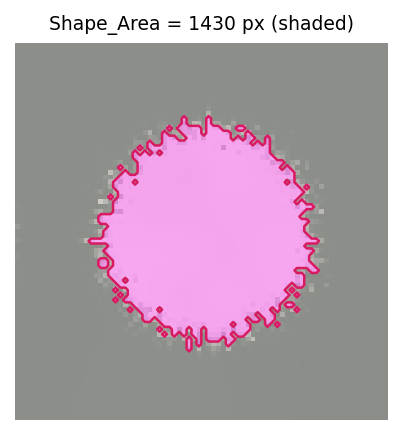
PerimeterTotal length of the colony’s outer boundary in pixels. Measures colony edge complexity and surface irregularity. Smooth, circular colonies have shorter perimeters relative to their area compared to irregular or filamentous colonies.
CircularityCalculated as \(\frac{4\pi*\text{Area}}{\text{Perimeter}^2}\). Measures how closely a colony approximates a perfect circle (value = 1). Values < 1 indicate irregular colony morphology, which may result from genetic mutations, environmental stress, or mixed microbial populations on agar plates.
ConvexAreaArea of the smallest convex polygon that completely contains the colony. Represents the colony’s “filled-in” appearance if all indentations and holes were removed. Useful for detecting colony spreading patterns or invasive growth characteristics.
MedianRadiusMedian distance from colony center to edge across all directions. Provides a robust measure of typical colony size that is less sensitive to outliers than mean width. Particularly useful for colonies with uneven growth or sectoring.
MeanRadiusAverage distance from colony center to edge across all directions. Represents overall colony expansion rate. In arrayed growth assays, this correlates with microbial fitness and growth kinetics under controlled conditions.
MaxRadiusMaximum distance from colony center to edge across all directions. Represents the furthest extent of colony growth from its center. In arrayed microbial assays, this measurement helps identify asymmetric growth patterns or colonies extending toward neighboring positions.
MinFeretDiameterMinimum caliper diameter - the shortest distance between two parallel tangent lines touching opposite sides of the colony. Represents the narrowest dimension of the colony regardless of orientation. Useful for detecting elongated or irregular colony morphologies and measuring colony width.
MaxFeretDiameterMaximum caliper diameter - the longest distance between two parallel tangent lines touching opposite sides of the colony. Represents the maximum dimension of the colony regardless of orientation. Often exceeds major axis length for irregular shapes and helps quantify maximum colony extent.
EccentricityMeasure of colony elongation, ranging from 0 (perfect circle) to 1 (highly elongated). Values near 0 indicate compact, radially symmetric growth typical of healthy bacterial colonies, while higher values may suggest directional growth, motility, or environmental gradients on the agar surface.
SolidityRatio of actual colony area to its convex hull area (Area/ConvexArea). Values near 1 indicate compact, solid colonies with minimal indentations. Lower values (< 0.9) may indicate invasive growth, colony spreading, or the presence of clearing zones around colonies.
ExtentRatio of colony area to its bounding box area (ObjectArea/BboxArea). Measures how efficiently the colony fills its allocated space. Compact colonies have higher extent values, while spread-out or irregular colonies have lower values.
BboxAreaArea of the smallest rectangle that completely contains the colony. Represents the total spatial shape of the colony including any empty space. In high-throughput assays, this helps assess colony positioning and potential interference with neighboring colonies.
MajorAxisLengthLength of the longest axis of the ellipse that best fits the colony shape. Represents the maximum colony dimension. In arrayed microbial growth, this measurement helps identify colonies that have grown beyond their intended grid positions.
MinorAxisLengthLength of the shortest axis of the ellipse that best fits the colony shape. Represents the minimum colony dimension. Together with major axis length, this helps characterize colony aspect ratio and growth anisotropy.
CompactnessCalculated as \(\frac{\text{Perimeter}^2}{4\pi*\text{Area}}\). Inverse of circularity (ranges from 1 for perfect circles to higher values for irregular shapes). Measures colony shape complexity - compact, circular colonies have values near 1, while irregular or filamentous colonies have much higher values.
OrientationAngle (in radians) between the colony’s major axis and the horizontal axis. Measures colony alignment and growth directionality. Random orientations are typical for most bacterial colonies, while consistent orientations may indicate environmental gradients or mechanical stresses during plating.
- classmethod __get_pydantic_json_schema__(core_schema: CoreSchema, handler: GetJsonSchemaHandler, /) JsonSchemaValue#
Hook into generating the model’s JSON schema.
- Parameters:
core_schema (CoreSchema) – A pydantic-core CoreSchema. You can ignore this argument and call the handler with a new CoreSchema, wrap this CoreSchema ({‘type’: ‘nullable’, ‘schema’: current_schema}), or just call the handler with the original schema.
handler (GetJsonSchemaHandler) – Call into Pydantic’s internal JSON schema generation. This will raise a pydantic.errors.PydanticInvalidForJsonSchema if JSON schema generation fails. Since this gets called by BaseModel.model_json_schema you can override the schema_generator argument to that function to change JSON schema generation globally for a type.
- Returns:
A JSON schema, as a Python object.
- Return type:
JsonSchemaValue
- classmethod __pydantic_init_subclass__(**kwargs: Any) None#
Populate field descriptions from the subclass docstring.
Runs once per concrete subclass after pydantic has built its model. Copies parameter descriptions parsed from the Google-style
Args:docstring block onto each field’sdescriptionslot so they surface inmodel_json_schema()— the machine-readable contract used by downstream tooling (e.g. an MCP server).- Parameters:
**kwargs (Any) – Class-keyword arguments forwarded by pydantic.
- Return type:
None
- classmethod __pydantic_on_complete__() None#
This is called once the class and its fields are fully initialized and ready to be used.
This typically happens when the class is created (just before [__pydantic_init_subclass__()][pydantic.main.BaseModel.__pydantic_init_subclass__] is called on the superclass), except when forward annotations are used that could not immediately be resolved. In that case, it will be called later, when the model is rebuilt automatically or explicitly using [model_rebuild()][pydantic.main.BaseModel.model_rebuild].
- Return type:
None
- classmethod from_json(json_data: str | Path | dict) BaseOperation#
Reconstruct an operation from JSON written by
to_json().Accepts a JSON string, a path to a JSON file, or a pre-parsed envelope dict (same input handling as
ImagePipeline.from_json()). Polymorphic:ImageOperation.from_json(path)returns whatever concrete operation the file holds. When called on a narrower subclass, the resolved class must be a subclass of it, else aTypeErroris raised.- Parameters:
json_data (str | Path | dict) – A JSON string, path to a JSON file, or envelope dict.
- Returns:
The reconstructed operation instance.
- Raises:
AttributeError – If the recorded class cannot be resolved in the
phenotypicnamespace.TypeError – If called on a concrete subclass and the file holds a class that is not a subclass of it.
- Return type:
Example
>>> import tempfile
>>> from pathlib import Path
>>> from phenotypic.abc_ import ImageOperation
>>> from phenotypic.detect import OtsuDetector
>>> with tempfile.TemporaryDirectory() as d:
...     p = Path(d) / "op.json"
...     OtsuDetector().to_json(p)
...     loaded = ImageOperation.from_json(p)  # polymorphic
>>> type(loaded).__name__
'OtsuDetector'
- classmethod model_construct(_fields_set: set[str] | None = None, **values: Any) Self#
Creates a new instance of the Model class with validated data.
Creates a new model setting __dict__ and __pydantic_fields_set__ from trusted or pre-validated data. Default values are respected, but no other validation is performed.
- !!! note
model_construct() generally respects the model_config.extra setting on the provided model. That is, if model_config.extra == ‘allow’, then all extra passed values are added to the model instance’s __dict__ and __pydantic_extra__ fields. If model_config.extra == ‘ignore’ (the default), then all extra passed values are ignored. Because no validation is performed with a call to model_construct(), having model_config.extra == ‘forbid’ does not result in an error if extra values are passed, but they will be ignored.
- Parameters:
_fields_set (set[str] | None) – A set of field names that were originally explicitly set during instantiation. If provided, this is directly used for the [model_fields_set][pydantic.BaseModel.model_fields_set] attribute. Otherwise, the field names from the values argument will be used.
values (Any) – Trusted or pre-validated data dictionary.
- Returns:
A new instance of the Model class with validated data.
- Return type:
- classmethod model_json_schema(by_alias: bool = True, ref_template: str = '#/$defs/{model}', schema_generator: type[~pydantic.json_schema.GenerateJsonSchema] = <class 'pydantic.json_schema.GenerateJsonSchema'>, mode: ~typing.Literal['validation', 'serialization'] = 'validation', *, union_format: ~typing.Literal['any_of', 'primitive_type_array'] = 'any_of') dict[str, Any]#
Generates a JSON schema for a model class.
- Parameters:
by_alias (bool) – Whether to use attribute aliases or not.
ref_template (str) – The reference template.
union_format (Literal['any_of', 'primitive_type_array']) –
The format to use when combining schemas from unions together. Can be one of:
’any_of’: Use the [anyOf](https://json-schema.org/understanding-json-schema/reference/combining#anyOf)
keyword to combine schemas (the default). - ‘primitive_type_array’: Use the [type](https://json-schema.org/understanding-json-schema/reference/type) keyword as an array of strings, containing each type of the combination. If any of the schemas is not a primitive type (string, boolean, null, integer or number) or contains constraints/metadata, falls back to any_of.
schema_generator (type[GenerateJsonSchema]) – To override the logic used to generate the JSON schema, as a subclass of GenerateJsonSchema with your desired modifications
mode (Literal['validation', 'serialization']) – The mode in which to generate the schema.
- Returns:
The JSON schema for the given model class.
- Return type:
- classmethod model_parametrized_name(params: tuple[type[Any], ...]) str#
Compute the class name for parametrizations of generic classes.
This method can be overridden to achieve a custom naming scheme for generic BaseModels.
- Parameters:
params (tuple[type[Any], ...]) – Tuple of types of the class. Given a generic class Model with 2 type variables and a concrete model Model[str, int], the value (str, int) would be passed to params.
- Returns:
String representing the new class where params are passed to cls as type variables.
- Raises:
TypeError – Raised when trying to generate concrete names for non-generic models.
- Return type:
- classmethod model_rebuild(*, force: bool = False, raise_errors: bool = True, _parent_namespace_depth: int = 2, _types_namespace: MappingNamespace | None = None) bool | None#
Try to rebuild the pydantic-core schema for the model.
This may be necessary when one of the annotations is a ForwardRef which could not be resolved during the initial attempt to build the schema, and automatic rebuilding fails.
- Parameters:
force (bool) – Whether to force the rebuilding of the model schema, defaults to False.
raise_errors (bool) – Whether to raise errors, defaults to True.
_parent_namespace_depth (int) – The depth level of the parent namespace, defaults to 2.
_types_namespace (MappingNamespace | None) – The types namespace, defaults to None.
- Returns:
Returns None if the schema is already “complete” and rebuilding was not required. If rebuilding _was_ required, returns True if rebuilding was successful, otherwise False.
- Return type:
bool | None
- classmethod model_validate(obj: Any, *, strict: bool | None = None, extra: Literal['allow', 'ignore', 'forbid'] | None = None, from_attributes: bool | None = None, context: Any | None = None, by_alias: bool | None = None, by_name: bool | None = None) Self#
Validate a pydantic model instance.
- Parameters:
obj (Any) – The object to validate.
strict (bool | None) – Whether to enforce types strictly.
extra (Literal['allow', 'ignore', 'forbid'] | None) – Whether to ignore, allow, or forbid extra data during model validation. See the [extra configuration value][pydantic.ConfigDict.extra] for details.
from_attributes (bool | None) – Whether to extract data from object attributes.
context (Any | None) – Additional context to pass to the validator.
by_alias (bool | None) – Whether to use the field’s alias when validating against the provided input data.
by_name (bool | None) – Whether to use the field’s name when validating against the provided input data.
- Raises:
ValidationError – If the object could not be validated.
- Returns:
The validated model instance.
- Return type:
- classmethod model_validate_json(json_data: str | bytes | bytearray, *, strict: bool | None = None, extra: Literal['allow', 'ignore', 'forbid'] | None = None, context: Any | None = None, by_alias: bool | None = None, by_name: bool | None = None) Self#
- !!! abstract “Usage Documentation”
[JSON Parsing](../concepts/json.md#json-parsing)
Validate the given JSON data against the Pydantic model.
- Parameters:
json_data (str | bytes | bytearray) – The JSON data to validate.
strict (bool | None) – Whether to enforce types strictly.
extra (Literal['allow', 'ignore', 'forbid'] | None) – Whether to ignore, allow, or forbid extra data during model validation. See the [extra configuration value][pydantic.ConfigDict.extra] for details.
context (Any | None) – Extra variables to pass to the validator.
by_alias (bool | None) – Whether to use the field’s alias when validating against the provided input data.
by_name (bool | None) – Whether to use the field’s name when validating against the provided input data.
- Returns:
The validated Pydantic model.
- Raises:
ValidationError – If json_data is not a JSON string or the object could not be validated.
- Return type:
- classmethod model_validate_strings(obj: Any, *, strict: bool | None = None, extra: Literal['allow', 'ignore', 'forbid'] | None = None, context: Any | None = None, by_alias: bool | None = None, by_name: bool | None = None) Self#
Validate the given object with string data against the Pydantic model.
- Parameters:
obj (Any) – The object containing string data to validate.
strict (bool | None) – Whether to enforce types strictly.
extra (Literal['allow', 'ignore', 'forbid'] | None) – Whether to ignore, allow, or forbid extra data during model validation. See the [extra configuration value][pydantic.ConfigDict.extra] for details.
context (Any | None) – Extra variables to pass to the validator.
by_alias (bool | None) – Whether to use the field’s alias when validating against the provided input data.
by_name (bool | None) – Whether to use the field’s name when validating against the provided input data.
- Returns:
The validated Pydantic model.
- Return type:
- classmethod parse_file(path: str | Path, *, content_type: str | None = None, encoding: str = 'utf8', proto: DeprecatedParseProtocol | None = None, allow_pickle: bool = False) Self#
- classmethod parse_raw(b: str | bytes, *, content_type: str | None = None, encoding: str = 'utf8', proto: DeprecatedParseProtocol | None = None, allow_pickle: bool = False) Self#
- classmethod schema_json(*, by_alias: bool = True, ref_template: str = '#/$defs/{model}', **dumps_kwargs: Any) str#
- __del__()#
Automatically stop tracemalloc when the object is deleted.
- __init__(**data: Any) None#
Create a new model by parsing and validating input data from keyword arguments.
Raises [ValidationError][pydantic_core.ValidationError] if the input data cannot be validated to form a valid model.
self is explicitly positional-only to allow self as a field name.
- Parameters:
data (Any)
- Return type:
None
- __pretty__(fmt: Callable[[Any], Any], **kwargs: Any) Generator[Any]#
Used by devtools (https://python-devtools.helpmanual.io/) to pretty print objects.
- __rich_repr__() RichReprResult#
Used by Rich (https://rich.readthedocs.io/en/stable/pretty.html) to pretty print objects.
- Return type:
RichReprResult
- copy(*, include: AbstractSetIntStr | MappingIntStrAny | None = None, exclude: AbstractSetIntStr | MappingIntStrAny | None = None, update: Dict[str, Any] | None = None, deep: bool = False) Self#
Returns a copy of the model.
- !!! warning “Deprecated”
This method is now deprecated; use model_copy instead.
If you need include or exclude, use:
`python {test="skip" lint="skip"} data = self.model_dump(include=include, exclude=exclude, round_trip=True) data = {**data, **(update or {})} copied = self.model_validate(data) `- Parameters:
include (AbstractSetIntStr | MappingIntStrAny | None) – Optional set or mapping specifying which fields to include in the copied model.
exclude (AbstractSetIntStr | MappingIntStrAny | None) – Optional set or mapping specifying which fields to exclude in the copied model.
update (Dict[str, Any] | None) – Optional dictionary of field-value pairs to override field values in the copied model.
deep (bool) – If True, the values of fields that are Pydantic models will be deep-copied.
- Returns:
A copy of the model with included, excluded and updated fields as specified.
- Return type:
Self
- dict(*, include: set[int] | set[str] | Mapping[int, set[int] | set[str] | Mapping[int, IncEx | bool] | Mapping[str, IncEx | bool] | bool] | Mapping[str, set[int] | set[str] | Mapping[int, IncEx | bool] | Mapping[str, IncEx | bool] | bool] | None = None, exclude: set[int] | set[str] | Mapping[int, set[int] | set[str] | Mapping[int, IncEx | bool] | Mapping[str, IncEx | bool] | bool] | Mapping[str, set[int] | set[str] | Mapping[int, IncEx | bool] | Mapping[str, IncEx | bool] | bool] | None = None, by_alias: bool = False, exclude_unset: bool = False, exclude_defaults: bool = False, exclude_none: bool = False) Dict[str, Any]#
- Parameters:
include (set[int] | set[str] | Mapping[int, set[int] | set[str] | Mapping[int, IncEx | bool] | Mapping[str, IncEx | bool] | bool] | Mapping[str, set[int] | set[str] | Mapping[int, IncEx | bool] | Mapping[str, IncEx | bool] | bool] | None)
exclude (set[int] | set[str] | Mapping[int, set[int] | set[str] | Mapping[int, IncEx | bool] | Mapping[str, IncEx | bool] | bool] | Mapping[str, set[int] | set[str] | Mapping[int, IncEx | bool] | Mapping[str, IncEx | bool] | bool] | None)
by_alias (bool)
exclude_unset (bool)
exclude_defaults (bool)
exclude_none (bool)
- Return type:
- json(*, include: set[int] | set[str] | Mapping[int, set[int] | set[str] | Mapping[int, IncEx | bool] | Mapping[str, IncEx | bool] | bool] | Mapping[str, set[int] | set[str] | Mapping[int, IncEx | bool] | Mapping[str, IncEx | bool] | bool] | None = None, exclude: set[int] | set[str] | Mapping[int, set[int] | set[str] | Mapping[int, IncEx | bool] | Mapping[str, IncEx | bool] | bool] | Mapping[str, set[int] | set[str] | Mapping[int, IncEx | bool] | Mapping[str, IncEx | bool] | bool] | None = None, by_alias: bool = False, exclude_unset: bool = False, exclude_defaults: bool = False, exclude_none: bool = False, encoder: Callable[[Any], Any] | None = PydanticUndefined, models_as_dict: bool = PydanticUndefined, **dumps_kwargs: Any) str#
- Parameters:
include (set[int] | set[str] | Mapping[int, set[int] | set[str] | Mapping[int, IncEx | bool] | Mapping[str, IncEx | bool] | bool] | Mapping[str, set[int] | set[str] | Mapping[int, IncEx | bool] | Mapping[str, IncEx | bool] | bool] | None)
exclude (set[int] | set[str] | Mapping[int, set[int] | set[str] | Mapping[int, IncEx | bool] | Mapping[str, IncEx | bool] | bool] | Mapping[str, set[int] | set[str] | Mapping[int, IncEx | bool] | Mapping[str, IncEx | bool] | bool] | None)
by_alias (bool)
exclude_unset (bool)
exclude_defaults (bool)
exclude_none (bool)
models_as_dict (bool)
dumps_kwargs (Any)
- Return type:
- measure(image, include_meta=False)#
Execute the measurement operation on a detected-object image.
This is the main public API method for extracting measurements. It handles: input validation, parameter extraction via introspection, calling the subclass-specific _operate() method, optional metadata merging, and exception handling.
How it works (for users):
Pass your processed Image (with detected objects) to measure()
The method calls your subclass’s _operate() implementation
Results are validated and returned as a pandas DataFrame
If include_meta=True, image metadata (filename, grid info) is merged in
How it works (for developers):
When you subclass MeasureFeatures, you only implement _operate(). This measure() method automatically:
Calls _operate(), which reads its parameters from
selfValidates the Image has detected objects (objmap)
Wraps exceptions in OperationFailedError with context
Merges grid/object metadata if requested
- Parameters:
image (Image) – A PhenoTypic Image object with detected objects (must have non-empty objmap from a prior detection operation).
include_meta (bool, optional) – If True, merge image metadata columns (filename, grid position, etc.) into the results DataFrame. Defaults to False.
- Returns:
Measurement results with structure:
First column: OBJECT.LABEL (integer IDs from image.objmap[:])
Remaining columns: Measurement values (float, int, or string)
One row per detected object
If include_meta=True, additional metadata columns are prepended before OBJECT.LABEL (e.g., Filename, GridRow, GridCol).
- Return type:
pd.DataFrame
- Raises:
OperationFailedError – If _operate() raises any exception, it is caught and re-raised as OperationFailedError with details including the original exception type, message, image name, and operation class. This provides consistent error handling across all measurers.
Notes
This method is the main entry point; do not override in subclasses
Subclasses implement _operate() only, not this method
Automatic memory profiling is available via logging configuration
Image must have detected objects (image.objmap should be non-empty)
Examples
Basic measurement extraction:
>>> from phenotypic import Image
>>> from phenotypic.measure import MeasureSize
>>> from phenotypic.detect import OtsuDetector
>>> # Load and detect
>>> image = Image('plate.jpg')
>>> image = OtsuDetector().operate(image)
>>> # Extract measurements
>>> measurer = MeasureSize()
>>> df = measurer.measure(image)
>>> print(df.head())
Include metadata in measurements:
>>> # With image metadata (filename, grid info)
>>> df_with_meta = measurer.measure(image, include_meta=True)
>>> print(df_with_meta.columns)
# Output: ['Filename', 'GridRow', 'GridCol', 'OBJECT.LABEL',
#          'Area', 'IntegratedIntensity', ...]
- model_copy(*, update: Mapping[str, Any] | None = None, deep: bool = False) Self#
- !!! abstract “Usage Documentation”
[model_copy](../concepts/models.md#model-copy)
Returns a copy of the model.
- !!! note
The underlying instance’s [__dict__][object.__dict__] attribute is copied. This might have unexpected side effects if you store anything in it, on top of the model fields (e.g. the value of [cached properties][functools.cached_property]).
- model_dump(*, mode: Literal['json', 'python'] | str = 'python', include: set[int] | set[str] | Mapping[int, set[int] | set[str] | Mapping[int, IncEx | bool] | Mapping[str, IncEx | bool] | bool] | Mapping[str, set[int] | set[str] | Mapping[int, IncEx | bool] | Mapping[str, IncEx | bool] | bool] | None = None, exclude: set[int] | set[str] | Mapping[int, set[int] | set[str] | Mapping[int, IncEx | bool] | Mapping[str, IncEx | bool] | bool] | Mapping[str, set[int] | set[str] | Mapping[int, IncEx | bool] | Mapping[str, IncEx | bool] | bool] | None = None, context: Any | None = None, by_alias: bool | None = None, exclude_unset: bool = False, exclude_defaults: bool = False, exclude_none: bool = False, exclude_computed_fields: bool = False, round_trip: bool = False, warnings: bool | Literal['none', 'warn', 'error'] = True, fallback: Callable[[Any], Any] | None = None, serialize_as_any: bool = False) dict[str, Any]#
- !!! abstract “Usage Documentation”
[model_dump](../concepts/serialization.md#python-mode)
Generate a dictionary representation of the model, optionally specifying which fields to include or exclude.
- Parameters:
mode (Literal['json', 'python'] | str) – The mode in which to_python should run. If mode is ‘json’, the output will only contain JSON serializable types. If mode is ‘python’, the output may contain non-JSON-serializable Python objects.
include (set[int] | set[str] | Mapping[int, set[int] | set[str] | Mapping[int, IncEx | bool] | Mapping[str, IncEx | bool] | bool] | Mapping[str, set[int] | set[str] | Mapping[int, IncEx | bool] | Mapping[str, IncEx | bool] | bool] | None) – A set of fields to include in the output.
exclude (set[int] | set[str] | Mapping[int, set[int] | set[str] | Mapping[int, IncEx | bool] | Mapping[str, IncEx | bool] | bool] | Mapping[str, set[int] | set[str] | Mapping[int, IncEx | bool] | Mapping[str, IncEx | bool] | bool] | None) – A set of fields to exclude from the output.
context (Any | None) – Additional context to pass to the serializer.
by_alias (bool | None) – Whether to use the field’s alias in the dictionary key if defined.
exclude_unset (bool) – Whether to exclude fields that have not been explicitly set.
exclude_defaults (bool) – Whether to exclude fields that are set to their default value.
exclude_none (bool) – Whether to exclude fields that have a value of None.
exclude_computed_fields (bool) – Whether to exclude computed fields. While this can be useful for round-tripping, it is usually recommended to use the dedicated round_trip parameter instead.
round_trip (bool) – If True, dumped values should be valid as input for non-idempotent types such as Json[T].
warnings (bool | Literal['none', 'warn', 'error']) – How to handle serialization errors. False/”none” ignores them, True/”warn” logs errors, “error” raises a [PydanticSerializationError][pydantic_core.PydanticSerializationError].
fallback (Callable[[Any], Any] | None) – A function to call when an unknown value is encountered. If not provided, a [PydanticSerializationError][pydantic_core.PydanticSerializationError] error is raised.
serialize_as_any (bool) – Whether to serialize fields with duck-typing serialization behavior.
- Returns:
A dictionary representation of the model.
- Return type:
- model_dump_json(*, indent: int | None = None, ensure_ascii: bool = False, include: set[int] | set[str] | Mapping[int, set[int] | set[str] | Mapping[int, IncEx | bool] | Mapping[str, IncEx | bool] | bool] | Mapping[str, set[int] | set[str] | Mapping[int, IncEx | bool] | Mapping[str, IncEx | bool] | bool] | None = None, exclude: set[int] | set[str] | Mapping[int, set[int] | set[str] | Mapping[int, IncEx | bool] | Mapping[str, IncEx | bool] | bool] | Mapping[str, set[int] | set[str] | Mapping[int, IncEx | bool] | Mapping[str, IncEx | bool] | bool] | None = None, context: Any | None = None, by_alias: bool | None = None, exclude_unset: bool = False, exclude_defaults: bool = False, exclude_none: bool = False, exclude_computed_fields: bool = False, round_trip: bool = False, warnings: bool | Literal['none', 'warn', 'error'] = True, fallback: Callable[[Any], Any] | None = None, serialize_as_any: bool = False) str#
- !!! abstract “Usage Documentation”
[model_dump_json](../concepts/serialization.md#json-mode)
Generates a JSON representation of the model using Pydantic’s to_json method.
- Parameters:
indent (int | None) – Indentation to use in the JSON output. If None is passed, the output will be compact.
ensure_ascii (bool) – If True, the output is guaranteed to have all incoming non-ASCII characters escaped. If False (the default), these characters will be output as-is.
include (set[int] | set[str] | Mapping[int, set[int] | set[str] | Mapping[int, IncEx | bool] | Mapping[str, IncEx | bool] | bool] | Mapping[str, set[int] | set[str] | Mapping[int, IncEx | bool] | Mapping[str, IncEx | bool] | bool] | None) – Field(s) to include in the JSON output.
exclude (set[int] | set[str] | Mapping[int, set[int] | set[str] | Mapping[int, IncEx | bool] | Mapping[str, IncEx | bool] | bool] | Mapping[str, set[int] | set[str] | Mapping[int, IncEx | bool] | Mapping[str, IncEx | bool] | bool] | None) – Field(s) to exclude from the JSON output.
context (Any | None) – Additional context to pass to the serializer.
by_alias (bool | None) – Whether to serialize using field aliases.
exclude_unset (bool) – Whether to exclude fields that have not been explicitly set.
exclude_defaults (bool) – Whether to exclude fields that are set to their default value.
exclude_none (bool) – Whether to exclude fields that have a value of None.
exclude_computed_fields (bool) – Whether to exclude computed fields. While this can be useful for round-tripping, it is usually recommended to use the dedicated round_trip parameter instead.
round_trip (bool) – If True, dumped values should be valid as input for non-idempotent types such as Json[T].
warnings (bool | Literal['none', 'warn', 'error']) – How to handle serialization errors. False/”none” ignores them, True/”warn” logs errors, “error” raises a [PydanticSerializationError][pydantic_core.PydanticSerializationError].
fallback (Callable[[Any], Any] | None) – A function to call when an unknown value is encountered. If not provided, a [PydanticSerializationError][pydantic_core.PydanticSerializationError] error is raised.
serialize_as_any (bool) – Whether to serialize fields with duck-typing serialization behavior.
- Returns:
A JSON string representation of the model.
- Return type:
- model_post_init(_BaseOperation__context: Any) None#
Initialize logging and memory tracking after model construction.
Replaces the legacy
__init__body: creates the per-class logger and, when that logger is enabled for INFO level or higher, startstracemallocso per-operation memory usage can be logged.- Parameters:
__context – Pydantic post-init context (unused).
_BaseOperation__context (Any)
- Return type:
None
- to_json(filepath: str | Path | None = None) str | None#
Serialize this operation to JSON.
Captures the operation as a
{"class", "params"}envelope:paramsismodel_dump(mode="json")(every declared field, including nested operations and raw arrays;PrivateAttrstate such as loggers and timing is excluded automatically), andclassrecords the concrete class name sofrom_json()can rebuild the right subclass. This mirrorsImagePipeline.to_json().- Parameters:
filepath (str | Path | None) – Optional path to write the JSON to. When None, the JSON string is returned instead. Accepts a
strorPath.- Returns:
The JSON string when
filepathis None, otherwise None.- Return type:
str | None
Example
>>> import tempfile
>>> from pathlib import Path
>>> from phenotypic.detect import OtsuDetector
>>> from phenotypic.sdk_ import CONFIG_SUFFIX_OPERATION, ensure_typed_json_suffix
>>> with tempfile.TemporaryDirectory() as d:
...     p = Path(d) / "op.json"
...     saved = ensure_typed_json_suffix(p, CONFIG_SUFFIX_OPERATION)
...     OtsuDetector(ignore_zeros=True).to_json(p)
...     loaded = OtsuDetector.from_json(saved)
>>> loaded.ignore_zeros
True
- model_computed_fields = {}#
- model_config: ClassVar[ConfigDict] = {'arbitrary_types_allowed': True, 'extra': 'forbid', 'validate_assignment': True}#
Configuration for the model, should be a dictionary conforming to [ConfigDict][pydantic.config.ConfigDict].
- property model_extra: dict[str, Any] | None#
Get extra fields set during validation.
- Returns:
A dictionary of extra fields, or None if config.extra is not set to “allow”.
- model_fields = {}#
- class phenotypic.measure.MeasureSize[source]#
Bases:
MeasureFeaturesMeasure colony area and integrated intensity as lightweight size proxies.
Extract two fundamental size metrics per detected colony: pixel area (biomass extent) and integrated grayscale intensity (total brightness, a proxy for optical density). This is a convenience class for rapid size assessment without the overhead of full shape or intensity statistical analysis.
- Returns:
pd.DataFrame: Object-level size measurements with columns:
Label: unique object identifier.
Area: number of pixels occupied by the colony.
IntegratedIntensity: sum of grayscale pixel values (proxy for biomass / optical density).
- Best For:
Quick quality-control screening of colony size distributions.
Time-course growth tracking via area at successive time points.
Filtering colonies by minimum size to exclude debris or aborted growth before downstream measurement.
- Consider Also:
MeasureShapefor comprehensive morphological metrics (circularity, convex hull, Feret diameters).MeasureIntensityfor full intensity statistics (percentiles, variance, coefficient of variation).MeasureGridSpreadfor detecting multi-object wells in arrayed assays.
- See Also:
Tutorial 7: Measuring and Exporting for a walkthrough of measuring and exporting colony data. Measurement Metrics and Their Biological Meaning for interpreting size metrics in a biological context.
Category: Size# Name
Description
AreaTotal number of pixels occupied by the microbial colony.Larger areas typically indicate more robust growth or longer incubation times.
IntegratedIntensityThe sum of the object’s grayscale pixels. Calculated as \(\sum{\text{pixel values}} \times \text{area}\).
- classmethod __get_pydantic_json_schema__(core_schema: CoreSchema, handler: GetJsonSchemaHandler, /) JsonSchemaValue#
Hook into generating the model’s JSON schema.
- Parameters:
core_schema (CoreSchema) – A pydantic-core CoreSchema. You can ignore this argument and call the handler with a new CoreSchema, wrap this CoreSchema ({‘type’: ‘nullable’, ‘schema’: current_schema}), or just call the handler with the original schema.
handler (GetJsonSchemaHandler) – Call into Pydantic’s internal JSON schema generation. This will raise a pydantic.errors.PydanticInvalidForJsonSchema if JSON schema generation fails. Since this gets called by BaseModel.model_json_schema you can override the schema_generator argument to that function to change JSON schema generation globally for a type.
- Returns:
A JSON schema, as a Python object.
- Return type:
JsonSchemaValue
- classmethod __pydantic_init_subclass__(**kwargs: Any) None#
Populate field descriptions from the subclass docstring.
Runs once per concrete subclass after pydantic has built its model. Copies parameter descriptions parsed from the Google-style
Args:docstring block onto each field’sdescriptionslot so they surface inmodel_json_schema()— the machine-readable contract used by downstream tooling (e.g. an MCP server).- Parameters:
**kwargs (Any) – Class-keyword arguments forwarded by pydantic.
- Return type:
None
- classmethod __pydantic_on_complete__() None#
This is called once the class and its fields are fully initialized and ready to be used.
This typically happens when the class is created (just before [__pydantic_init_subclass__()][pydantic.main.BaseModel.__pydantic_init_subclass__] is called on the superclass), except when forward annotations are used that could not immediately be resolved. In that case, it will be called later, when the model is rebuilt automatically or explicitly using [model_rebuild()][pydantic.main.BaseModel.model_rebuild].
- Return type:
None
- classmethod from_json(json_data: str | Path | dict) BaseOperation#
Reconstruct an operation from JSON written by
to_json().Accepts a JSON string, a path to a JSON file, or a pre-parsed envelope dict (same input handling as
ImagePipeline.from_json()). Polymorphic:ImageOperation.from_json(path)returns whatever concrete operation the file holds. When called on a narrower subclass, the resolved class must be a subclass of it, else aTypeErroris raised.- Parameters:
json_data (str | Path | dict) – A JSON string, path to a JSON file, or envelope dict.
- Returns:
The reconstructed operation instance.
- Raises:
AttributeError – If the recorded class cannot be resolved in the
phenotypicnamespace.TypeError – If called on a concrete subclass and the file holds a class that is not a subclass of it.
- Return type:
Example
>>> import tempfile
>>> from pathlib import Path
>>> from phenotypic.abc_ import ImageOperation
>>> from phenotypic.detect import OtsuDetector
>>> with tempfile.TemporaryDirectory() as d:
...     p = Path(d) / "op.json"
...     OtsuDetector().to_json(p)
...     loaded = ImageOperation.from_json(p)  # polymorphic
>>> type(loaded).__name__
'OtsuDetector'
- classmethod model_construct(_fields_set: set[str] | None = None, **values: Any) Self#
Creates a new instance of the Model class with validated data.
Creates a new model setting __dict__ and __pydantic_fields_set__ from trusted or pre-validated data. Default values are respected, but no other validation is performed.
- !!! note
model_construct() generally respects the model_config.extra setting on the provided model. That is, if model_config.extra == ‘allow’, then all extra passed values are added to the model instance’s __dict__ and __pydantic_extra__ fields. If model_config.extra == ‘ignore’ (the default), then all extra passed values are ignored. Because no validation is performed with a call to model_construct(), having model_config.extra == ‘forbid’ does not result in an error if extra values are passed, but they will be ignored.
- Parameters:
_fields_set (set[str] | None) – A set of field names that were originally explicitly set during instantiation. If provided, this is directly used for the [model_fields_set][pydantic.BaseModel.model_fields_set] attribute. Otherwise, the field names from the values argument will be used.
values (Any) – Trusted or pre-validated data dictionary.
- Returns:
A new instance of the Model class with validated data.
- Return type:
- classmethod model_json_schema(by_alias: bool = True, ref_template: str = '#/$defs/{model}', schema_generator: type[~pydantic.json_schema.GenerateJsonSchema] = <class 'pydantic.json_schema.GenerateJsonSchema'>, mode: ~typing.Literal['validation', 'serialization'] = 'validation', *, union_format: ~typing.Literal['any_of', 'primitive_type_array'] = 'any_of') dict[str, Any]#
Generates a JSON schema for a model class.
- Parameters:
by_alias (bool) – Whether to use attribute aliases or not.
ref_template (str) – The reference template.
union_format (Literal['any_of', 'primitive_type_array']) –
The format to use when combining schemas from unions together. Can be one of:
’any_of’: Use the [anyOf](https://json-schema.org/understanding-json-schema/reference/combining#anyOf)
keyword to combine schemas (the default). - ‘primitive_type_array’: Use the [type](https://json-schema.org/understanding-json-schema/reference/type) keyword as an array of strings, containing each type of the combination. If any of the schemas is not a primitive type (string, boolean, null, integer or number) or contains constraints/metadata, falls back to any_of.
schema_generator (type[GenerateJsonSchema]) – To override the logic used to generate the JSON schema, as a subclass of GenerateJsonSchema with your desired modifications
mode (Literal['validation', 'serialization']) – The mode in which to generate the schema.
- Returns:
The JSON schema for the given model class.
- Return type:
- classmethod model_parametrized_name(params: tuple[type[Any], ...]) str#
Compute the class name for parametrizations of generic classes.
This method can be overridden to achieve a custom naming scheme for generic BaseModels.
- Parameters:
params (tuple[type[Any], ...]) – Tuple of types of the class. Given a generic class Model with 2 type variables and a concrete model Model[str, int], the value (str, int) would be passed to params.
- Returns:
String representing the new class where params are passed to cls as type variables.
- Raises:
TypeError – Raised when trying to generate concrete names for non-generic models.
- Return type:
- classmethod model_rebuild(*, force: bool = False, raise_errors: bool = True, _parent_namespace_depth: int = 2, _types_namespace: MappingNamespace | None = None) bool | None#
Try to rebuild the pydantic-core schema for the model.
This may be necessary when one of the annotations is a ForwardRef which could not be resolved during the initial attempt to build the schema, and automatic rebuilding fails.
- Parameters:
force (bool) – Whether to force the rebuilding of the model schema, defaults to False.
raise_errors (bool) – Whether to raise errors, defaults to True.
_parent_namespace_depth (int) – The depth level of the parent namespace, defaults to 2.
_types_namespace (MappingNamespace | None) – The types namespace, defaults to None.
- Returns:
Returns None if the schema is already “complete” and rebuilding was not required. If rebuilding _was_ required, returns True if rebuilding was successful, otherwise False.
- Return type:
bool | None
- classmethod model_validate(obj: Any, *, strict: bool | None = None, extra: Literal['allow', 'ignore', 'forbid'] | None = None, from_attributes: bool | None = None, context: Any | None = None, by_alias: bool | None = None, by_name: bool | None = None) Self#
Validate a pydantic model instance.
- Parameters:
obj (Any) – The object to validate.
strict (bool | None) – Whether to enforce types strictly.
extra (Literal['allow', 'ignore', 'forbid'] | None) – Whether to ignore, allow, or forbid extra data during model validation. See the [extra configuration value][pydantic.ConfigDict.extra] for details.
from_attributes (bool | None) – Whether to extract data from object attributes.
context (Any | None) – Additional context to pass to the validator.
by_alias (bool | None) – Whether to use the field’s alias when validating against the provided input data.
by_name (bool | None) – Whether to use the field’s name when validating against the provided input data.
- Raises:
ValidationError – If the object could not be validated.
- Returns:
The validated model instance.
- Return type:
- classmethod model_validate_json(json_data: str | bytes | bytearray, *, strict: bool | None = None, extra: Literal['allow', 'ignore', 'forbid'] | None = None, context: Any | None = None, by_alias: bool | None = None, by_name: bool | None = None) Self#
- !!! abstract “Usage Documentation”
[JSON Parsing](../concepts/json.md#json-parsing)
Validate the given JSON data against the Pydantic model.
- Parameters:
json_data (str | bytes | bytearray) – The JSON data to validate.
strict (bool | None) – Whether to enforce types strictly.
extra (Literal['allow', 'ignore', 'forbid'] | None) – Whether to ignore, allow, or forbid extra data during model validation. See the [extra configuration value][pydantic.ConfigDict.extra] for details.
context (Any | None) – Extra variables to pass to the validator.
by_alias (bool | None) – Whether to use the field’s alias when validating against the provided input data.
by_name (bool | None) – Whether to use the field’s name when validating against the provided input data.
- Returns:
The validated Pydantic model.
- Raises:
ValidationError – If json_data is not a JSON string or the object could not be validated.
- Return type:
- classmethod model_validate_strings(obj: Any, *, strict: bool | None = None, extra: Literal['allow', 'ignore', 'forbid'] | None = None, context: Any | None = None, by_alias: bool | None = None, by_name: bool | None = None) Self#
Validate the given object with string data against the Pydantic model.
- Parameters:
obj (Any) – The object containing string data to validate.
strict (bool | None) – Whether to enforce types strictly.
extra (Literal['allow', 'ignore', 'forbid'] | None) – Whether to ignore, allow, or forbid extra data during model validation. See the [extra configuration value][pydantic.ConfigDict.extra] for details.
context (Any | None) – Extra variables to pass to the validator.
by_alias (bool | None) – Whether to use the field’s alias when validating against the provided input data.
by_name (bool | None) – Whether to use the field’s name when validating against the provided input data.
- Returns:
The validated Pydantic model.
- Return type:
- classmethod parse_file(path: str | Path, *, content_type: str | None = None, encoding: str = 'utf8', proto: DeprecatedParseProtocol | None = None, allow_pickle: bool = False) Self#
- classmethod parse_raw(b: str | bytes, *, content_type: str | None = None, encoding: str = 'utf8', proto: DeprecatedParseProtocol | None = None, allow_pickle: bool = False) Self#
- classmethod schema_json(*, by_alias: bool = True, ref_template: str = '#/$defs/{model}', **dumps_kwargs: Any) str#
- __del__()#
Automatically stop tracemalloc when the object is deleted.
- __init__(**data: Any) None#
Create a new model by parsing and validating input data from keyword arguments.
Raises [ValidationError][pydantic_core.ValidationError] if the input data cannot be validated to form a valid model.
self is explicitly positional-only to allow self as a field name.
- Parameters:
data (Any)
- Return type:
None
- __pretty__(fmt: Callable[[Any], Any], **kwargs: Any) Generator[Any]#
Used by devtools (https://python-devtools.helpmanual.io/) to pretty print objects.
- __rich_repr__() RichReprResult#
Used by Rich (https://rich.readthedocs.io/en/stable/pretty.html) to pretty print objects.
- Return type:
RichReprResult
- copy(*, include: AbstractSetIntStr | MappingIntStrAny | None = None, exclude: AbstractSetIntStr | MappingIntStrAny | None = None, update: Dict[str, Any] | None = None, deep: bool = False) Self#
Returns a copy of the model.
- !!! warning “Deprecated”
This method is now deprecated; use model_copy instead.
If you need include or exclude, use:
`python {test="skip" lint="skip"} data = self.model_dump(include=include, exclude=exclude, round_trip=True) data = {**data, **(update or {})} copied = self.model_validate(data) `- Parameters:
include (AbstractSetIntStr | MappingIntStrAny | None) – Optional set or mapping specifying which fields to include in the copied model.
exclude (AbstractSetIntStr | MappingIntStrAny | None) – Optional set or mapping specifying which fields to exclude in the copied model.
update (Dict[str, Any] | None) – Optional dictionary of field-value pairs to override field values in the copied model.
deep (bool) – If True, the values of fields that are Pydantic models will be deep-copied.
- Returns:
A copy of the model with included, excluded and updated fields as specified.
- Return type:
Self
- dict(*, include: set[int] | set[str] | Mapping[int, set[int] | set[str] | Mapping[int, IncEx | bool] | Mapping[str, IncEx | bool] | bool] | Mapping[str, set[int] | set[str] | Mapping[int, IncEx | bool] | Mapping[str, IncEx | bool] | bool] | None = None, exclude: set[int] | set[str] | Mapping[int, set[int] | set[str] | Mapping[int, IncEx | bool] | Mapping[str, IncEx | bool] | bool] | Mapping[str, set[int] | set[str] | Mapping[int, IncEx | bool] | Mapping[str, IncEx | bool] | bool] | None = None, by_alias: bool = False, exclude_unset: bool = False, exclude_defaults: bool = False, exclude_none: bool = False) Dict[str, Any]#
- Parameters:
include (set[int] | set[str] | Mapping[int, set[int] | set[str] | Mapping[int, IncEx | bool] | Mapping[str, IncEx | bool] | bool] | Mapping[str, set[int] | set[str] | Mapping[int, IncEx | bool] | Mapping[str, IncEx | bool] | bool] | None)
exclude (set[int] | set[str] | Mapping[int, set[int] | set[str] | Mapping[int, IncEx | bool] | Mapping[str, IncEx | bool] | bool] | Mapping[str, set[int] | set[str] | Mapping[int, IncEx | bool] | Mapping[str, IncEx | bool] | bool] | None)
by_alias (bool)
exclude_unset (bool)
exclude_defaults (bool)
exclude_none (bool)
- Return type:
- json(*, include: set[int] | set[str] | Mapping[int, set[int] | set[str] | Mapping[int, IncEx | bool] | Mapping[str, IncEx | bool] | bool] | Mapping[str, set[int] | set[str] | Mapping[int, IncEx | bool] | Mapping[str, IncEx | bool] | bool] | None = None, exclude: set[int] | set[str] | Mapping[int, set[int] | set[str] | Mapping[int, IncEx | bool] | Mapping[str, IncEx | bool] | bool] | Mapping[str, set[int] | set[str] | Mapping[int, IncEx | bool] | Mapping[str, IncEx | bool] | bool] | None = None, by_alias: bool = False, exclude_unset: bool = False, exclude_defaults: bool = False, exclude_none: bool = False, encoder: Callable[[Any], Any] | None = PydanticUndefined, models_as_dict: bool = PydanticUndefined, **dumps_kwargs: Any) str#
- Parameters:
include (set[int] | set[str] | Mapping[int, set[int] | set[str] | Mapping[int, IncEx | bool] | Mapping[str, IncEx | bool] | bool] | Mapping[str, set[int] | set[str] | Mapping[int, IncEx | bool] | Mapping[str, IncEx | bool] | bool] | None)
exclude (set[int] | set[str] | Mapping[int, set[int] | set[str] | Mapping[int, IncEx | bool] | Mapping[str, IncEx | bool] | bool] | Mapping[str, set[int] | set[str] | Mapping[int, IncEx | bool] | Mapping[str, IncEx | bool] | bool] | None)
by_alias (bool)
exclude_unset (bool)
exclude_defaults (bool)
exclude_none (bool)
models_as_dict (bool)
dumps_kwargs (Any)
- Return type:
- measure(image, include_meta=False)#
Execute the measurement operation on a detected-object image.
This is the main public API method for extracting measurements. It handles: input validation, parameter extraction via introspection, calling the subclass-specific _operate() method, optional metadata merging, and exception handling.
How it works (for users):
Pass your processed Image (with detected objects) to measure()
The method calls your subclass’s _operate() implementation
Results are validated and returned as a pandas DataFrame
If include_meta=True, image metadata (filename, grid info) is merged in
How it works (for developers):
When you subclass MeasureFeatures, you only implement _operate(). This measure() method automatically:
Calls _operate(), which reads its parameters from
selfValidates the Image has detected objects (objmap)
Wraps exceptions in OperationFailedError with context
Merges grid/object metadata if requested
- Parameters:
image (Image) – A PhenoTypic Image object with detected objects (must have non-empty objmap from a prior detection operation).
include_meta (bool, optional) – If True, merge image metadata columns (filename, grid position, etc.) into the results DataFrame. Defaults to False.
- Returns:
Measurement results with structure:
First column: OBJECT.LABEL (integer IDs from image.objmap[:])
Remaining columns: Measurement values (float, int, or string)
One row per detected object
If include_meta=True, additional metadata columns are prepended before OBJECT.LABEL (e.g., Filename, GridRow, GridCol).
- Return type:
pd.DataFrame
- Raises:
OperationFailedError – If _operate() raises any exception, it is caught and re-raised as OperationFailedError with details including the original exception type, message, image name, and operation class. This provides consistent error handling across all measurers.
Notes
This method is the main entry point; do not override in subclasses
Subclasses implement _operate() only, not this method
Automatic memory profiling is available via logging configuration
Image must have detected objects (image.objmap should be non-empty)
Examples
Basic measurement extraction:
>>> from phenotypic import Image
>>> from phenotypic.measure import MeasureSize
>>> from phenotypic.detect import OtsuDetector
>>> # Load and detect
>>> image = Image('plate.jpg')
>>> image = OtsuDetector().operate(image)
>>> # Extract measurements
>>> measurer = MeasureSize()
>>> df = measurer.measure(image)
>>> print(df.head())
Include metadata in measurements:
>>> # With image metadata (filename, grid info)
>>> df_with_meta = measurer.measure(image, include_meta=True)
>>> print(df_with_meta.columns)
# Output: ['Filename', 'GridRow', 'GridCol', 'OBJECT.LABEL',
#          'Area', 'IntegratedIntensity', ...]
- model_copy(*, update: Mapping[str, Any] | None = None, deep: bool = False) Self#
- !!! abstract “Usage Documentation”
[model_copy](../concepts/models.md#model-copy)
Returns a copy of the model.
- !!! note
The underlying instance’s [__dict__][object.__dict__] attribute is copied. This might have unexpected side effects if you store anything in it, on top of the model fields (e.g. the value of [cached properties][functools.cached_property]).
- model_dump(*, mode: Literal['json', 'python'] | str = 'python', include: set[int] | set[str] | Mapping[int, set[int] | set[str] | Mapping[int, IncEx | bool] | Mapping[str, IncEx | bool] | bool] | Mapping[str, set[int] | set[str] | Mapping[int, IncEx | bool] | Mapping[str, IncEx | bool] | bool] | None = None, exclude: set[int] | set[str] | Mapping[int, set[int] | set[str] | Mapping[int, IncEx | bool] | Mapping[str, IncEx | bool] | bool] | Mapping[str, set[int] | set[str] | Mapping[int, IncEx | bool] | Mapping[str, IncEx | bool] | bool] | None = None, context: Any | None = None, by_alias: bool | None = None, exclude_unset: bool = False, exclude_defaults: bool = False, exclude_none: bool = False, exclude_computed_fields: bool = False, round_trip: bool = False, warnings: bool | Literal['none', 'warn', 'error'] = True, fallback: Callable[[Any], Any] | None = None, serialize_as_any: bool = False) dict[str, Any]#
- !!! abstract “Usage Documentation”
[model_dump](../concepts/serialization.md#python-mode)
Generate a dictionary representation of the model, optionally specifying which fields to include or exclude.
- Parameters:
mode (Literal['json', 'python'] | str) – The mode in which to_python should run. If mode is ‘json’, the output will only contain JSON serializable types. If mode is ‘python’, the output may contain non-JSON-serializable Python objects.
include (set[int] | set[str] | Mapping[int, set[int] | set[str] | Mapping[int, IncEx | bool] | Mapping[str, IncEx | bool] | bool] | Mapping[str, set[int] | set[str] | Mapping[int, IncEx | bool] | Mapping[str, IncEx | bool] | bool] | None) – A set of fields to include in the output.
exclude (set[int] | set[str] | Mapping[int, set[int] | set[str] | Mapping[int, IncEx | bool] | Mapping[str, IncEx | bool] | bool] | Mapping[str, set[int] | set[str] | Mapping[int, IncEx | bool] | Mapping[str, IncEx | bool] | bool] | None) – A set of fields to exclude from the output.
context (Any | None) – Additional context to pass to the serializer.
by_alias (bool | None) – Whether to use the field’s alias in the dictionary key if defined.
exclude_unset (bool) – Whether to exclude fields that have not been explicitly set.
exclude_defaults (bool) – Whether to exclude fields that are set to their default value.
exclude_none (bool) – Whether to exclude fields that have a value of None.
exclude_computed_fields (bool) – Whether to exclude computed fields. While this can be useful for round-tripping, it is usually recommended to use the dedicated round_trip parameter instead.
round_trip (bool) – If True, dumped values should be valid as input for non-idempotent types such as Json[T].
warnings (bool | Literal['none', 'warn', 'error']) – How to handle serialization errors. False/”none” ignores them, True/”warn” logs errors, “error” raises a [PydanticSerializationError][pydantic_core.PydanticSerializationError].
fallback (Callable[[Any], Any] | None) – A function to call when an unknown value is encountered. If not provided, a [PydanticSerializationError][pydantic_core.PydanticSerializationError] error is raised.
serialize_as_any (bool) – Whether to serialize fields with duck-typing serialization behavior.
- Returns:
A dictionary representation of the model.
- Return type:
- model_dump_json(*, indent: int | None = None, ensure_ascii: bool = False, include: set[int] | set[str] | Mapping[int, set[int] | set[str] | Mapping[int, IncEx | bool] | Mapping[str, IncEx | bool] | bool] | Mapping[str, set[int] | set[str] | Mapping[int, IncEx | bool] | Mapping[str, IncEx | bool] | bool] | None = None, exclude: set[int] | set[str] | Mapping[int, set[int] | set[str] | Mapping[int, IncEx | bool] | Mapping[str, IncEx | bool] | bool] | Mapping[str, set[int] | set[str] | Mapping[int, IncEx | bool] | Mapping[str, IncEx | bool] | bool] | None = None, context: Any | None = None, by_alias: bool | None = None, exclude_unset: bool = False, exclude_defaults: bool = False, exclude_none: bool = False, exclude_computed_fields: bool = False, round_trip: bool = False, warnings: bool | Literal['none', 'warn', 'error'] = True, fallback: Callable[[Any], Any] | None = None, serialize_as_any: bool = False) str#
- !!! abstract “Usage Documentation”
[model_dump_json](../concepts/serialization.md#json-mode)
Generates a JSON representation of the model using Pydantic’s to_json method.
- Parameters:
indent (int | None) – Indentation to use in the JSON output. If None is passed, the output will be compact.
ensure_ascii (bool) – If True, the output is guaranteed to have all incoming non-ASCII characters escaped. If False (the default), these characters will be output as-is.
include (set[int] | set[str] | Mapping[int, set[int] | set[str] | Mapping[int, IncEx | bool] | Mapping[str, IncEx | bool] | bool] | Mapping[str, set[int] | set[str] | Mapping[int, IncEx | bool] | Mapping[str, IncEx | bool] | bool] | None) – Field(s) to include in the JSON output.
exclude (set[int] | set[str] | Mapping[int, set[int] | set[str] | Mapping[int, IncEx | bool] | Mapping[str, IncEx | bool] | bool] | Mapping[str, set[int] | set[str] | Mapping[int, IncEx | bool] | Mapping[str, IncEx | bool] | bool] | None) – Field(s) to exclude from the JSON output.
context (Any | None) – Additional context to pass to the serializer.
by_alias (bool | None) – Whether to serialize using field aliases.
exclude_unset (bool) – Whether to exclude fields that have not been explicitly set.
exclude_defaults (bool) – Whether to exclude fields that are set to their default value.
exclude_none (bool) – Whether to exclude fields that have a value of None.
exclude_computed_fields (bool) – Whether to exclude computed fields. While this can be useful for round-tripping, it is usually recommended to use the dedicated round_trip parameter instead.
round_trip (bool) – If True, dumped values should be valid as input for non-idempotent types such as Json[T].
warnings (bool | Literal['none', 'warn', 'error']) – How to handle serialization errors. False/”none” ignores them, True/”warn” logs errors, “error” raises a [PydanticSerializationError][pydantic_core.PydanticSerializationError].
fallback (Callable[[Any], Any] | None) – A function to call when an unknown value is encountered. If not provided, a [PydanticSerializationError][pydantic_core.PydanticSerializationError] error is raised.
serialize_as_any (bool) – Whether to serialize fields with duck-typing serialization behavior.
- Returns:
A JSON string representation of the model.
- Return type:
- model_post_init(_BaseOperation__context: Any) None#
Initialize logging and memory tracking after model construction.
Replaces the legacy
__init__body: creates the per-class logger and, when that logger is enabled for INFO level or higher, startstracemallocso per-operation memory usage can be logged.- Parameters:
__context – Pydantic post-init context (unused).
_BaseOperation__context (Any)
- Return type:
None
- to_json(filepath: str | Path | None = None) str | None#
Serialize this operation to JSON.
Captures the operation as a
{"class", "params"}envelope:paramsismodel_dump(mode="json")(every declared field, including nested operations and raw arrays;PrivateAttrstate such as loggers and timing is excluded automatically), andclassrecords the concrete class name sofrom_json()can rebuild the right subclass. This mirrorsImagePipeline.to_json().- Parameters:
filepath (str | Path | None) – Optional path to write the JSON to. When None, the JSON string is returned instead. Accepts a
strorPath.- Returns:
The JSON string when
filepathis None, otherwise None.- Return type:
str | None
Example
>>> import tempfile
>>> from pathlib import Path
>>> from phenotypic.detect import OtsuDetector
>>> from phenotypic.sdk_ import CONFIG_SUFFIX_OPERATION, ensure_typed_json_suffix
>>> with tempfile.TemporaryDirectory() as d:
...     p = Path(d) / "op.json"
...     saved = ensure_typed_json_suffix(p, CONFIG_SUFFIX_OPERATION)
...     OtsuDetector(ignore_zeros=True).to_json(p)
...     loaded = OtsuDetector.from_json(saved)
>>> loaded.ignore_zeros
True
- model_computed_fields = {}#
- model_config: ClassVar[ConfigDict] = {'arbitrary_types_allowed': True, 'extra': 'forbid', 'validate_assignment': True}#
Configuration for the model, should be a dictionary conforming to [ConfigDict][pydantic.config.ConfigDict].
- property model_extra: dict[str, Any] | None#
Get extra fields set during validation.
- Returns:
A dictionary of extra fields, or None if config.extra is not set to “allow”.
- model_fields = {}#
- class phenotypic.measure.MeasureSymmetricZones(*, n_annuli: int = 100, pelt_penalty: float = 5.0, symmetry_threshold: float = 0.6666666666666666, n_angular_bins: int = 6, smoothing_window: int = 3, method: Literal['distance', 'intensity'] = 'distance', extent_margin: float = 0.05, min_samples_per_ring: int = 5, tau_core: float = 0.9, tau_dense: float = 0.5, tau_sparse: float = 0.1, intensity_source: Literal['gray', 'detect_mat'] = 'gray')[source]#
Bases:
MeasureFeatures,FigureProviderMeasure colony radial expansion and angular symmetry from the object mask alone.
Quantifies each colony by four scalars derived directly from its binary mask and distance-from-inoculum map — no skeletonization, no branch tracing, no runner outlier flagging. The headline output is
SymmetricRadius, the first radius past the inoculum core at which the per-annulus circular mean resultant length of mask-boundary pixels drops below a tunable symmetry threshold.CoreRadius(PELT changepoint on the radial density profile, identical algorithm toMeasureRadialExpansion) anchors the measurement;MeanExpansionandMaxExpansionsummarise how far growth reached past that core.Zone segmentation (core / dense / sparse) uses a 1D per-annulus normalised colony-ness signal
c(r)computed from the ring-wide mean intensity. After calibratingI_coreandI_agarfrom percentiles of the expanded crop, each ring’s mean intensity is mapped into[0, 1]where 1 = pure colony and 0 = pure agar. For a roughly circular colony,c(r)decreases monotonically outward (uniform dense core ≈ 1, mixed dense branching ≈ 0.5–0.8, sparse branching ≈ 0.1–0.4, agar = 0), so zone boundaries follow directly from threshold crossings — no peak-finding. Zones are emitted as concentric circles at the three scalar radii. Variance and raw mean per ring are retained in the intermediates for diagnostic access but do not drive segmentation.The mask’s only role in this signal is to (1) isolate which colony is being analysed, (2) seed the inoculum centre as the peak of the in-mask Euclidean distance transform, and (3) detect the colony-vs-agar intensity direction so the normalisation handles dark colonies (gray convention) and bright colonies (detect_mat convention) uniformly. The ring accumulation extends out to
r_max = max_mask_radius × (1 + extent_margin)regardless of mask boundaries, so background pixels contribute truthfully to the signal.- Args:
- n_annuli: Number of equal-area annuli used for the radial density
profile and angular analysis. Defaults to 100.
- pelt_penalty: PELT penalty controlling changepoint sensitivity for
core detection. Defaults to 5.0.
- symmetry_threshold: Minimum angular coverage (fraction of angular
bins occupied) for growth to be considered symmetric. Defaults to 4/6 (~0.667); with 6 angular bins this means at least 4 of 6 60-degree sectors must contain mask pixels.
- n_angular_bins: Number of angular bins used to compute the
per-annulus angular coverage diagnostic. Defaults to 36 (10 degree resolution).
- smoothing_window: Moving-average window (in annuli) applied to the
angular R̄ profile before the threshold test. Defaults to 3.
- method: Inoculum centre estimator —
"distance"uses the peak of the Euclidean distance transform,
"intensity"uses the intensity-weighted centroid. Defaults to"distance".- extent_margin: Fractional expansion of the ring accumulator past
the farthest mask pixel, so the outer annuli sample a small agar tail for the
I_agarreference. Defaults to 0.05 (5%) — deliberately small because tight plates risk touching neighbouring colonies.- min_samples_per_ring: Minimum pixel count required to compute
a mean for a given ring; below this the ring’s mean is filled by linear interpolation from its neighbours before normalisation. Defaults to 5.
- tau_core: Colony-ness threshold that marks the core/dense
boundary. The core zone extends out to the last ring where
c(r) ≥ tau_core. Defaults to 0.9 (last “≥90% colony” ring).- tau_dense: Colony-ness threshold that marks the dense/sparse
boundary. The dense zone extends to the last ring where
c(r) ≥ tau_dense. Defaults to 0.5 (last “majority colony” ring).- tau_sparse: Colony-ness threshold that marks the sparse/outside
boundary. The sparse zone extends to the last ring where
c(r) ≥ tau_sparse, capped at the mask envelope. Defaults to 0.1.- intensity_source: Image array used for the mean-intensity
calculation –
"gray"uses the grayscale (dark = colony),"detect_mat"uses the detection matrix (bright = colony). Direction is auto-detected. Defaults to"gray".
- Returns:
pd.DataFrame: Object-level radial symmetry measurements with columns:
Object_Label: unique object identifier.
SymZones_CoreRadius: inoculum core radius (pixels).
SymZones_SymmetricRadius: first radius past the core where R̄ exceeds the symmetry threshold (pixels).
SymZones_MeanExpansion: mean boundary-pixel distance beyond the core (pixels, clamped at 0).
SymZones_MaxExpansion: maximum mask-pixel distance beyond the core (pixels, clamped at 0).
SymZones_CoreEndRadius: mean per-angle core boundary radius from the bright-fraction outward walk (pixels).
SymZones_DenseEndRadius: mean per-angle outer radius of the dense branching zone (pixels).
SymZones_SparseEndRadius: mean per-angle outer radius of the sparse branching zone, capped at the symmetric envelope (pixels).
SymZones_CoreArea: pixel^2 area of the inoculum core zone integrated across the 360-sector polar polygon.
SymZones_DenseArea: pixel^2 area of the dense branching zone (annular region between core and dense boundaries).
SymZones_SparseArea: pixel^2 area of the sparse branching zone (annular region between dense and outer boundaries).
- Best For:
Summarising colony-level radial growth with a single symmetry figure of merit.
Distinguishing uniformly-expanding colonies from those with sectors, lopsided growth, or directional bias.
Comparing wild-type versus mutant expansion phenotypes when the biological question is about the colony envelope, not individual hyphae.
Time-course assays where runner counts are noisy but colony extent is informative.
- Consider Also:
MeasureRadialExpansionwhen you need per-branch statistics (branch counts, outlier runner detection) rather than a single symmetry scalar.MeasureShapefor general morphological descriptors (circularity, eccentricity) that do not require radial analysis.MeasureBoundsfor lightweight bounding-box data without any radial pipeline.
- See Also:
Tutorial 7: Measuring and Exporting for a walkthrough of measuring and exporting colony data.
Category: SymZones# Name
Description
CoreRadiusRadius of the dense inoculum core, determined by PELT changepoint detection on the radial mask-density profile centered on the inoculum. Growth measurements are reported relative to this boundary.
SymmetricRadiusRadial distance from the inoculum centroid at which colony growth ceases to be angularly uniform. Computed as the first radius past the core where the smoothed per-annulus circular mean resultant length of mask-boundary pixels exceeds the symmetry threshold. Equals the colony outer envelope when growth remains symmetric throughout.
MeanExpansionMean distance of mask-boundary pixels from the inoculum centroid, measured from the core boundary outward. Captures the typical radial extent of growth past the inoculum, averaged over all angular directions.
MaxExpansionMaximum distance of any mask pixel from the inoculum centroid, measured from the core boundary outward. Captures the farthest extent of growth past the inoculum.
CoreEndRadiusMean radius of the inoculum core boundary derived from the per-angle bright/background ratio walk. Each of 360 1° angular sectors finds the outer edge of the contiguous core run (bright fraction >= tau_core); the reported value is the mean across sectors. Compare with CoreRadius (the global PELT changepoint) — close agreement indicates a well-formed core.
DenseEndRadiusMean outer radius of the dense branching zone, where mask-bright pixels dominate (bright fraction >= tau_sparse). Per-angle radii are capped at the SymmetricRadius and angularly median-smoothed before averaging.
SparseEndRadiusMean outer radius of the sparse branching zone (= colony envelope inside the symmetric growth front). Equals min(objmask outer envelope, SymmetricRadius) per angle, averaged across 360 sectors.
CoreAreaPixel^2 area of the inoculum core zone, integrated across the 360-sector polar polygon defined by the per-angle core radii.
DenseAreaPixel^2 area of the dense branching zone, the annular region between the per-angle core boundary and dense-branching boundary.
SparseAreaPixel^2 area of the sparse branching zone, the annular region between the per-angle dense boundary and the symmetric-envelope outer boundary.
- Parameters:
n_annuli (int)
pelt_penalty (float)
symmetry_threshold (float)
n_angular_bins (int)
smoothing_window (int)
method (Literal['distance', 'intensity'])
extent_margin (float)
min_samples_per_ring (int)
tau_core (float)
tau_dense (float)
tau_sparse (float)
intensity_source (Literal['gray', 'detect_mat'])
- classmethod __get_pydantic_json_schema__(core_schema: CoreSchema, handler: GetJsonSchemaHandler, /) JsonSchemaValue#
Hook into generating the model’s JSON schema.
- Parameters:
core_schema (CoreSchema) – A pydantic-core CoreSchema. You can ignore this argument and call the handler with a new CoreSchema, wrap this CoreSchema ({‘type’: ‘nullable’, ‘schema’: current_schema}), or just call the handler with the original schema.
handler (GetJsonSchemaHandler) – Call into Pydantic’s internal JSON schema generation. This will raise a pydantic.errors.PydanticInvalidForJsonSchema if JSON schema generation fails. Since this gets called by BaseModel.model_json_schema you can override the schema_generator argument to that function to change JSON schema generation globally for a type.
- Returns:
A JSON schema, as a Python object.
- Return type:
JsonSchemaValue
- classmethod __pydantic_init_subclass__(**kwargs: Any) None#
Populate field descriptions from the subclass docstring.
Runs once per concrete subclass after pydantic has built its model. Copies parameter descriptions parsed from the Google-style
Args:docstring block onto each field’sdescriptionslot so they surface inmodel_json_schema()— the machine-readable contract used by downstream tooling (e.g. an MCP server).- Parameters:
**kwargs (Any) – Class-keyword arguments forwarded by pydantic.
- Return type:
None
- classmethod __pydantic_on_complete__() None#
This is called once the class and its fields are fully initialized and ready to be used.
This typically happens when the class is created (just before [__pydantic_init_subclass__()][pydantic.main.BaseModel.__pydantic_init_subclass__] is called on the superclass), except when forward annotations are used that could not immediately be resolved. In that case, it will be called later, when the model is rebuilt automatically or explicitly using [model_rebuild()][pydantic.main.BaseModel.model_rebuild].
- Return type:
None
- classmethod from_json(json_data: str | Path | dict) BaseOperation#
Reconstruct an operation from JSON written by
to_json().Accepts a JSON string, a path to a JSON file, or a pre-parsed envelope dict (same input handling as
ImagePipeline.from_json()). Polymorphic:ImageOperation.from_json(path)returns whatever concrete operation the file holds. When called on a narrower subclass, the resolved class must be a subclass of it, else aTypeErroris raised.- Parameters:
json_data (str | Path | dict) – A JSON string, path to a JSON file, or envelope dict.
- Returns:
The reconstructed operation instance.
- Raises:
AttributeError – If the recorded class cannot be resolved in the
phenotypicnamespace.TypeError – If called on a concrete subclass and the file holds a class that is not a subclass of it.
- Return type:
Example
>>> import tempfile
>>> from pathlib import Path
>>> from phenotypic.abc_ import ImageOperation
>>> from phenotypic.detect import OtsuDetector
>>> with tempfile.TemporaryDirectory() as d:
...     p = Path(d) / "op.json"
...     OtsuDetector().to_json(p)
...     loaded = ImageOperation.from_json(p)  # polymorphic
>>> type(loaded).__name__
'OtsuDetector'
- classmethod model_construct(_fields_set: set[str] | None = None, **values: Any) Self#
Creates a new instance of the Model class with validated data.
Creates a new model setting __dict__ and __pydantic_fields_set__ from trusted or pre-validated data. Default values are respected, but no other validation is performed.
- !!! note
model_construct() generally respects the model_config.extra setting on the provided model. That is, if model_config.extra == ‘allow’, then all extra passed values are added to the model instance’s __dict__ and __pydantic_extra__ fields. If model_config.extra == ‘ignore’ (the default), then all extra passed values are ignored. Because no validation is performed with a call to model_construct(), having model_config.extra == ‘forbid’ does not result in an error if extra values are passed, but they will be ignored.
- Parameters:
_fields_set (set[str] | None) – A set of field names that were originally explicitly set during instantiation. If provided, this is directly used for the [model_fields_set][pydantic.BaseModel.model_fields_set] attribute. Otherwise, the field names from the values argument will be used.
values (Any) – Trusted or pre-validated data dictionary.
- Returns:
A new instance of the Model class with validated data.
- Return type:
- classmethod model_json_schema(by_alias: bool = True, ref_template: str = '#/$defs/{model}', schema_generator: type[~pydantic.json_schema.GenerateJsonSchema] = <class 'pydantic.json_schema.GenerateJsonSchema'>, mode: ~typing.Literal['validation', 'serialization'] = 'validation', *, union_format: ~typing.Literal['any_of', 'primitive_type_array'] = 'any_of') dict[str, Any]#
Generates a JSON schema for a model class.
- Parameters:
by_alias (bool) – Whether to use attribute aliases or not.
ref_template (str) – The reference template.
union_format (Literal['any_of', 'primitive_type_array']) –
The format to use when combining schemas from unions together. Can be one of:
’any_of’: Use the [anyOf](https://json-schema.org/understanding-json-schema/reference/combining#anyOf)
keyword to combine schemas (the default). - ‘primitive_type_array’: Use the [type](https://json-schema.org/understanding-json-schema/reference/type) keyword as an array of strings, containing each type of the combination. If any of the schemas is not a primitive type (string, boolean, null, integer or number) or contains constraints/metadata, falls back to any_of.
schema_generator (type[GenerateJsonSchema]) – To override the logic used to generate the JSON schema, as a subclass of GenerateJsonSchema with your desired modifications
mode (Literal['validation', 'serialization']) – The mode in which to generate the schema.
- Returns:
The JSON schema for the given model class.
- Return type:
- classmethod model_parametrized_name(params: tuple[type[Any], ...]) str#
Compute the class name for parametrizations of generic classes.
This method can be overridden to achieve a custom naming scheme for generic BaseModels.
- Parameters:
params (tuple[type[Any], ...]) – Tuple of types of the class. Given a generic class Model with 2 type variables and a concrete model Model[str, int], the value (str, int) would be passed to params.
- Returns:
String representing the new class where params are passed to cls as type variables.
- Raises:
TypeError – Raised when trying to generate concrete names for non-generic models.
- Return type:
- classmethod model_rebuild(*, force: bool = False, raise_errors: bool = True, _parent_namespace_depth: int = 2, _types_namespace: MappingNamespace | None = None) bool | None#
Try to rebuild the pydantic-core schema for the model.
This may be necessary when one of the annotations is a ForwardRef which could not be resolved during the initial attempt to build the schema, and automatic rebuilding fails.
- Parameters:
force (bool) – Whether to force the rebuilding of the model schema, defaults to False.
raise_errors (bool) – Whether to raise errors, defaults to True.
_parent_namespace_depth (int) – The depth level of the parent namespace, defaults to 2.
_types_namespace (MappingNamespace | None) – The types namespace, defaults to None.
- Returns:
Returns None if the schema is already “complete” and rebuilding was not required. If rebuilding _was_ required, returns True if rebuilding was successful, otherwise False.
- Return type:
bool | None
- classmethod model_validate(obj: Any, *, strict: bool | None = None, extra: Literal['allow', 'ignore', 'forbid'] | None = None, from_attributes: bool | None = None, context: Any | None = None, by_alias: bool | None = None, by_name: bool | None = None) Self#
Validate a pydantic model instance.
- Parameters:
obj (Any) – The object to validate.
strict (bool | None) – Whether to enforce types strictly.
extra (Literal['allow', 'ignore', 'forbid'] | None) – Whether to ignore, allow, or forbid extra data during model validation. See the [extra configuration value][pydantic.ConfigDict.extra] for details.
from_attributes (bool | None) – Whether to extract data from object attributes.
context (Any | None) – Additional context to pass to the validator.
by_alias (bool | None) – Whether to use the field’s alias when validating against the provided input data.
by_name (bool | None) – Whether to use the field’s name when validating against the provided input data.
- Raises:
ValidationError – If the object could not be validated.
- Returns:
The validated model instance.
- Return type:
- classmethod model_validate_json(json_data: str | bytes | bytearray, *, strict: bool | None = None, extra: Literal['allow', 'ignore', 'forbid'] | None = None, context: Any | None = None, by_alias: bool | None = None, by_name: bool | None = None) Self#
- !!! abstract “Usage Documentation”
[JSON Parsing](../concepts/json.md#json-parsing)
Validate the given JSON data against the Pydantic model.
- Parameters:
json_data (str | bytes | bytearray) – The JSON data to validate.
strict (bool | None) – Whether to enforce types strictly.
extra (Literal['allow', 'ignore', 'forbid'] | None) – Whether to ignore, allow, or forbid extra data during model validation. See the [extra configuration value][pydantic.ConfigDict.extra] for details.
context (Any | None) – Extra variables to pass to the validator.
by_alias (bool | None) – Whether to use the field’s alias when validating against the provided input data.
by_name (bool | None) – Whether to use the field’s name when validating against the provided input data.
- Returns:
The validated Pydantic model.
- Raises:
ValidationError – If json_data is not a JSON string or the object could not be validated.
- Return type:
- classmethod model_validate_strings(obj: Any, *, strict: bool | None = None, extra: Literal['allow', 'ignore', 'forbid'] | None = None, context: Any | None = None, by_alias: bool | None = None, by_name: bool | None = None) Self#
Validate the given object with string data against the Pydantic model.
- Parameters:
obj (Any) – The object containing string data to validate.
strict (bool | None) – Whether to enforce types strictly.
extra (Literal['allow', 'ignore', 'forbid'] | None) – Whether to ignore, allow, or forbid extra data during model validation. See the [extra configuration value][pydantic.ConfigDict.extra] for details.
context (Any | None) – Extra variables to pass to the validator.
by_alias (bool | None) – Whether to use the field’s alias when validating against the provided input data.
by_name (bool | None) – Whether to use the field’s name when validating against the provided input data.
- Returns:
The validated Pydantic model.
- Return type:
- classmethod parse_file(path: str | Path, *, content_type: str | None = None, encoding: str = 'utf8', proto: DeprecatedParseProtocol | None = None, allow_pickle: bool = False) Self#
- classmethod parse_raw(b: str | bytes, *, content_type: str | None = None, encoding: str = 'utf8', proto: DeprecatedParseProtocol | None = None, allow_pickle: bool = False) Self#
- classmethod schema_json(*, by_alias: bool = True, ref_template: str = '#/$defs/{model}', **dumps_kwargs: Any) str#
- __del__()#
Automatically stop tracemalloc when the object is deleted.
- __init__(**data: Any) None#
Create a new model by parsing and validating input data from keyword arguments.
Raises [ValidationError][pydantic_core.ValidationError] if the input data cannot be validated to form a valid model.
self is explicitly positional-only to allow self as a field name.
- Parameters:
data (Any)
- Return type:
None
- __pretty__(fmt: Callable[[Any], Any], **kwargs: Any) Generator[Any]#
Used by devtools (https://python-devtools.helpmanual.io/) to pretty print objects.
- __rich_repr__() RichReprResult#
Used by Rich (https://rich.readthedocs.io/en/stable/pretty.html) to pretty print objects.
- Return type:
RichReprResult
- copy(*, include: AbstractSetIntStr | MappingIntStrAny | None = None, exclude: AbstractSetIntStr | MappingIntStrAny | None = None, update: Dict[str, Any] | None = None, deep: bool = False) Self#
Returns a copy of the model.
- !!! warning “Deprecated”
This method is now deprecated; use model_copy instead.
If you need include or exclude, use:
`python {test="skip" lint="skip"} data = self.model_dump(include=include, exclude=exclude, round_trip=True) data = {**data, **(update or {})} copied = self.model_validate(data) `- Parameters:
include (AbstractSetIntStr | MappingIntStrAny | None) – Optional set or mapping specifying which fields to include in the copied model.
exclude (AbstractSetIntStr | MappingIntStrAny | None) – Optional set or mapping specifying which fields to exclude in the copied model.
update (Dict[str, Any] | None) – Optional dictionary of field-value pairs to override field values in the copied model.
deep (bool) – If True, the values of fields that are Pydantic models will be deep-copied.
- Returns:
A copy of the model with included, excluded and updated fields as specified.
- Return type:
Self
- dash(subject: Any = None) Any#
The interactive view.
No
Controlanywhere → a composed subplotgo.Figure(preserving the repo-wide.dash() -> go.Figurecontract).Any
Controlpresent → the ipywidgets notebook dashboard.
- dict(*, include: set[int] | set[str] | Mapping[int, set[int] | set[str] | Mapping[int, IncEx | bool] | Mapping[str, IncEx | bool] | bool] | Mapping[str, set[int] | set[str] | Mapping[int, IncEx | bool] | Mapping[str, IncEx | bool] | bool] | None = None, exclude: set[int] | set[str] | Mapping[int, set[int] | set[str] | Mapping[int, IncEx | bool] | Mapping[str, IncEx | bool] | bool] | Mapping[str, set[int] | set[str] | Mapping[int, IncEx | bool] | Mapping[str, IncEx | bool] | bool] | None = None, by_alias: bool = False, exclude_unset: bool = False, exclude_defaults: bool = False, exclude_none: bool = False) Dict[str, Any]#
- Parameters:
include (set[int] | set[str] | Mapping[int, set[int] | set[str] | Mapping[int, IncEx | bool] | Mapping[str, IncEx | bool] | bool] | Mapping[str, set[int] | set[str] | Mapping[int, IncEx | bool] | Mapping[str, IncEx | bool] | bool] | None)
exclude (set[int] | set[str] | Mapping[int, set[int] | set[str] | Mapping[int, IncEx | bool] | Mapping[str, IncEx | bool] | bool] | Mapping[str, set[int] | set[str] | Mapping[int, IncEx | bool] | Mapping[str, IncEx | bool] | bool] | None)
by_alias (bool)
exclude_unset (bool)
exclude_defaults (bool)
exclude_none (bool)
- Return type:
- figures(subject: Any = None) BoundFigures#
Bind
subject→ a transientBoundFiguresthe Dash adapter consumes. The per-render cache lives on the returned object, not here.- Parameters:
subject (Any)
- Return type:
- inspect(image: Image | None = None, base_layer: Literal['rgb', 'gray', 'detect_mat'] = 'gray', *, for_save: bool = False)[source]#
Plate-level diagnostic overlay for symmetric-radius measurement.
- Parameters:
image (Image | None) – Detected Image with objmap/objmask. If None, the image cached by the most recent
measure()call is reused.base_layer (Literal['rgb', 'gray', 'detect_mat']) – Which image array to use as the plotly background.
for_save (bool) – When True, every overlay trace is force-shown (no
visible="legendonly") so the figure renders meaningfully as a static raster. The CLI’s--save-inspectflag passes this. Defaults to False (interactive Jupyter use, with overlay layers toggleable from the legend).
- Returns:
plotly.graph_objects.Figure with toggleable overlay layers. Renders natively in Jupyter via the plotly mime bundle. For scroll-to-zoom, call
fig.show(config={"scrollZoom": True}).
- iter_figures() list[FigureSpec]#
All
@figurespecs on this instance’s class, in definition order.Walks the MRO so inherited figures are included. Normal Python override semantics apply: a subclass method without
@figureshadows and removes the inherited figure, while a redecorated override keeps the inherited figure’s original position.- Return type:
- json(*, include: set[int] | set[str] | Mapping[int, set[int] | set[str] | Mapping[int, IncEx | bool] | Mapping[str, IncEx | bool] | bool] | Mapping[str, set[int] | set[str] | Mapping[int, IncEx | bool] | Mapping[str, IncEx | bool] | bool] | None = None, exclude: set[int] | set[str] | Mapping[int, set[int] | set[str] | Mapping[int, IncEx | bool] | Mapping[str, IncEx | bool] | bool] | Mapping[str, set[int] | set[str] | Mapping[int, IncEx | bool] | Mapping[str, IncEx | bool] | bool] | None = None, by_alias: bool = False, exclude_unset: bool = False, exclude_defaults: bool = False, exclude_none: bool = False, encoder: Callable[[Any], Any] | None = PydanticUndefined, models_as_dict: bool = PydanticUndefined, **dumps_kwargs: Any) str#
- Parameters:
include (set[int] | set[str] | Mapping[int, set[int] | set[str] | Mapping[int, IncEx | bool] | Mapping[str, IncEx | bool] | bool] | Mapping[str, set[int] | set[str] | Mapping[int, IncEx | bool] | Mapping[str, IncEx | bool] | bool] | None)
exclude (set[int] | set[str] | Mapping[int, set[int] | set[str] | Mapping[int, IncEx | bool] | Mapping[str, IncEx | bool] | bool] | Mapping[str, set[int] | set[str] | Mapping[int, IncEx | bool] | Mapping[str, IncEx | bool] | bool] | None)
by_alias (bool)
exclude_unset (bool)
exclude_defaults (bool)
exclude_none (bool)
models_as_dict (bool)
dumps_kwargs (Any)
- Return type:
- measure(image, include_meta=False)#
Execute the measurement operation on a detected-object image.
This is the main public API method for extracting measurements. It handles: input validation, parameter extraction via introspection, calling the subclass-specific _operate() method, optional metadata merging, and exception handling.
How it works (for users):
Pass your processed Image (with detected objects) to measure()
The method calls your subclass’s _operate() implementation
Results are validated and returned as a pandas DataFrame
If include_meta=True, image metadata (filename, grid info) is merged in
How it works (for developers):
When you subclass MeasureFeatures, you only implement _operate(). This measure() method automatically:
Calls _operate(), which reads its parameters from
selfValidates the Image has detected objects (objmap)
Wraps exceptions in OperationFailedError with context
Merges grid/object metadata if requested
- Parameters:
image (Image) – A PhenoTypic Image object with detected objects (must have non-empty objmap from a prior detection operation).
include_meta (bool, optional) – If True, merge image metadata columns (filename, grid position, etc.) into the results DataFrame. Defaults to False.
- Returns:
Measurement results with structure:
First column: OBJECT.LABEL (integer IDs from image.objmap[:])
Remaining columns: Measurement values (float, int, or string)
One row per detected object
If include_meta=True, additional metadata columns are prepended before OBJECT.LABEL (e.g., Filename, GridRow, GridCol).
- Return type:
pd.DataFrame
- Raises:
OperationFailedError – If _operate() raises any exception, it is caught and re-raised as OperationFailedError with details including the original exception type, message, image name, and operation class. This provides consistent error handling across all measurers.
Notes
This method is the main entry point; do not override in subclasses
Subclasses implement _operate() only, not this method
Automatic memory profiling is available via logging configuration
Image must have detected objects (image.objmap should be non-empty)
Examples
Basic measurement extraction:
>>> from phenotypic import Image
>>> from phenotypic.measure import MeasureSize
>>> from phenotypic.detect import OtsuDetector
>>> # Load and detect
>>> image = Image('plate.jpg')
>>> image = OtsuDetector().operate(image)
>>> # Extract measurements
>>> measurer = MeasureSize()
>>> df = measurer.measure(image)
>>> print(df.head())
Include metadata in measurements:
>>> # With image metadata (filename, grid info)
>>> df_with_meta = measurer.measure(image, include_meta=True)
>>> print(df_with_meta.columns)
# Output: ['Filename', 'GridRow', 'GridCol', 'OBJECT.LABEL',
#          'Area', 'IntegratedIntensity', ...]
- model_copy(*, update: Mapping[str, Any] | None = None, deep: bool = False) Self#
- !!! abstract “Usage Documentation”
[model_copy](../concepts/models.md#model-copy)
Returns a copy of the model.
- !!! note
The underlying instance’s [__dict__][object.__dict__] attribute is copied. This might have unexpected side effects if you store anything in it, on top of the model fields (e.g. the value of [cached properties][functools.cached_property]).
- model_dump(*, mode: Literal['json', 'python'] | str = 'python', include: set[int] | set[str] | Mapping[int, set[int] | set[str] | Mapping[int, IncEx | bool] | Mapping[str, IncEx | bool] | bool] | Mapping[str, set[int] | set[str] | Mapping[int, IncEx | bool] | Mapping[str, IncEx | bool] | bool] | None = None, exclude: set[int] | set[str] | Mapping[int, set[int] | set[str] | Mapping[int, IncEx | bool] | Mapping[str, IncEx | bool] | bool] | Mapping[str, set[int] | set[str] | Mapping[int, IncEx | bool] | Mapping[str, IncEx | bool] | bool] | None = None, context: Any | None = None, by_alias: bool | None = None, exclude_unset: bool = False, exclude_defaults: bool = False, exclude_none: bool = False, exclude_computed_fields: bool = False, round_trip: bool = False, warnings: bool | Literal['none', 'warn', 'error'] = True, fallback: Callable[[Any], Any] | None = None, serialize_as_any: bool = False) dict[str, Any]#
- !!! abstract “Usage Documentation”
[model_dump](../concepts/serialization.md#python-mode)
Generate a dictionary representation of the model, optionally specifying which fields to include or exclude.
- Parameters:
mode (Literal['json', 'python'] | str) – The mode in which to_python should run. If mode is ‘json’, the output will only contain JSON serializable types. If mode is ‘python’, the output may contain non-JSON-serializable Python objects.
include (set[int] | set[str] | Mapping[int, set[int] | set[str] | Mapping[int, IncEx | bool] | Mapping[str, IncEx | bool] | bool] | Mapping[str, set[int] | set[str] | Mapping[int, IncEx | bool] | Mapping[str, IncEx | bool] | bool] | None) – A set of fields to include in the output.
exclude (set[int] | set[str] | Mapping[int, set[int] | set[str] | Mapping[int, IncEx | bool] | Mapping[str, IncEx | bool] | bool] | Mapping[str, set[int] | set[str] | Mapping[int, IncEx | bool] | Mapping[str, IncEx | bool] | bool] | None) – A set of fields to exclude from the output.
context (Any | None) – Additional context to pass to the serializer.
by_alias (bool | None) – Whether to use the field’s alias in the dictionary key if defined.
exclude_unset (bool) – Whether to exclude fields that have not been explicitly set.
exclude_defaults (bool) – Whether to exclude fields that are set to their default value.
exclude_none (bool) – Whether to exclude fields that have a value of None.
exclude_computed_fields (bool) – Whether to exclude computed fields. While this can be useful for round-tripping, it is usually recommended to use the dedicated round_trip parameter instead.
round_trip (bool) – If True, dumped values should be valid as input for non-idempotent types such as Json[T].
warnings (bool | Literal['none', 'warn', 'error']) – How to handle serialization errors. False/”none” ignores them, True/”warn” logs errors, “error” raises a [PydanticSerializationError][pydantic_core.PydanticSerializationError].
fallback (Callable[[Any], Any] | None) – A function to call when an unknown value is encountered. If not provided, a [PydanticSerializationError][pydantic_core.PydanticSerializationError] error is raised.
serialize_as_any (bool) – Whether to serialize fields with duck-typing serialization behavior.
- Returns:
A dictionary representation of the model.
- Return type:
- model_dump_json(*, indent: int | None = None, ensure_ascii: bool = False, include: set[int] | set[str] | Mapping[int, set[int] | set[str] | Mapping[int, IncEx | bool] | Mapping[str, IncEx | bool] | bool] | Mapping[str, set[int] | set[str] | Mapping[int, IncEx | bool] | Mapping[str, IncEx | bool] | bool] | None = None, exclude: set[int] | set[str] | Mapping[int, set[int] | set[str] | Mapping[int, IncEx | bool] | Mapping[str, IncEx | bool] | bool] | Mapping[str, set[int] | set[str] | Mapping[int, IncEx | bool] | Mapping[str, IncEx | bool] | bool] | None = None, context: Any | None = None, by_alias: bool | None = None, exclude_unset: bool = False, exclude_defaults: bool = False, exclude_none: bool = False, exclude_computed_fields: bool = False, round_trip: bool = False, warnings: bool | Literal['none', 'warn', 'error'] = True, fallback: Callable[[Any], Any] | None = None, serialize_as_any: bool = False) str#
- !!! abstract “Usage Documentation”
[model_dump_json](../concepts/serialization.md#json-mode)
Generates a JSON representation of the model using Pydantic’s to_json method.
- Parameters:
indent (int | None) – Indentation to use in the JSON output. If None is passed, the output will be compact.
ensure_ascii (bool) – If True, the output is guaranteed to have all incoming non-ASCII characters escaped. If False (the default), these characters will be output as-is.
include (set[int] | set[str] | Mapping[int, set[int] | set[str] | Mapping[int, IncEx | bool] | Mapping[str, IncEx | bool] | bool] | Mapping[str, set[int] | set[str] | Mapping[int, IncEx | bool] | Mapping[str, IncEx | bool] | bool] | None) – Field(s) to include in the JSON output.
exclude (set[int] | set[str] | Mapping[int, set[int] | set[str] | Mapping[int, IncEx | bool] | Mapping[str, IncEx | bool] | bool] | Mapping[str, set[int] | set[str] | Mapping[int, IncEx | bool] | Mapping[str, IncEx | bool] | bool] | None) – Field(s) to exclude from the JSON output.
context (Any | None) – Additional context to pass to the serializer.
by_alias (bool | None) – Whether to serialize using field aliases.
exclude_unset (bool) – Whether to exclude fields that have not been explicitly set.
exclude_defaults (bool) – Whether to exclude fields that are set to their default value.
exclude_none (bool) – Whether to exclude fields that have a value of None.
exclude_computed_fields (bool) – Whether to exclude computed fields. While this can be useful for round-tripping, it is usually recommended to use the dedicated round_trip parameter instead.
round_trip (bool) – If True, dumped values should be valid as input for non-idempotent types such as Json[T].
warnings (bool | Literal['none', 'warn', 'error']) – How to handle serialization errors. False/”none” ignores them, True/”warn” logs errors, “error” raises a [PydanticSerializationError][pydantic_core.PydanticSerializationError].
fallback (Callable[[Any], Any] | None) – A function to call when an unknown value is encountered. If not provided, a [PydanticSerializationError][pydantic_core.PydanticSerializationError] error is raised.
serialize_as_any (bool) – Whether to serialize fields with duck-typing serialization behavior.
- Returns:
A JSON string representation of the model.
- Return type:
- model_post_init(_BaseOperation__context: Any) None#
Initialize logging and memory tracking after model construction.
Replaces the legacy
__init__body: creates the per-class logger and, when that logger is enabled for INFO level or higher, startstracemallocso per-operation memory usage can be logged.- Parameters:
__context – Pydantic post-init context (unused).
_BaseOperation__context (Any)
- Return type:
None
- to_json(filepath: str | Path | None = None) str | None#
Serialize this operation to JSON.
Captures the operation as a
{"class", "params"}envelope:paramsismodel_dump(mode="json")(every declared field, including nested operations and raw arrays;PrivateAttrstate such as loggers and timing is excluded automatically), andclassrecords the concrete class name sofrom_json()can rebuild the right subclass. This mirrorsImagePipeline.to_json().- Parameters:
filepath (str | Path | None) – Optional path to write the JSON to. When None, the JSON string is returned instead. Accepts a
strorPath.- Returns:
The JSON string when
filepathis None, otherwise None.- Return type:
str | None
Example
>>> import tempfile
>>> from pathlib import Path
>>> from phenotypic.detect import OtsuDetector
>>> from phenotypic.sdk_ import CONFIG_SUFFIX_OPERATION, ensure_typed_json_suffix
>>> with tempfile.TemporaryDirectory() as d:
...     p = Path(d) / "op.json"
...     saved = ensure_typed_json_suffix(p, CONFIG_SUFFIX_OPERATION)
...     OtsuDetector(ignore_zeros=True).to_json(p)
...     loaded = OtsuDetector.from_json(saved)
>>> loaded.ignore_zeros
True
- intensity_source: Literal['gray', 'detect_mat']#
- method: Literal['distance', 'intensity']#
- model_computed_fields = {}#
- model_config: ClassVar[ConfigDict] = {'arbitrary_types_allowed': True, 'extra': 'forbid', 'validate_assignment': True}#
Configuration for the model, should be a dictionary conforming to [ConfigDict][pydantic.config.ConfigDict].
- property model_extra: dict[str, Any] | None#
Get extra fields set during validation.
- Returns:
A dictionary of extra fields, or None if config.extra is not set to “allow”.
- model_fields = {'extent_margin': FieldInfo(annotation=float, required=False, default=0.05, description='Fractional expansion of the ring accumulator past the farthest mask pixel, so the outer annuli sample a small agar tail for the ``I_agar`` reference. Defaults to 0.05 (5%) — deliberately small because tight plates risk touching neighbouring colonies.'), 'intensity_source': FieldInfo(annotation=Literal['gray', 'detect_mat'], required=False, default='gray', description='Image array used for the mean-intensity calculation -- ``"gray"`` uses the grayscale (dark = colony), ``"detect_mat"`` uses the detection matrix (bright = colony). Direction is auto-detected. Defaults to ``"gray"``.'), 'method': FieldInfo(annotation=Literal['distance', 'intensity'], required=False, default='distance', description='Inoculum centre estimator --- ``"distance"`` uses the peak of the Euclidean distance transform, ``"intensity"`` uses the intensity-weighted centroid. Defaults to ``"distance"``.'), 'min_samples_per_ring': FieldInfo(annotation=int, required=False, default=5, description="Minimum pixel count required to compute a mean for a given ring; below this the ring's mean is filled by linear interpolation from its neighbours before normalisation. Defaults to 5."), 'n_angular_bins': FieldInfo(annotation=int, required=False, default=6, description='Number of angular bins used to compute the per-annulus angular coverage diagnostic. Defaults to 36 (10 degree resolution).'), 'n_annuli': FieldInfo(annotation=int, required=False, default=100, description='Number of equal-area annuli used for the radial density profile and angular analysis. Defaults to 100.'), 'pelt_penalty': FieldInfo(annotation=float, required=False, default=5.0, description='PELT penalty controlling changepoint sensitivity for core detection. Defaults to 5.0.'), 'smoothing_window': FieldInfo(annotation=int, required=False, default=3, description='Moving-average window (in annuli) applied to the angular R̄ profile before the threshold test. Defaults to 3.'), 'symmetry_threshold': FieldInfo(annotation=float, required=False, default=0.6666666666666666, description='Minimum angular coverage (fraction of angular bins occupied) for growth to be considered symmetric. Defaults to 4/6 (~0.667); with 6 angular bins this means at least 4 of 6 60-degree sectors must contain mask pixels.'), 'tau_core': FieldInfo(annotation=float, required=False, default=0.9, description='Colony-ness threshold that marks the core/dense boundary. The core zone extends out to the last ring where ``c(r) ≥ tau_core``. Defaults to 0.9 (last "≥90% colony" ring).'), 'tau_dense': FieldInfo(annotation=float, required=False, default=0.5, description='Colony-ness threshold that marks the dense/sparse boundary. The dense zone extends to the last ring where ``c(r) ≥ tau_dense``. Defaults to 0.5 (last "majority colony" ring).'), 'tau_sparse': FieldInfo(annotation=float, required=False, default=0.1, description='Colony-ness threshold that marks the sparse/outside boundary. The sparse zone extends to the last ring where ``c(r) ≥ tau_sparse``, capped at the mask envelope. Defaults to 0.1.')}#
- class phenotypic.measure.MeasureTexture(*, scale: List[int] = [5], quant_lvl: Literal[8, 16, 32, 64] = 32, enhance: bool = False, warn: bool = False)[source]#
Bases:
MeasureFeaturesMeasure colony surface texture using Haralick features from gray-level co-occurrence matrices.
Compute 13 second-order Haralick texture features per colony at one or more pixel-offset scales, across four directional angles (0, 45, 90, 135 degrees), plus direction-averaged values. These features quantify surface roughness, regularity, and directional patterns that distinguish colony morphotypes.
- Args:
- scale: Pixel offset(s) for the co-occurrence matrix. A single
integer or list of integers. Small values (1–2) capture fine texture; large values (5–10) capture coarse patterns. Default:
5.- quant_lvl: Number of gray-level bins for quantization. Accepted
values:
8,16,32,64. Lower values are faster; higher values preserve texture nuance but are more noise-sensitive. Default:32.- enhance: Rescale each colony’s intensity to [0, 1] before
computing Haralick features. Improves contrast in low-variance regions but can bias cross-colony comparisons. Default:
False.- warn: Emit warnings when Haralick computation fails for
individual colonies (typically very small objects). Default:
False.
- Returns:
pd.DataFrame: Object-level texture measurements with columns:
Label: unique object identifier.
13 Haralick features x 4 angles = 52 directional columns per scale (e.g.,
Contrast-deg000-scale05).13 direction-averaged columns per scale (e.g.,
Contrast-avg-scale05).
- References:
[1] R. M. Haralick, K. Shanmugam, and I. Dinstein, “Textural features for image classification,” IEEE Trans. Syst., Man, Cybern., vol. SMC-3, no. 6, pp. 610–621, Nov. 1973.
- Best For:
Distinguishing smooth wild-type colonies from rough, wrinkled, or sporulated mutants.
Assessing mycelial organization in filamentous fungi (radial vs cottony growth).
Multi-feature phenotypic clustering when combined with size, shape, and color measurements.
- Consider Also:
MeasureShapefor geometric morphology metrics (circularity, Feret diameters) that complement texture.MeasureIntensityfor brightness statistics without spatial co-occurrence information.MeasureColorfor pigmentation-based phenotyping.
- See Also:
Tutorial 7: Measuring and Exporting for a walkthrough of measuring and exporting colony data. Measurement Metrics and Their Biological Meaning for interpreting texture metrics in a biological context.
Category: Texture# Name
Description
AngularSecondMoment- Angular second moment (energy / uniformity). Measures the degree of local homogeneity
(Σ p(i,j)²). High values → uniform texture (e.g., smooth, yeast-like colonies with consistent mycelial density). Low values → heterogeneous surfaces (e.g., sectored, wrinkled, or mixed sporulation zones). Reflects colony surface regularity rather than brightness.
Contrast- Contrast (local intensity variation; Σ (i–j)² p(i,j)). High values indicate strong gray-level
differences (e.g., sharply defined rings, radial sectors, raised or folded regions). Low values indicate gradual tonal changes or uniformly pigmented colonies. Quantifies visual roughness and zonation amplitude.
Correlation- Linear gray-level correlation between neighboring pixels. Positive, high values suggest
structured spatial dependence (e.g., oriented radial hyphae or concentric patterns); near-zero values indicate uncorrelated, disordered growth (e.g., diffuse cottony mycelium). Sensitive to illumination gradients and directional GLCM computation.
HaralickVariance- GLCM variance (Σ (i–μ)² p(i,j)). Captures spread of co-occurring gray-level pairs, distinct
from raw intensity variance. High values → complex, multi-zone textures with variable hyphal/spore densities. Low values → consistent gray-level relationships and simpler colony surfaces.
InverseDifferenceMoment- Homogeneity (Σ p(i,j) / (1 + (i–j)²)). High values → smooth, locally uniform textures
(e.g., glabrous colonies, uniform aerial mycelium). Low values → abrupt gray-level changes (e.g., granular sporulation, wrinkled surfaces). Typically inversely correlated with Contrast.
SumAverage- Mean of gray-level sums (Σ k·p_{x+y}(k)). Reflects the average intensity combination of
neighboring pixels. In fungal colonies, can loosely parallel mean colony brightness when illumination and exposure are controlled, but remains a second-order rather than first-order intensity metric.
SumVariance- Variance of gray-level sum distribution. High values → heterogeneous brightness zones
(e.g., alternating dense/sparse or pigmented/non-pigmented regions). Low values → uniform tone across the colony. Often correlated with Contrast; use comparatively within one setup.
SumEntropy- Entropy of the gray-level sum distribution. High values → diverse brightness combinations
and irregular zonation. Low values → repetitive or periodic brightness patterns (e.g., evenly spaced rings). Indicates spatial unpredictability of summed intensities.
Entropy- Global GLCM entropy (–Σ p(i,j)·log p(i,j)). Measures total texture disorder and information
content. High values → complex, irregular colony surfaces (powdery, fuzzy, or sectored growth). Low values → simple, smooth, predictable patterns (glabrous or uniform colonies). Sensitive to gray-level quantization and image dynamic range.
DiffVariance- Variance of gray-level difference distribution. High values → mixture of smooth and textured
regions (e.g., smooth margins with wrinkled centers). Low values → consistent edge content. Highlights heterogeneity in edge magnitude across the colony.
DiffEntropy- Entropy of gray-level difference distribution. High values → irregular, unpredictable
intensity transitions (e.g., random sporulation or uneven mycelial networks). Low values → regular periodic transitions (e.g., concentric zonation). Reflects randomness of local contrast rather than its magnitude.
InfoCorrelation1- Information measure of correlation 1. Compares joint vs marginal entropies to quantify
mutual dependence between gray levels. Positive values → structured, predictable textures (e.g., organized radial growth); near-zero → independence between adjacent regions. Direction of sign varies with implementation.
InfoCorrelation2- Information measure of correlation 2 (√[1 – exp(–2 (H_xy2–H_xy))]). Always ≥ 0.
Values approaching 1 → strong spatial dependence and organized architecture (e.g., symmetric rings, radial structure). Values near 0 → random, independent patterns. Captures nonlinear organization missed by linear correlation.
- classmethod __get_pydantic_json_schema__(core_schema: CoreSchema, handler: GetJsonSchemaHandler, /) JsonSchemaValue#
Hook into generating the model’s JSON schema.
- Parameters:
core_schema (CoreSchema) – A pydantic-core CoreSchema. You can ignore this argument and call the handler with a new CoreSchema, wrap this CoreSchema ({‘type’: ‘nullable’, ‘schema’: current_schema}), or just call the handler with the original schema.
handler (GetJsonSchemaHandler) – Call into Pydantic’s internal JSON schema generation. This will raise a pydantic.errors.PydanticInvalidForJsonSchema if JSON schema generation fails. Since this gets called by BaseModel.model_json_schema you can override the schema_generator argument to that function to change JSON schema generation globally for a type.
- Returns:
A JSON schema, as a Python object.
- Return type:
JsonSchemaValue
- classmethod __pydantic_init_subclass__(**kwargs: Any) None#
Populate field descriptions from the subclass docstring.
Runs once per concrete subclass after pydantic has built its model. Copies parameter descriptions parsed from the Google-style
Args:docstring block onto each field’sdescriptionslot so they surface inmodel_json_schema()— the machine-readable contract used by downstream tooling (e.g. an MCP server).- Parameters:
**kwargs (Any) – Class-keyword arguments forwarded by pydantic.
- Return type:
None
- classmethod __pydantic_on_complete__() None#
This is called once the class and its fields are fully initialized and ready to be used.
This typically happens when the class is created (just before [__pydantic_init_subclass__()][pydantic.main.BaseModel.__pydantic_init_subclass__] is called on the superclass), except when forward annotations are used that could not immediately be resolved. In that case, it will be called later, when the model is rebuilt automatically or explicitly using [model_rebuild()][pydantic.main.BaseModel.model_rebuild].
- Return type:
None
- classmethod from_json(json_data: str | Path | dict) BaseOperation#
Reconstruct an operation from JSON written by
to_json().Accepts a JSON string, a path to a JSON file, or a pre-parsed envelope dict (same input handling as
ImagePipeline.from_json()). Polymorphic:ImageOperation.from_json(path)returns whatever concrete operation the file holds. When called on a narrower subclass, the resolved class must be a subclass of it, else aTypeErroris raised.- Parameters:
json_data (str | Path | dict) – A JSON string, path to a JSON file, or envelope dict.
- Returns:
The reconstructed operation instance.
- Raises:
AttributeError – If the recorded class cannot be resolved in the
phenotypicnamespace.TypeError – If called on a concrete subclass and the file holds a class that is not a subclass of it.
- Return type:
Example
>>> import tempfile
>>> from pathlib import Path
>>> from phenotypic.abc_ import ImageOperation
>>> from phenotypic.detect import OtsuDetector
>>> with tempfile.TemporaryDirectory() as d:
...     p = Path(d) / "op.json"
...     OtsuDetector().to_json(p)
...     loaded = ImageOperation.from_json(p)  # polymorphic
>>> type(loaded).__name__
'OtsuDetector'
- classmethod model_construct(_fields_set: set[str] | None = None, **values: Any) Self#
Creates a new instance of the Model class with validated data.
Creates a new model setting __dict__ and __pydantic_fields_set__ from trusted or pre-validated data. Default values are respected, but no other validation is performed.
- !!! note
model_construct() generally respects the model_config.extra setting on the provided model. That is, if model_config.extra == ‘allow’, then all extra passed values are added to the model instance’s __dict__ and __pydantic_extra__ fields. If model_config.extra == ‘ignore’ (the default), then all extra passed values are ignored. Because no validation is performed with a call to model_construct(), having model_config.extra == ‘forbid’ does not result in an error if extra values are passed, but they will be ignored.
- Parameters:
_fields_set (set[str] | None) – A set of field names that were originally explicitly set during instantiation. If provided, this is directly used for the [model_fields_set][pydantic.BaseModel.model_fields_set] attribute. Otherwise, the field names from the values argument will be used.
values (Any) – Trusted or pre-validated data dictionary.
- Returns:
A new instance of the Model class with validated data.
- Return type:
- classmethod model_json_schema(by_alias: bool = True, ref_template: str = '#/$defs/{model}', schema_generator: type[~pydantic.json_schema.GenerateJsonSchema] = <class 'pydantic.json_schema.GenerateJsonSchema'>, mode: ~typing.Literal['validation', 'serialization'] = 'validation', *, union_format: ~typing.Literal['any_of', 'primitive_type_array'] = 'any_of') dict[str, Any]#
Generates a JSON schema for a model class.
- Parameters:
by_alias (bool) – Whether to use attribute aliases or not.
ref_template (str) – The reference template.
union_format (Literal['any_of', 'primitive_type_array']) –
The format to use when combining schemas from unions together. Can be one of:
’any_of’: Use the [anyOf](https://json-schema.org/understanding-json-schema/reference/combining#anyOf)
keyword to combine schemas (the default). - ‘primitive_type_array’: Use the [type](https://json-schema.org/understanding-json-schema/reference/type) keyword as an array of strings, containing each type of the combination. If any of the schemas is not a primitive type (string, boolean, null, integer or number) or contains constraints/metadata, falls back to any_of.
schema_generator (type[GenerateJsonSchema]) – To override the logic used to generate the JSON schema, as a subclass of GenerateJsonSchema with your desired modifications
mode (Literal['validation', 'serialization']) – The mode in which to generate the schema.
- Returns:
The JSON schema for the given model class.
- Return type:
- classmethod model_parametrized_name(params: tuple[type[Any], ...]) str#
Compute the class name for parametrizations of generic classes.
This method can be overridden to achieve a custom naming scheme for generic BaseModels.
- Parameters:
params (tuple[type[Any], ...]) – Tuple of types of the class. Given a generic class Model with 2 type variables and a concrete model Model[str, int], the value (str, int) would be passed to params.
- Returns:
String representing the new class where params are passed to cls as type variables.
- Raises:
TypeError – Raised when trying to generate concrete names for non-generic models.
- Return type:
- classmethod model_rebuild(*, force: bool = False, raise_errors: bool = True, _parent_namespace_depth: int = 2, _types_namespace: MappingNamespace | None = None) bool | None#
Try to rebuild the pydantic-core schema for the model.
This may be necessary when one of the annotations is a ForwardRef which could not be resolved during the initial attempt to build the schema, and automatic rebuilding fails.
- Parameters:
force (bool) – Whether to force the rebuilding of the model schema, defaults to False.
raise_errors (bool) – Whether to raise errors, defaults to True.
_parent_namespace_depth (int) – The depth level of the parent namespace, defaults to 2.
_types_namespace (MappingNamespace | None) – The types namespace, defaults to None.
- Returns:
Returns None if the schema is already “complete” and rebuilding was not required. If rebuilding _was_ required, returns True if rebuilding was successful, otherwise False.
- Return type:
bool | None
- classmethod model_validate(obj: Any, *, strict: bool | None = None, extra: Literal['allow', 'ignore', 'forbid'] | None = None, from_attributes: bool | None = None, context: Any | None = None, by_alias: bool | None = None, by_name: bool | None = None) Self#
Validate a pydantic model instance.
- Parameters:
obj (Any) – The object to validate.
strict (bool | None) – Whether to enforce types strictly.
extra (Literal['allow', 'ignore', 'forbid'] | None) – Whether to ignore, allow, or forbid extra data during model validation. See the [extra configuration value][pydantic.ConfigDict.extra] for details.
from_attributes (bool | None) – Whether to extract data from object attributes.
context (Any | None) – Additional context to pass to the validator.
by_alias (bool | None) – Whether to use the field’s alias when validating against the provided input data.
by_name (bool | None) – Whether to use the field’s name when validating against the provided input data.
- Raises:
ValidationError – If the object could not be validated.
- Returns:
The validated model instance.
- Return type:
- classmethod model_validate_json(json_data: str | bytes | bytearray, *, strict: bool | None = None, extra: Literal['allow', 'ignore', 'forbid'] | None = None, context: Any | None = None, by_alias: bool | None = None, by_name: bool | None = None) Self#
- !!! abstract “Usage Documentation”
[JSON Parsing](../concepts/json.md#json-parsing)
Validate the given JSON data against the Pydantic model.
- Parameters:
json_data (str | bytes | bytearray) – The JSON data to validate.
strict (bool | None) – Whether to enforce types strictly.
extra (Literal['allow', 'ignore', 'forbid'] | None) – Whether to ignore, allow, or forbid extra data during model validation. See the [extra configuration value][pydantic.ConfigDict.extra] for details.
context (Any | None) – Extra variables to pass to the validator.
by_alias (bool | None) – Whether to use the field’s alias when validating against the provided input data.
by_name (bool | None) – Whether to use the field’s name when validating against the provided input data.
- Returns:
The validated Pydantic model.
- Raises:
ValidationError – If json_data is not a JSON string or the object could not be validated.
- Return type:
- classmethod model_validate_strings(obj: Any, *, strict: bool | None = None, extra: Literal['allow', 'ignore', 'forbid'] | None = None, context: Any | None = None, by_alias: bool | None = None, by_name: bool | None = None) Self#
Validate the given object with string data against the Pydantic model.
- Parameters:
obj (Any) – The object containing string data to validate.
strict (bool | None) – Whether to enforce types strictly.
extra (Literal['allow', 'ignore', 'forbid'] | None) – Whether to ignore, allow, or forbid extra data during model validation. See the [extra configuration value][pydantic.ConfigDict.extra] for details.
context (Any | None) – Extra variables to pass to the validator.
by_alias (bool | None) – Whether to use the field’s alias when validating against the provided input data.
by_name (bool | None) – Whether to use the field’s name when validating against the provided input data.
- Returns:
The validated Pydantic model.
- Return type:
- classmethod parse_file(path: str | Path, *, content_type: str | None = None, encoding: str = 'utf8', proto: DeprecatedParseProtocol | None = None, allow_pickle: bool = False) Self#
- classmethod parse_raw(b: str | bytes, *, content_type: str | None = None, encoding: str = 'utf8', proto: DeprecatedParseProtocol | None = None, allow_pickle: bool = False) Self#
- classmethod schema_json(*, by_alias: bool = True, ref_template: str = '#/$defs/{model}', **dumps_kwargs: Any) str#
- __del__()#
Automatically stop tracemalloc when the object is deleted.
- __init__(**data: Any) None#
Create a new model by parsing and validating input data from keyword arguments.
Raises [ValidationError][pydantic_core.ValidationError] if the input data cannot be validated to form a valid model.
self is explicitly positional-only to allow self as a field name.
- Parameters:
data (Any)
- Return type:
None
- __pretty__(fmt: Callable[[Any], Any], **kwargs: Any) Generator[Any]#
Used by devtools (https://python-devtools.helpmanual.io/) to pretty print objects.
- __rich_repr__() RichReprResult#
Used by Rich (https://rich.readthedocs.io/en/stable/pretty.html) to pretty print objects.
- Return type:
RichReprResult
- copy(*, include: AbstractSetIntStr | MappingIntStrAny | None = None, exclude: AbstractSetIntStr | MappingIntStrAny | None = None, update: Dict[str, Any] | None = None, deep: bool = False) Self#
Returns a copy of the model.
- !!! warning “Deprecated”
This method is now deprecated; use model_copy instead.
If you need include or exclude, use:
`python {test="skip" lint="skip"} data = self.model_dump(include=include, exclude=exclude, round_trip=True) data = {**data, **(update or {})} copied = self.model_validate(data) `- Parameters:
include (AbstractSetIntStr | MappingIntStrAny | None) – Optional set or mapping specifying which fields to include in the copied model.
exclude (AbstractSetIntStr | MappingIntStrAny | None) – Optional set or mapping specifying which fields to exclude in the copied model.
update (Dict[str, Any] | None) – Optional dictionary of field-value pairs to override field values in the copied model.
deep (bool) – If True, the values of fields that are Pydantic models will be deep-copied.
- Returns:
A copy of the model with included, excluded and updated fields as specified.
- Return type:
Self
- dict(*, include: set[int] | set[str] | Mapping[int, set[int] | set[str] | Mapping[int, IncEx | bool] | Mapping[str, IncEx | bool] | bool] | Mapping[str, set[int] | set[str] | Mapping[int, IncEx | bool] | Mapping[str, IncEx | bool] | bool] | None = None, exclude: set[int] | set[str] | Mapping[int, set[int] | set[str] | Mapping[int, IncEx | bool] | Mapping[str, IncEx | bool] | bool] | Mapping[str, set[int] | set[str] | Mapping[int, IncEx | bool] | Mapping[str, IncEx | bool] | bool] | None = None, by_alias: bool = False, exclude_unset: bool = False, exclude_defaults: bool = False, exclude_none: bool = False) Dict[str, Any]#
- Parameters:
include (set[int] | set[str] | Mapping[int, set[int] | set[str] | Mapping[int, IncEx | bool] | Mapping[str, IncEx | bool] | bool] | Mapping[str, set[int] | set[str] | Mapping[int, IncEx | bool] | Mapping[str, IncEx | bool] | bool] | None)
exclude (set[int] | set[str] | Mapping[int, set[int] | set[str] | Mapping[int, IncEx | bool] | Mapping[str, IncEx | bool] | bool] | Mapping[str, set[int] | set[str] | Mapping[int, IncEx | bool] | Mapping[str, IncEx | bool] | bool] | None)
by_alias (bool)
exclude_unset (bool)
exclude_defaults (bool)
exclude_none (bool)
- Return type:
- json(*, include: set[int] | set[str] | Mapping[int, set[int] | set[str] | Mapping[int, IncEx | bool] | Mapping[str, IncEx | bool] | bool] | Mapping[str, set[int] | set[str] | Mapping[int, IncEx | bool] | Mapping[str, IncEx | bool] | bool] | None = None, exclude: set[int] | set[str] | Mapping[int, set[int] | set[str] | Mapping[int, IncEx | bool] | Mapping[str, IncEx | bool] | bool] | Mapping[str, set[int] | set[str] | Mapping[int, IncEx | bool] | Mapping[str, IncEx | bool] | bool] | None = None, by_alias: bool = False, exclude_unset: bool = False, exclude_defaults: bool = False, exclude_none: bool = False, encoder: Callable[[Any], Any] | None = PydanticUndefined, models_as_dict: bool = PydanticUndefined, **dumps_kwargs: Any) str#
- Parameters:
include (set[int] | set[str] | Mapping[int, set[int] | set[str] | Mapping[int, IncEx | bool] | Mapping[str, IncEx | bool] | bool] | Mapping[str, set[int] | set[str] | Mapping[int, IncEx | bool] | Mapping[str, IncEx | bool] | bool] | None)
exclude (set[int] | set[str] | Mapping[int, set[int] | set[str] | Mapping[int, IncEx | bool] | Mapping[str, IncEx | bool] | bool] | Mapping[str, set[int] | set[str] | Mapping[int, IncEx | bool] | Mapping[str, IncEx | bool] | bool] | None)
by_alias (bool)
exclude_unset (bool)
exclude_defaults (bool)
exclude_none (bool)
models_as_dict (bool)
dumps_kwargs (Any)
- Return type:
- measure(image, include_meta=False)#
Execute the measurement operation on a detected-object image.
This is the main public API method for extracting measurements. It handles: input validation, parameter extraction via introspection, calling the subclass-specific _operate() method, optional metadata merging, and exception handling.
How it works (for users):
Pass your processed Image (with detected objects) to measure()
The method calls your subclass’s _operate() implementation
Results are validated and returned as a pandas DataFrame
If include_meta=True, image metadata (filename, grid info) is merged in
How it works (for developers):
When you subclass MeasureFeatures, you only implement _operate(). This measure() method automatically:
Calls _operate(), which reads its parameters from
selfValidates the Image has detected objects (objmap)
Wraps exceptions in OperationFailedError with context
Merges grid/object metadata if requested
- Parameters:
image (Image) – A PhenoTypic Image object with detected objects (must have non-empty objmap from a prior detection operation).
include_meta (bool, optional) – If True, merge image metadata columns (filename, grid position, etc.) into the results DataFrame. Defaults to False.
- Returns:
Measurement results with structure:
First column: OBJECT.LABEL (integer IDs from image.objmap[:])
Remaining columns: Measurement values (float, int, or string)
One row per detected object
If include_meta=True, additional metadata columns are prepended before OBJECT.LABEL (e.g., Filename, GridRow, GridCol).
- Return type:
pd.DataFrame
- Raises:
OperationFailedError – If _operate() raises any exception, it is caught and re-raised as OperationFailedError with details including the original exception type, message, image name, and operation class. This provides consistent error handling across all measurers.
Notes
This method is the main entry point; do not override in subclasses
Subclasses implement _operate() only, not this method
Automatic memory profiling is available via logging configuration
Image must have detected objects (image.objmap should be non-empty)
Examples
Basic measurement extraction:
>>> from phenotypic import Image
>>> from phenotypic.measure import MeasureSize
>>> from phenotypic.detect import OtsuDetector
>>> # Load and detect
>>> image = Image('plate.jpg')
>>> image = OtsuDetector().operate(image)
>>> # Extract measurements
>>> measurer = MeasureSize()
>>> df = measurer.measure(image)
>>> print(df.head())
Include metadata in measurements:
>>> # With image metadata (filename, grid info)
>>> df_with_meta = measurer.measure(image, include_meta=True)
>>> print(df_with_meta.columns)
# Output: ['Filename', 'GridRow', 'GridCol', 'OBJECT.LABEL',
#          'Area', 'IntegratedIntensity', ...]
- model_copy(*, update: Mapping[str, Any] | None = None, deep: bool = False) Self#
- !!! abstract “Usage Documentation”
[model_copy](../concepts/models.md#model-copy)
Returns a copy of the model.
- !!! note
The underlying instance’s [__dict__][object.__dict__] attribute is copied. This might have unexpected side effects if you store anything in it, on top of the model fields (e.g. the value of [cached properties][functools.cached_property]).
- model_dump(*, mode: Literal['json', 'python'] | str = 'python', include: set[int] | set[str] | Mapping[int, set[int] | set[str] | Mapping[int, IncEx | bool] | Mapping[str, IncEx | bool] | bool] | Mapping[str, set[int] | set[str] | Mapping[int, IncEx | bool] | Mapping[str, IncEx | bool] | bool] | None = None, exclude: set[int] | set[str] | Mapping[int, set[int] | set[str] | Mapping[int, IncEx | bool] | Mapping[str, IncEx | bool] | bool] | Mapping[str, set[int] | set[str] | Mapping[int, IncEx | bool] | Mapping[str, IncEx | bool] | bool] | None = None, context: Any | None = None, by_alias: bool | None = None, exclude_unset: bool = False, exclude_defaults: bool = False, exclude_none: bool = False, exclude_computed_fields: bool = False, round_trip: bool = False, warnings: bool | Literal['none', 'warn', 'error'] = True, fallback: Callable[[Any], Any] | None = None, serialize_as_any: bool = False) dict[str, Any]#
- !!! abstract “Usage Documentation”
[model_dump](../concepts/serialization.md#python-mode)
Generate a dictionary representation of the model, optionally specifying which fields to include or exclude.
- Parameters:
mode (Literal['json', 'python'] | str) – The mode in which to_python should run. If mode is ‘json’, the output will only contain JSON serializable types. If mode is ‘python’, the output may contain non-JSON-serializable Python objects.
include (set[int] | set[str] | Mapping[int, set[int] | set[str] | Mapping[int, IncEx | bool] | Mapping[str, IncEx | bool] | bool] | Mapping[str, set[int] | set[str] | Mapping[int, IncEx | bool] | Mapping[str, IncEx | bool] | bool] | None) – A set of fields to include in the output.
exclude (set[int] | set[str] | Mapping[int, set[int] | set[str] | Mapping[int, IncEx | bool] | Mapping[str, IncEx | bool] | bool] | Mapping[str, set[int] | set[str] | Mapping[int, IncEx | bool] | Mapping[str, IncEx | bool] | bool] | None) – A set of fields to exclude from the output.
context (Any | None) – Additional context to pass to the serializer.
by_alias (bool | None) – Whether to use the field’s alias in the dictionary key if defined.
exclude_unset (bool) – Whether to exclude fields that have not been explicitly set.
exclude_defaults (bool) – Whether to exclude fields that are set to their default value.
exclude_none (bool) – Whether to exclude fields that have a value of None.
exclude_computed_fields (bool) – Whether to exclude computed fields. While this can be useful for round-tripping, it is usually recommended to use the dedicated round_trip parameter instead.
round_trip (bool) – If True, dumped values should be valid as input for non-idempotent types such as Json[T].
warnings (bool | Literal['none', 'warn', 'error']) – How to handle serialization errors. False/”none” ignores them, True/”warn” logs errors, “error” raises a [PydanticSerializationError][pydantic_core.PydanticSerializationError].
fallback (Callable[[Any], Any] | None) – A function to call when an unknown value is encountered. If not provided, a [PydanticSerializationError][pydantic_core.PydanticSerializationError] error is raised.
serialize_as_any (bool) – Whether to serialize fields with duck-typing serialization behavior.
- Returns:
A dictionary representation of the model.
- Return type:
- model_dump_json(*, indent: int | None = None, ensure_ascii: bool = False, include: set[int] | set[str] | Mapping[int, set[int] | set[str] | Mapping[int, IncEx | bool] | Mapping[str, IncEx | bool] | bool] | Mapping[str, set[int] | set[str] | Mapping[int, IncEx | bool] | Mapping[str, IncEx | bool] | bool] | None = None, exclude: set[int] | set[str] | Mapping[int, set[int] | set[str] | Mapping[int, IncEx | bool] | Mapping[str, IncEx | bool] | bool] | Mapping[str, set[int] | set[str] | Mapping[int, IncEx | bool] | Mapping[str, IncEx | bool] | bool] | None = None, context: Any | None = None, by_alias: bool | None = None, exclude_unset: bool = False, exclude_defaults: bool = False, exclude_none: bool = False, exclude_computed_fields: bool = False, round_trip: bool = False, warnings: bool | Literal['none', 'warn', 'error'] = True, fallback: Callable[[Any], Any] | None = None, serialize_as_any: bool = False) str#
- !!! abstract “Usage Documentation”
[model_dump_json](../concepts/serialization.md#json-mode)
Generates a JSON representation of the model using Pydantic’s to_json method.
- Parameters:
indent (int | None) – Indentation to use in the JSON output. If None is passed, the output will be compact.
ensure_ascii (bool) – If True, the output is guaranteed to have all incoming non-ASCII characters escaped. If False (the default), these characters will be output as-is.
include (set[int] | set[str] | Mapping[int, set[int] | set[str] | Mapping[int, IncEx | bool] | Mapping[str, IncEx | bool] | bool] | Mapping[str, set[int] | set[str] | Mapping[int, IncEx | bool] | Mapping[str, IncEx | bool] | bool] | None) – Field(s) to include in the JSON output.
exclude (set[int] | set[str] | Mapping[int, set[int] | set[str] | Mapping[int, IncEx | bool] | Mapping[str, IncEx | bool] | bool] | Mapping[str, set[int] | set[str] | Mapping[int, IncEx | bool] | Mapping[str, IncEx | bool] | bool] | None) – Field(s) to exclude from the JSON output.
context (Any | None) – Additional context to pass to the serializer.
by_alias (bool | None) – Whether to serialize using field aliases.
exclude_unset (bool) – Whether to exclude fields that have not been explicitly set.
exclude_defaults (bool) – Whether to exclude fields that are set to their default value.
exclude_none (bool) – Whether to exclude fields that have a value of None.
exclude_computed_fields (bool) – Whether to exclude computed fields. While this can be useful for round-tripping, it is usually recommended to use the dedicated round_trip parameter instead.
round_trip (bool) – If True, dumped values should be valid as input for non-idempotent types such as Json[T].
warnings (bool | Literal['none', 'warn', 'error']) – How to handle serialization errors. False/”none” ignores them, True/”warn” logs errors, “error” raises a [PydanticSerializationError][pydantic_core.PydanticSerializationError].
fallback (Callable[[Any], Any] | None) – A function to call when an unknown value is encountered. If not provided, a [PydanticSerializationError][pydantic_core.PydanticSerializationError] error is raised.
serialize_as_any (bool) – Whether to serialize fields with duck-typing serialization behavior.
- Returns:
A JSON string representation of the model.
- Return type:
- model_post_init(_BaseOperation__context: Any) None#
Initialize logging and memory tracking after model construction.
Replaces the legacy
__init__body: creates the per-class logger and, when that logger is enabled for INFO level or higher, startstracemallocso per-operation memory usage can be logged.- Parameters:
__context – Pydantic post-init context (unused).
_BaseOperation__context (Any)
- Return type:
None
- to_json(filepath: str | Path | None = None) str | None#
Serialize this operation to JSON.
Captures the operation as a
{"class", "params"}envelope:paramsismodel_dump(mode="json")(every declared field, including nested operations and raw arrays;PrivateAttrstate such as loggers and timing is excluded automatically), andclassrecords the concrete class name sofrom_json()can rebuild the right subclass. This mirrorsImagePipeline.to_json().- Parameters:
filepath (str | Path | None) – Optional path to write the JSON to. When None, the JSON string is returned instead. Accepts a
strorPath.- Returns:
The JSON string when
filepathis None, otherwise None.- Return type:
str | None
Example
>>> import tempfile
>>> from pathlib import Path
>>> from phenotypic.detect import OtsuDetector
>>> from phenotypic.sdk_ import CONFIG_SUFFIX_OPERATION, ensure_typed_json_suffix
>>> with tempfile.TemporaryDirectory() as d:
...     p = Path(d) / "op.json"
...     saved = ensure_typed_json_suffix(p, CONFIG_SUFFIX_OPERATION)
...     OtsuDetector(ignore_zeros=True).to_json(p)
...     loaded = OtsuDetector.from_json(saved)
>>> loaded.ignore_zeros
True
- model_computed_fields = {}#
- model_config: ClassVar[ConfigDict] = {'arbitrary_types_allowed': True, 'extra': 'forbid', 'validate_assignment': True}#
Configuration for the model, should be a dictionary conforming to [ConfigDict][pydantic.config.ConfigDict].
- property model_extra: dict[str, Any] | None#
Get extra fields set during validation.
- Returns:
A dictionary of extra fields, or None if config.extra is not set to “allow”.
- model_fields = {'enhance': FieldInfo(annotation=bool, required=False, default=False, description="Rescale each colony's intensity to [0, 1] before computing Haralick features. Improves contrast in low-variance regions but can bias cross-colony comparisons."), 'quant_lvl': FieldInfo(annotation=Literal[8, 16, 32, 64], required=False, default=32, description='Number of gray-level bins for quantization. Accepted'), 'scale': FieldInfo(annotation=List[int], required=False, default=[5], description='Pixel offset(s) for the co-occurrence matrix. A single integer or list of integers. Small values (1--2) capture fine texture; large values (5--10) capture coarse patterns.'), 'warn': FieldInfo(annotation=bool, required=False, default=False, description='Emit warnings when Haralick computation fails for individual colonies (typically very small objects).')}#
- property model_fields_set: set[str]#
Returns the set of fields that have been explicitly set on this model instance.
- Returns:
- A set of strings representing the fields that have been set,
i.e. that were not filled from defaults.
- quant_lvl: Literal[8, 16, 32, 64]#